DAWN
The early morning light woke me up with a start. A gentle breeze parted the curtains, revealing a blue sky dotted with white clouds. Time to get up, fling on some clothes and seize the day. Shorts, tee shirt, trainers pulled on in haste – it’s time to get into the park.
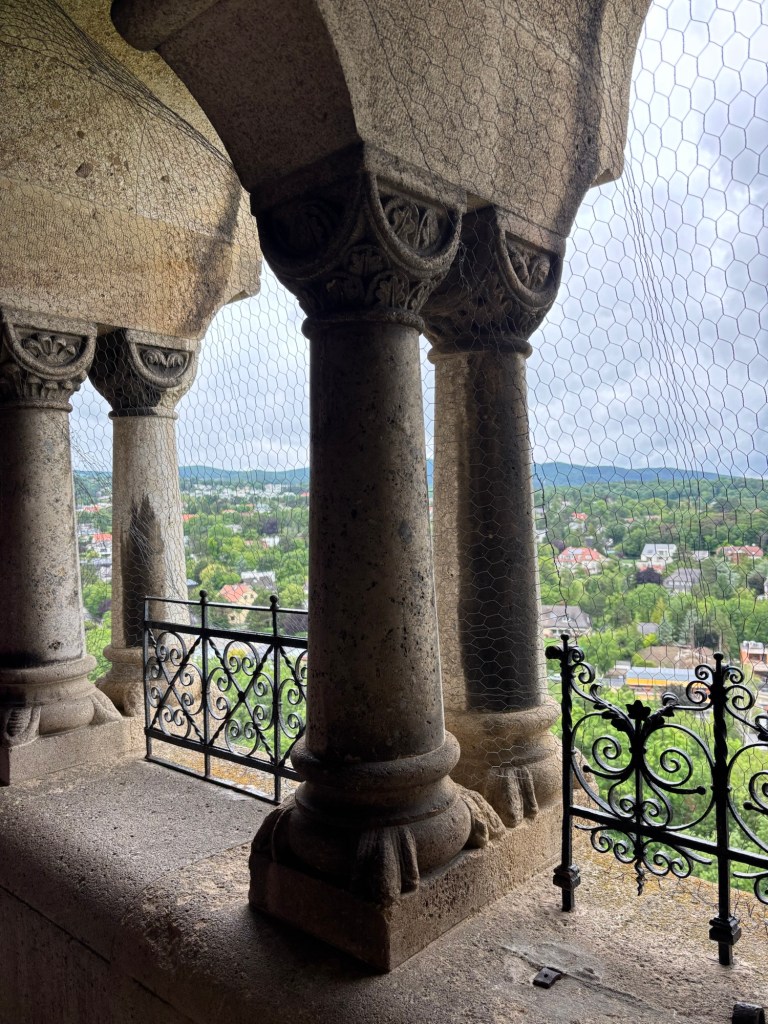
The gates opened at 6 am, by the time I get there it’s 6.20 and there’s not a soul in sight. I’m on a mission. I make my way up the hill towards the dramatic, classical building known as The Gloriette. It’s quite a steep climb up zigzagging paths of gravel. My shoes slip on the loose stones. Ahead I can see my goal, a fantastical, elaborate building with vast arched windows and numerous pillars and pilasters.
It’s the reflection in the pool below that I notice first, the sparkling, inverted image, mirrored in the pond. Creamy stone, blue sky, fluffy white clouds, reproduced perfectly in the reflection of the still waters. This is my starting point.
The Empress used to come to the Gloriette to escape the crowds in the palace. An endless stream of well-wishers, acquaintances, courtiers, all determined to engage her in some meaningless conversation. Small talk that she preferred to avoid. I like to wonder how she made her way up the hill? Did she come in a small carriage pulled by two horses, or perhaps a sedan chair, held aloft by four burly footmen, or possibly on foot, accompanied by a trusty lady’s maid.
The Gloriette is feminine architecture if that’s possible. It’s all curves and trim, lacey bits and delicacy. I can imagine taking tea here and looking down over the palace with the city of Vienna beyond. A delicate china cup and saucer before me, accompanied by tiny biscuits and cakes. Perhaps a friend to chat to or perhaps the luxury of isolation.
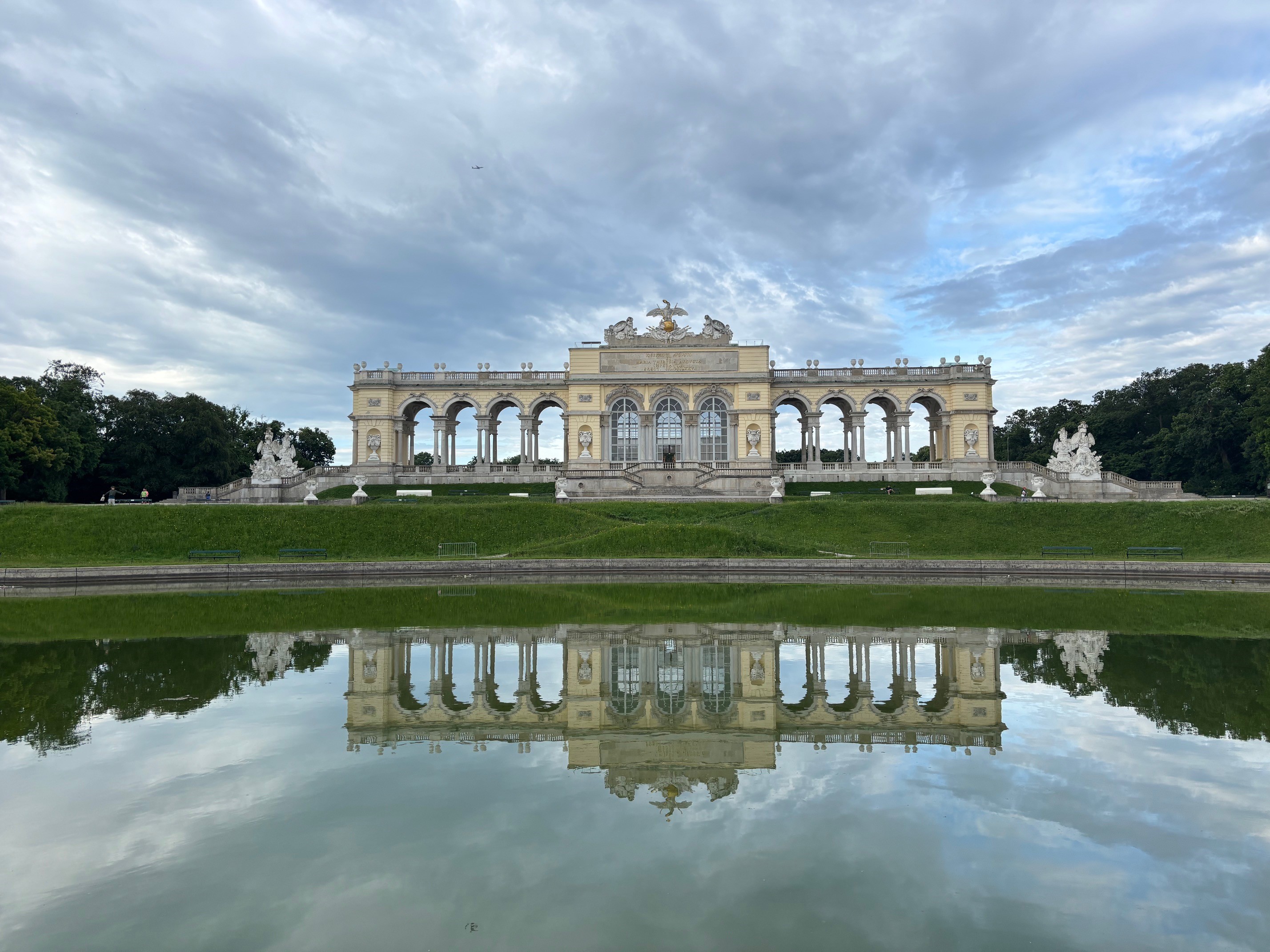
The Gloriette – creating perfect symmetry in the early morning light – Schonbrunn, Vienna
The symmetry of the park is comforting. I descend from the Gloriette down the steep path. It’s time to see the Roman ruins now, they’re not really Roman you know, my friend tells me, a few days earlier. They’re just a folly. Folly or not I want to see them.
Actually I’m very impressed. It was common in the 18th and 19th centuries for aristocrats to come back from a journey to the Italian peninsula and want to reproduce the beauties of Classical Rome in their own back yard! Even if they are not genuine they are most definitely romantic. There’s columns and arches, artfully arranged ruins and even a fountain. Corinthian columns, engraved stone friezes, carved shields and theatrical masks complete the scene. There’s a river god and a river goddess, perhaps representing the Danube or the Tiber. It’s a classical scene, carefully rendered in the heart of Schonbrunn. A little bit of Rome in Vienna. The vistas are perfect, avenues of trees guide the eye, from the ruins, up to the perimeter of the park and down to the palace courtyard and the rose garden. I start to wander down the hill.
The delicate perfume of the roses hangs in the air even before I enter the garden. It’s a rich sensation of velvet and cream, peach and strawberry, crimson and silk. A private kingdom of fragrance and calm. The scents cascade from the blooms. Even though it’s still early, the rose garden is busy. The bees are buzzing, the gardeners are weeding and the flowers are shedding their petals, delicately, one by one. Did Sisi stand here, on this spot I wonder, inhaling the scents of the roses, to dream and meander in her mind, perhaps to the Castle of Miramare…..
The local running club trots past and breaks my reverie. The idea of coffee and a croissant pops into my head and parks itself determinedly. It’s time to leave the park and start my day…..
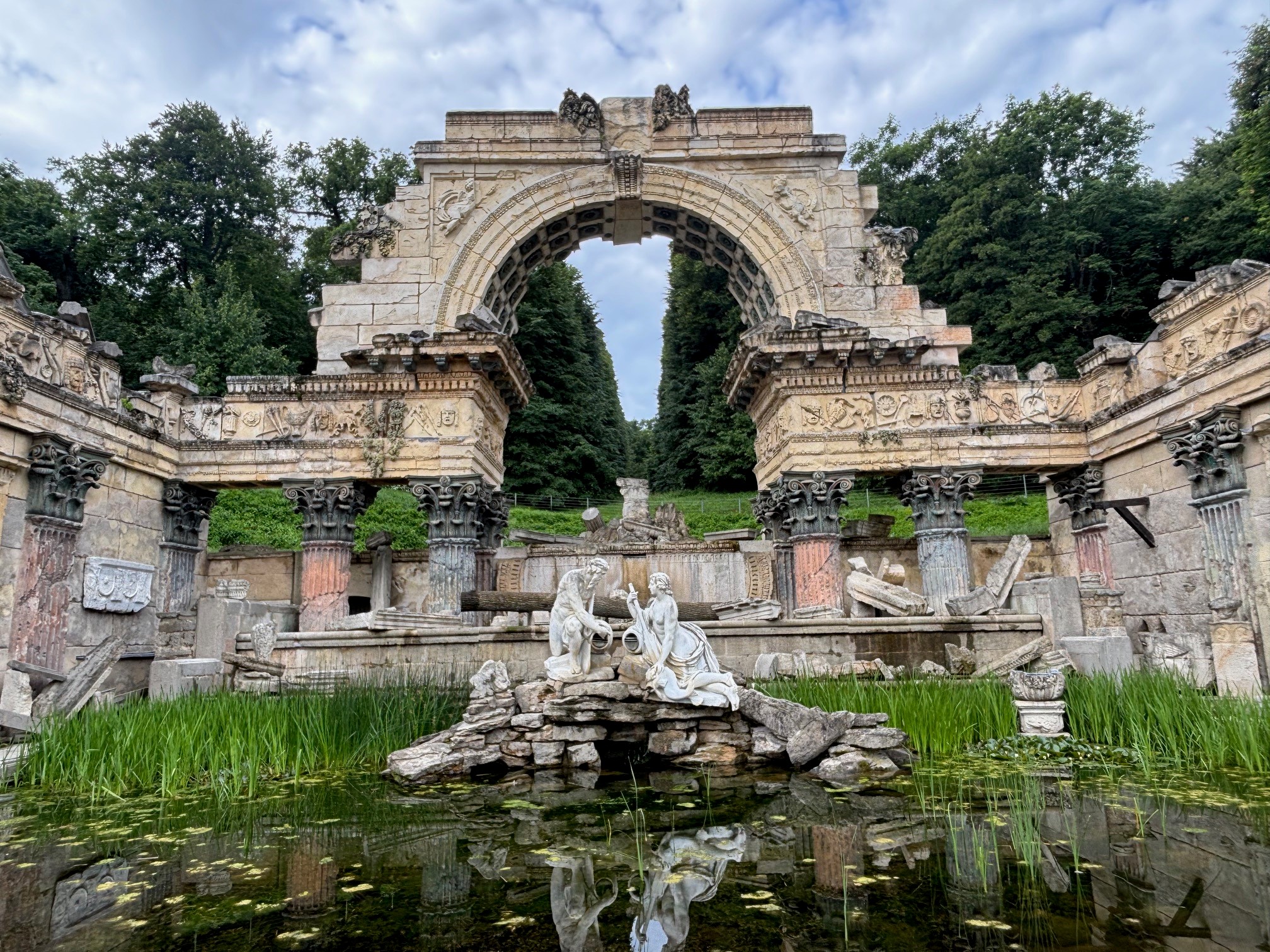
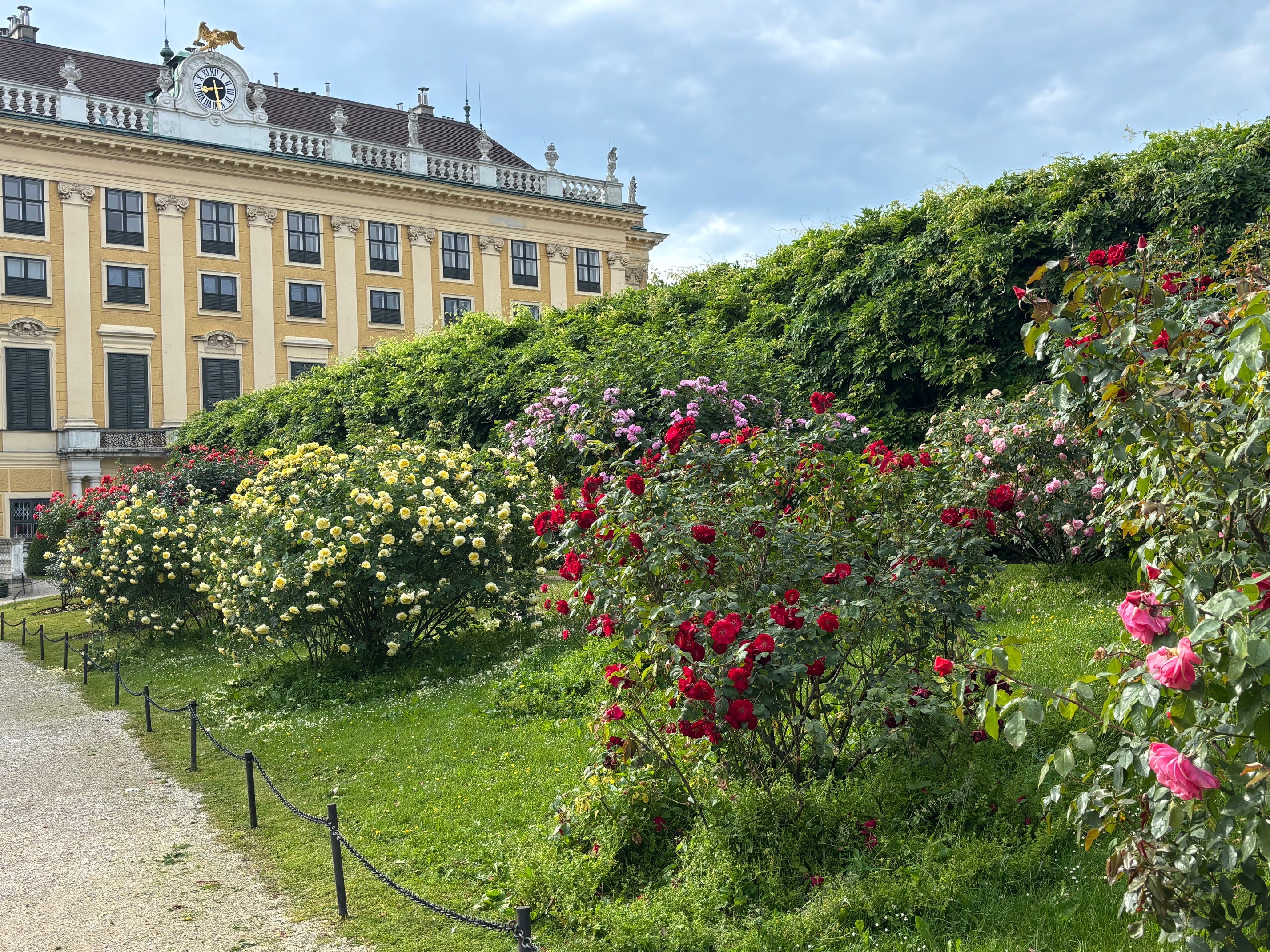
The Roman Ruins ‘Folly’ and a glimpse of the Rose Garden – Schonbrunn Palace, Vienna
THE JOURNEY BEGINS…….
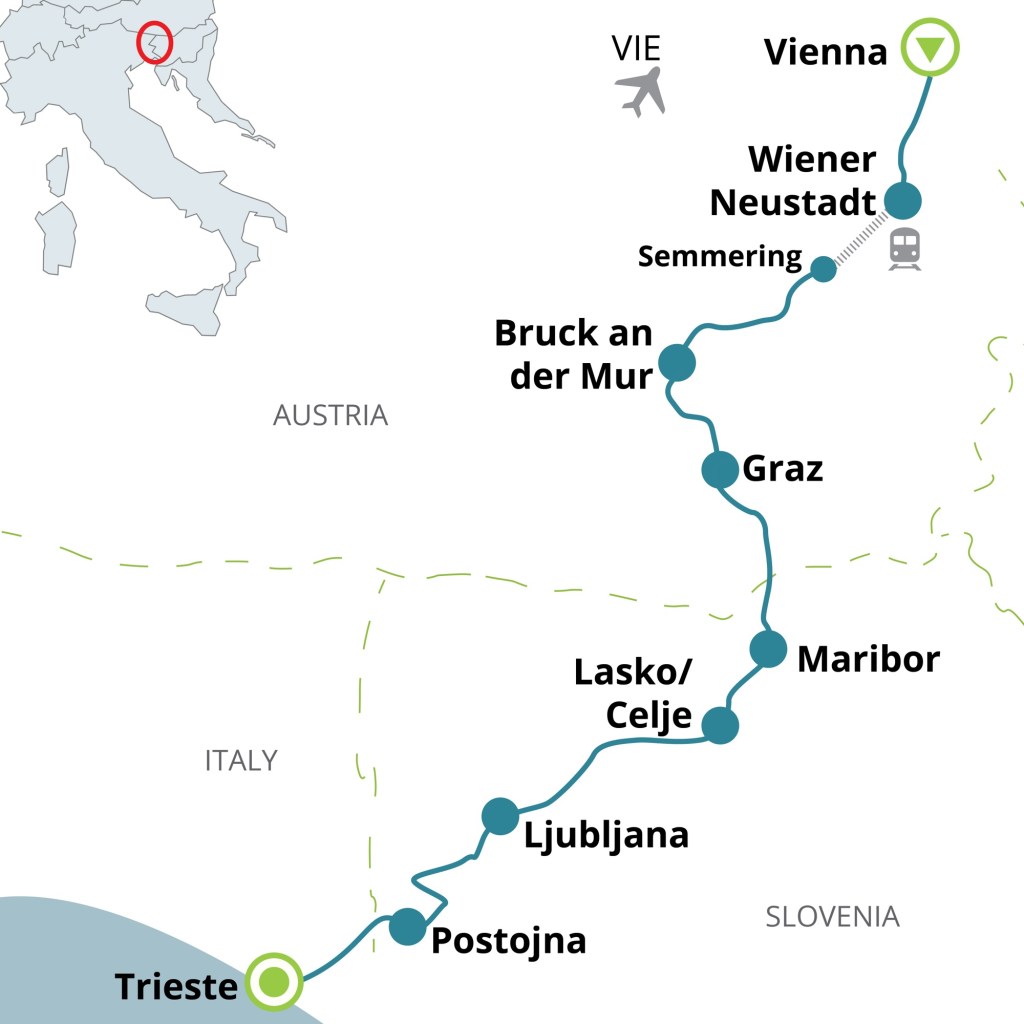
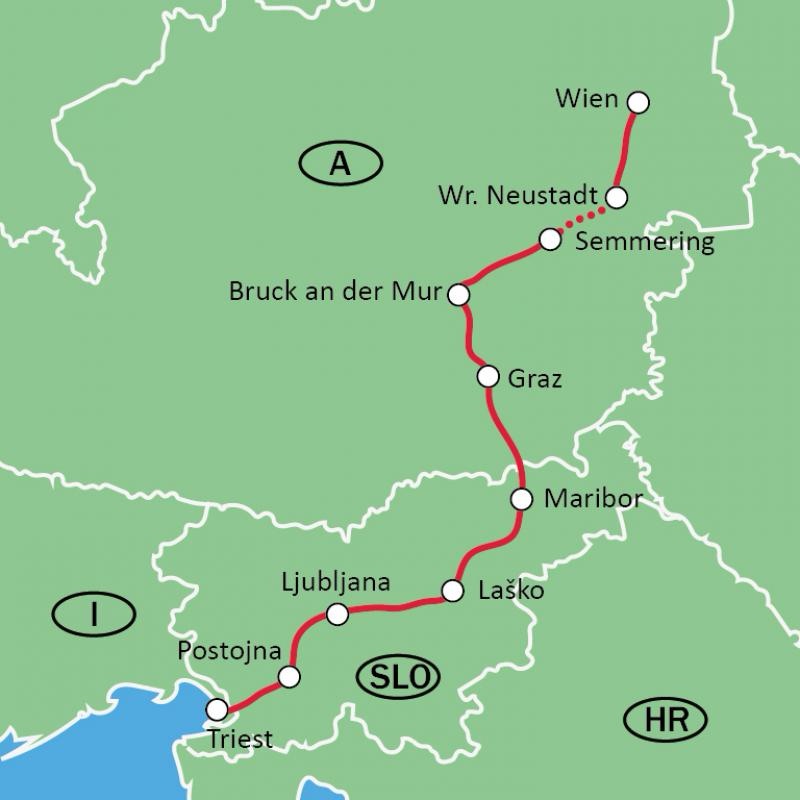
This is a very special journey for me, I’m following in the footsteps of the Habsburgs, as they made their way from Vienna to the sea. Even more importantly I’m travelling with Alistair, my youngest son, an adult now, who lives on the other side of the world. I’m grateful and lucky to have him at my side.
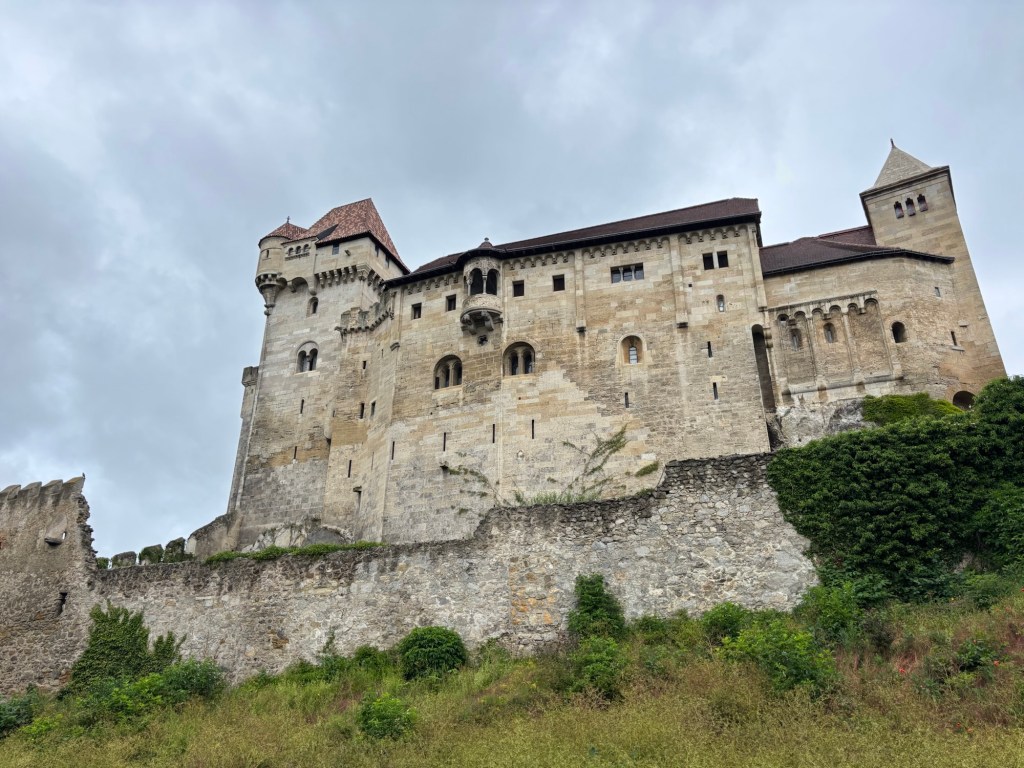
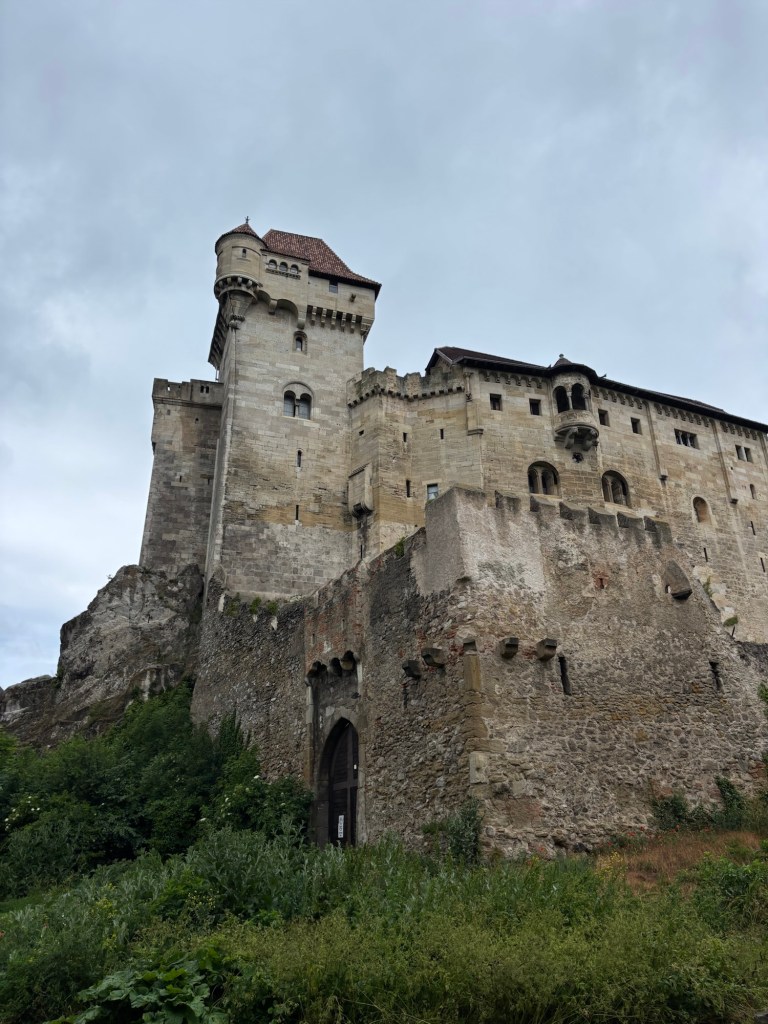
The road south from Vienna follows the line of the hills. The Wienerwald rises to the right. This is the ‘speck-girdle’ our guide tells us. Quite literally the bacon belt, I suppose we might call it the stockbroker belt. Nice houses, large gardens, the odd swimming pool. Lichtenstein Castle is today’s destination a medieval castle with 12th century foundations. It rises majestically from a rocky outcrop – the family home of the Lichtensteins until they decided that the castle wasn’t big enough or impressive enough and they moved to another castle, conveniently located between Austria and Switzerland.
The original castle was abandoned and left to rot until a local business man bought it and started to restore it, filling it with a strange selection of medieval paraphernalia acquired at random auctions and car boot sales. A few years ago the castle was used as a location for a film, providing a welcome boost to castle funds. Not much since.
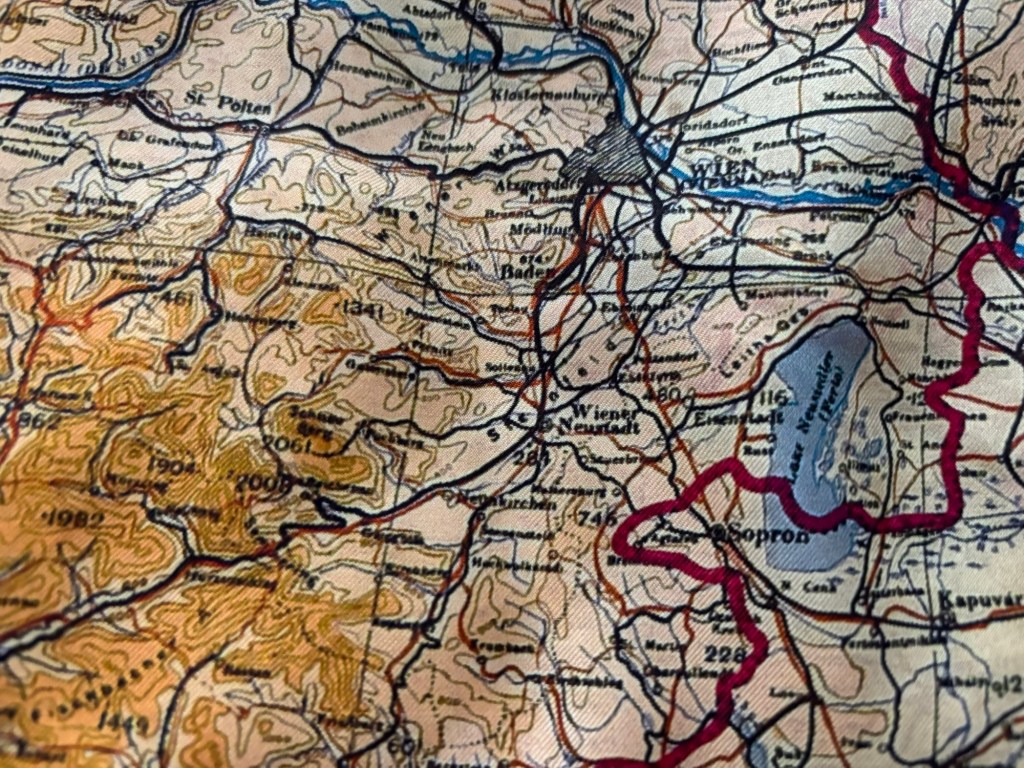
South of here it’s Mayerling. Now that’s a curious place. This is where Crown Prince Rudolf died on 30th January, 1889. An apparent suicide pact with his lover Mary Vetsera – he’d already proposed a death pact with his other mistress Mizzi Kaspar (an actress) she’d sensibly declined. Mayerling is an odd place to visit. It’s a memorial to Rudolf and yet it’s without a soul. The hunting lodge where he died is long gone, replaced by a modern convent and an earnest exhibition explaining the Crown Prince’s last hours. Rudolf’s parents, the Emperor Franz Joseph and his wife Empress Elizabeth (known as Sisi) never really recovered from this terrible event. Less than a decade later Sisi was assassinated, in broad daylight on the shores of Lake Geneva.
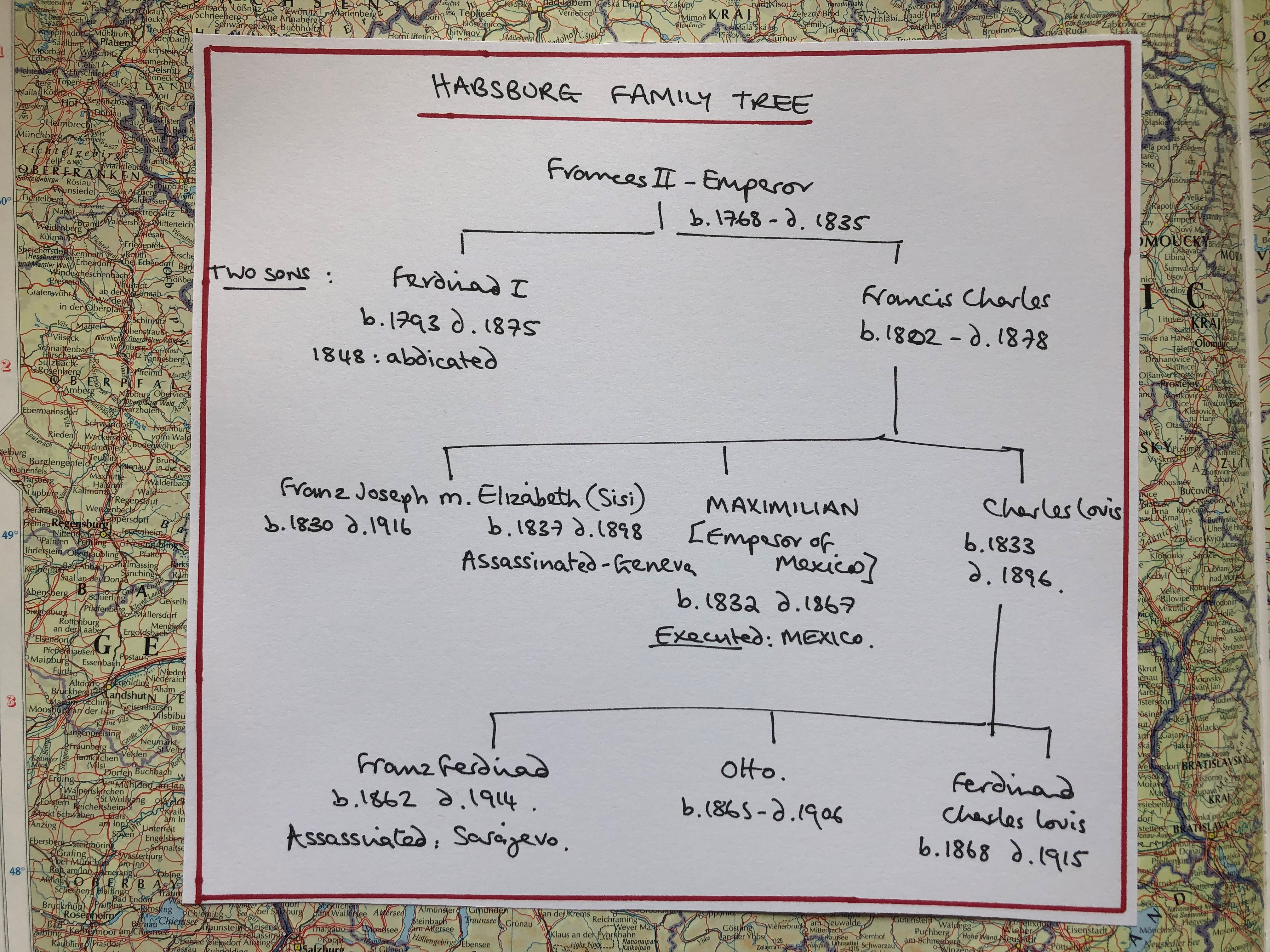
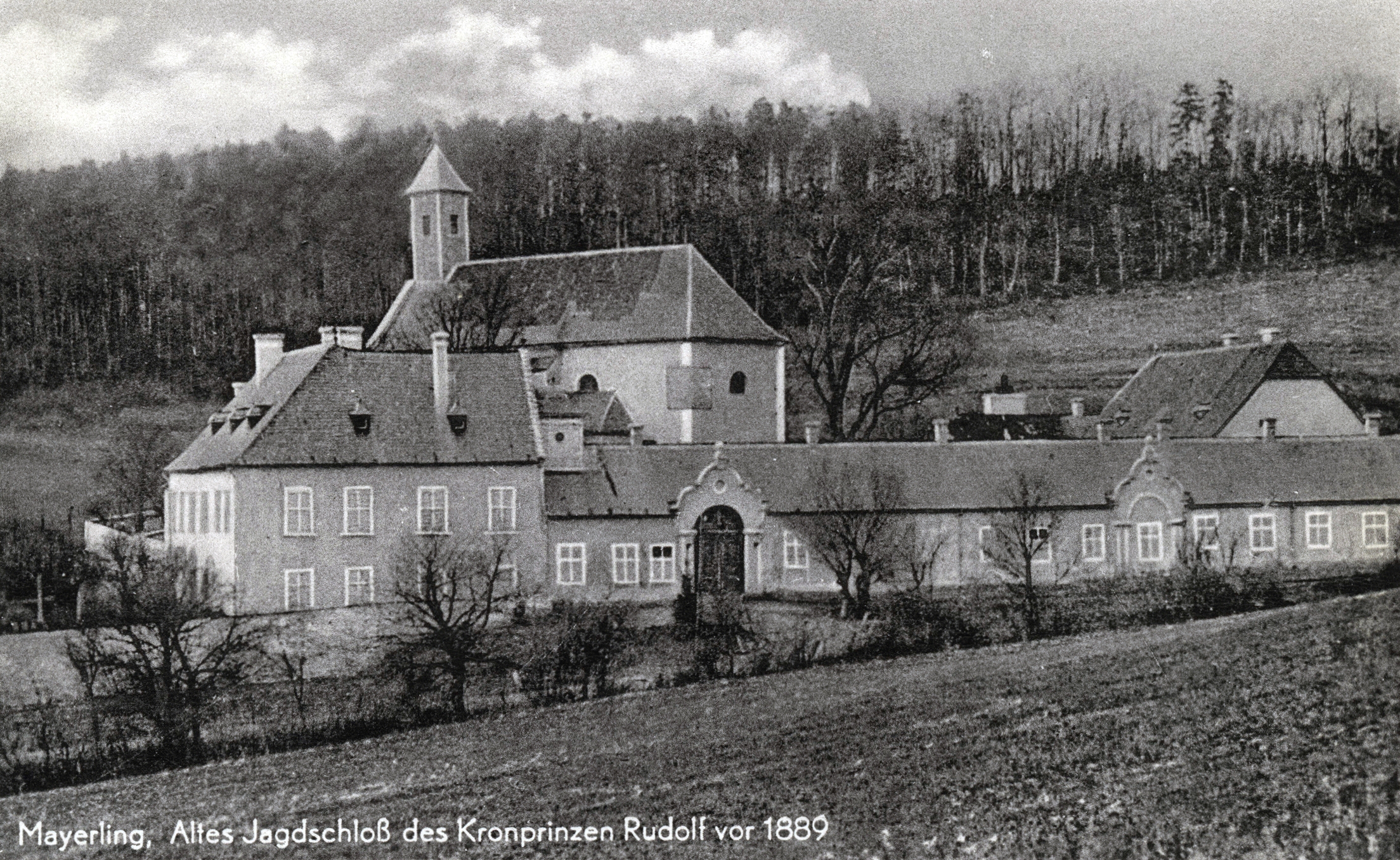
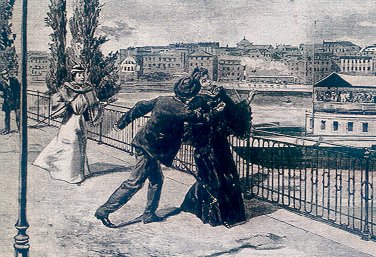
The Habsburg family tree, Mayerling photo c. 1889 and a graphic of Empress Sisi’s murder, Geneva, 1898
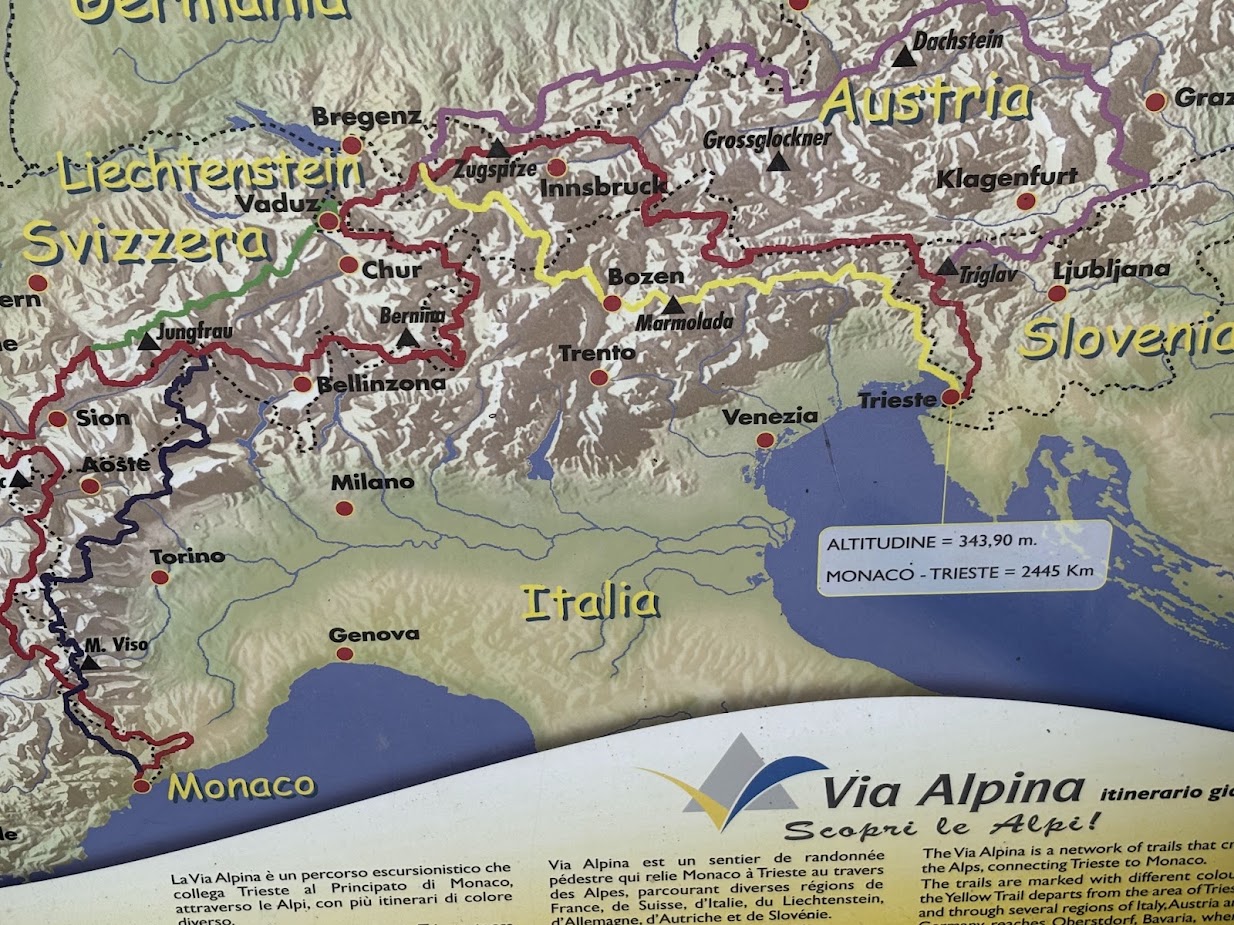
We’re on the route of the ‘Sud Bahn’ now the railway line that was completed in 1857 and connected Vienna and the Austrian Empire with the sea. The construction of the railway was a masterful feat of engineering that took decades to build and included the ascent of the tracks over the Semmering Pass at 895 metres above sea level. The Empress Sisi loved this route – she frequently boarded the imperial train and headed to the coast. She is said to have visited Miramare Castle, her brother-in-law’s seaside home more than a dozen times.
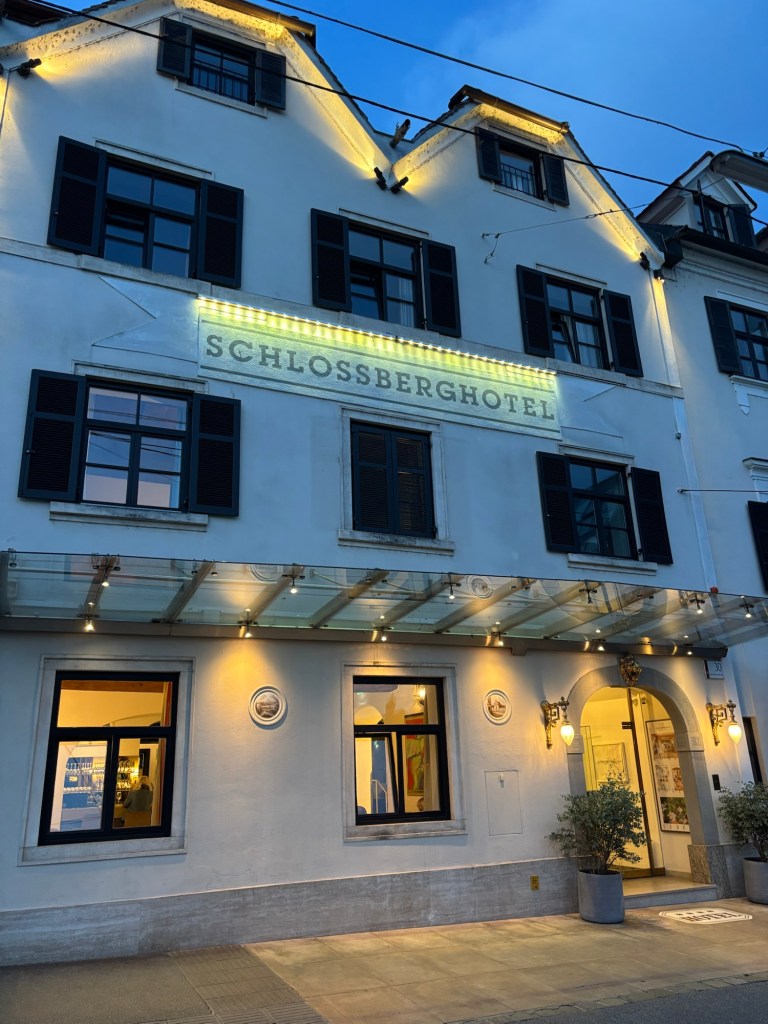
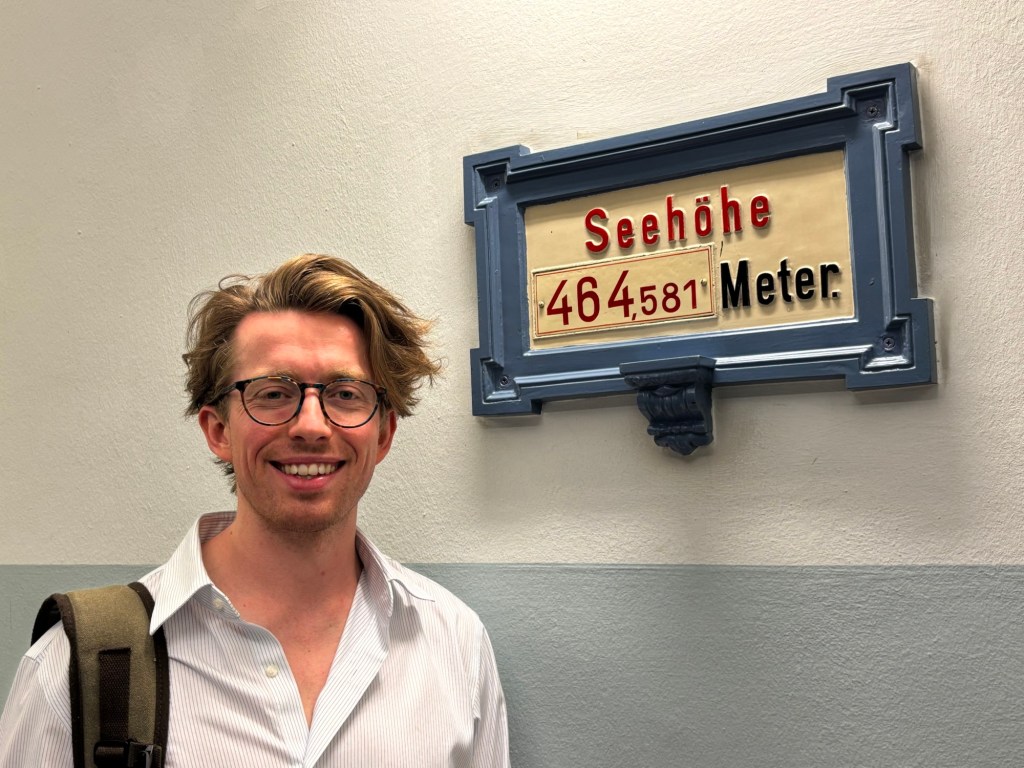
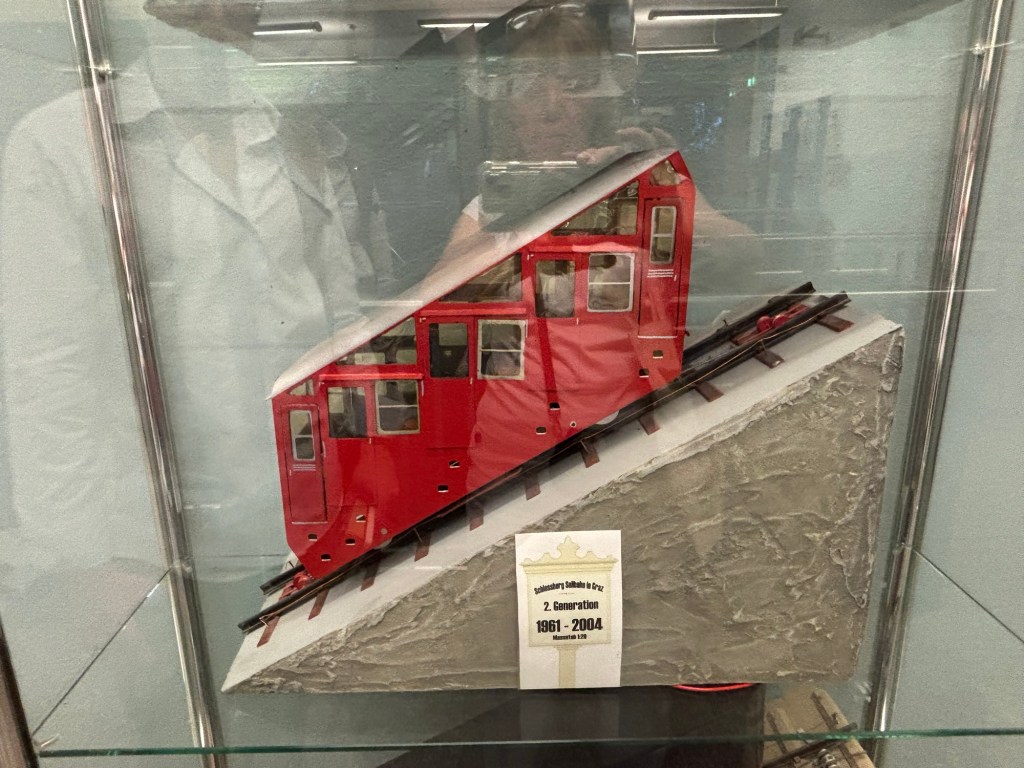
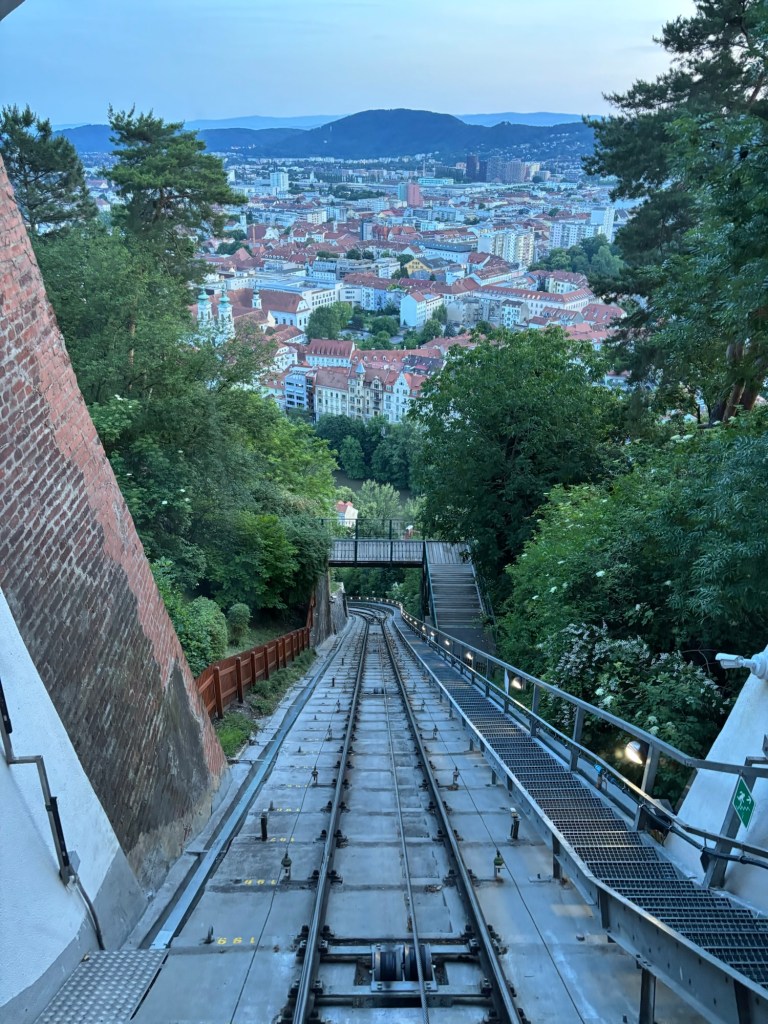
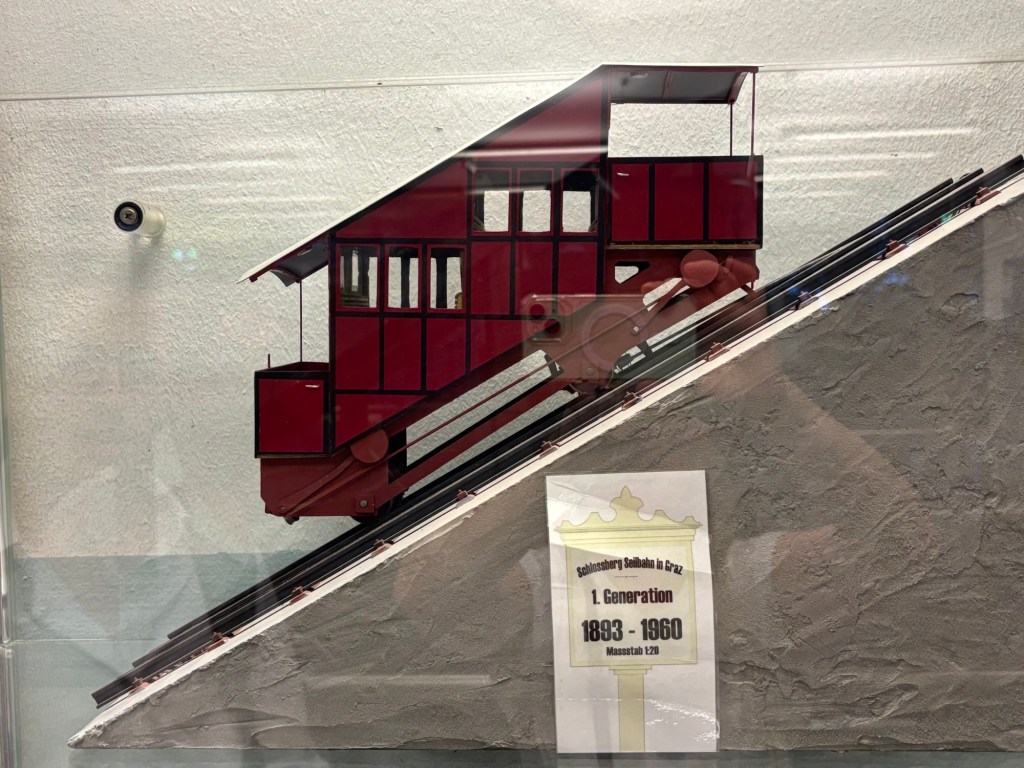
OUR STOP FOR THE NIGHT is The Schlossburg Hotel in the centre of Graz. The building clings to the hillside and is built into the rock. The garden scales the cliff in ever reducing terraces linked by steep staircases, the views are spectacular. There’s a Red Bull racing car attached with steel cables to the almost vertical rock. Next door to the hotel is a cable car that takes visitors to the top of the ‘burg’ at 464.6 metres above sea level. A cable car has operated on this rocky escarpment for over 100 years. There are models of the various cars in glass cases, reminding me of the cable car in ‘The Grand Budapest Hotel’. Alistair and I loved the ride to the top. We nearly went down immediately, when we got to the top, so that we could do the ride again, like two kids at a fun fair. It’s only a short ride, perhaps 10 minutes, up to the summit, but it’s a pretty steep ascent. At the top there are views for miles to all compass points. South to Trieste it’s 265 kms. North to Bratislava and Vienna about 200 kms. West to Innsbruck is 400 kms. East to Sarajevo is 500 kms. This feels like the heart of the Austro-Hungarian Empire. Perhaps Franz Ferdinand stopped here on his fateful final journey.
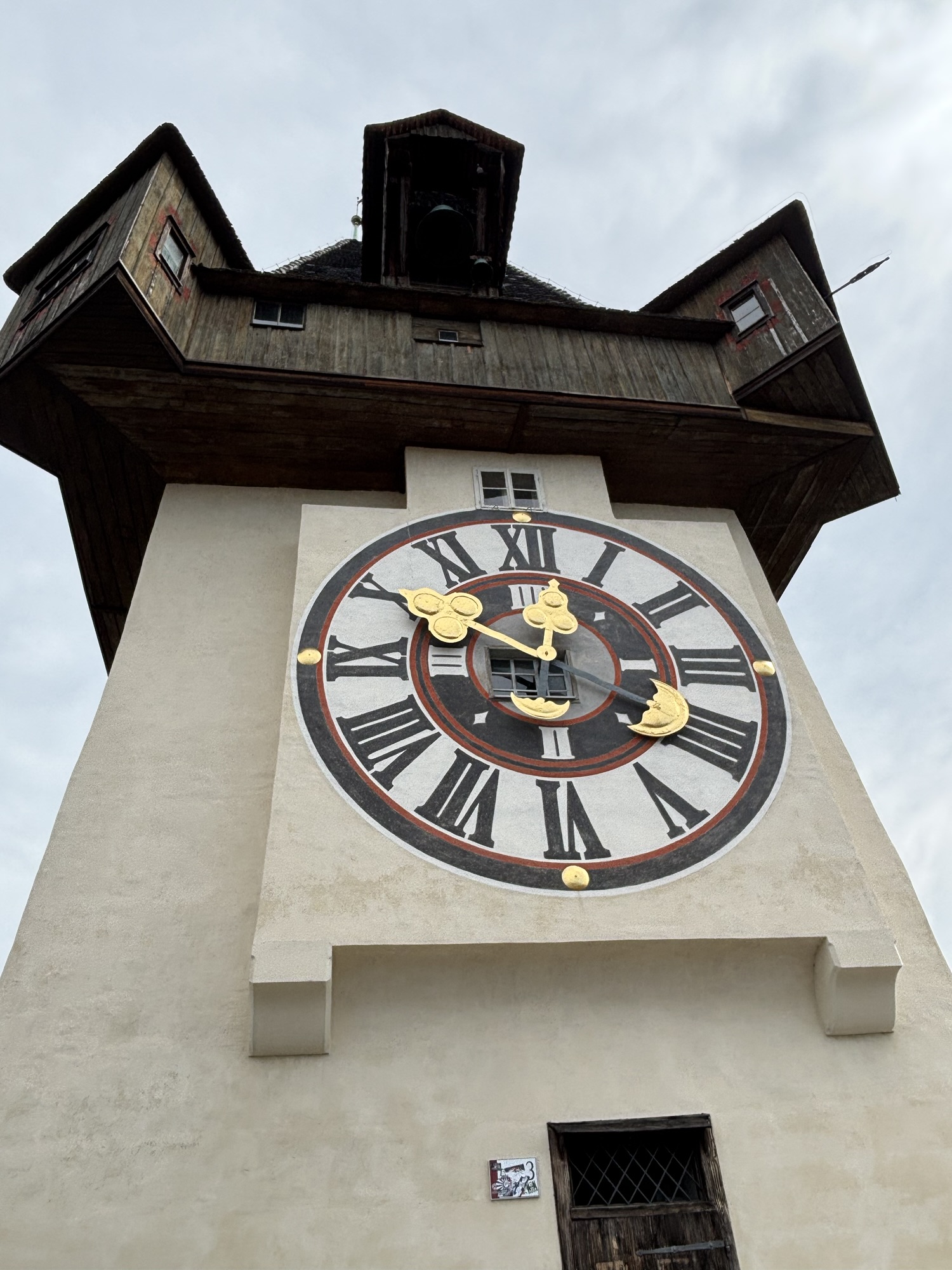
On the south side of the rock there’s a beautiful clock tower. A school group are arranging themselves for a class photo. We scuttle to the perimeter to avoid an accidental appearance in the frame.
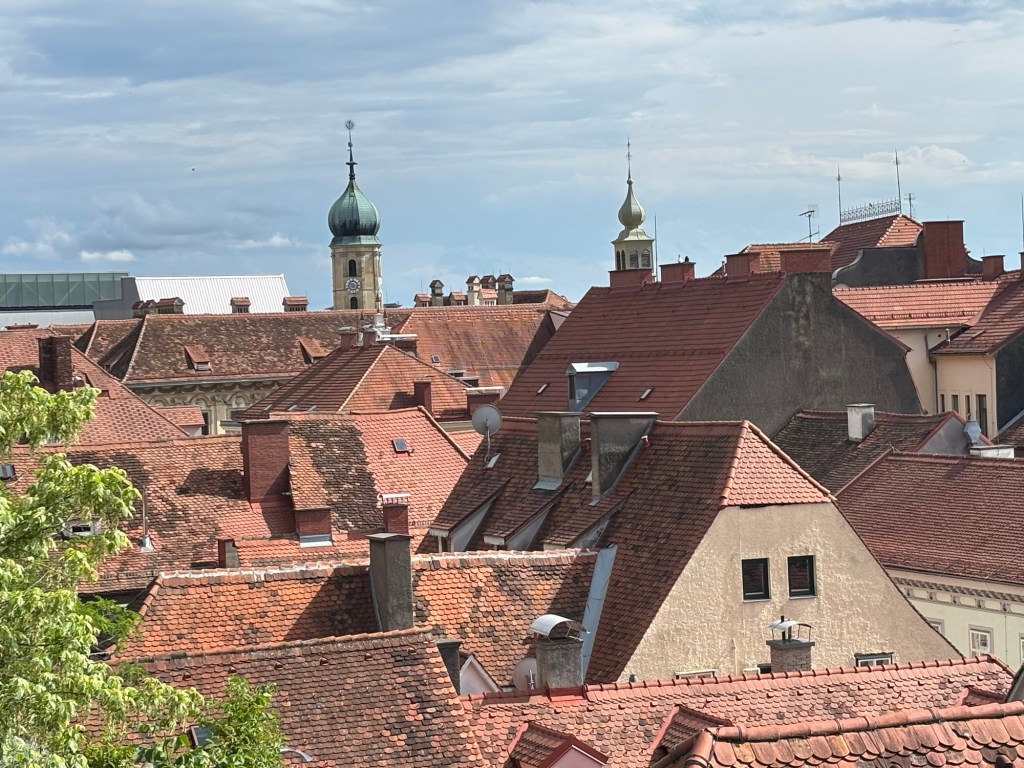
Graz has a favourite son – it’s ‘Arnie’ Arnold Schwarzenegger who was born just outside the town in the 1950s. He is honoured on every street corner, with photos, posters and mention of his name. Originally Mr Universe in Austria, Arnold Schwarzenegger went on to become one of Hollywood’s most bankable stars. He then moved on to a successful career in politics as Governor of California. The citizens of Graz are proud of their association with ‘Arnie’ and his photo is all over town.
We’ve given ourselves a free day in Graz. It’s a pleasure to meander through the town and absorb the atmosphere and ambiance of this compact and smart town.
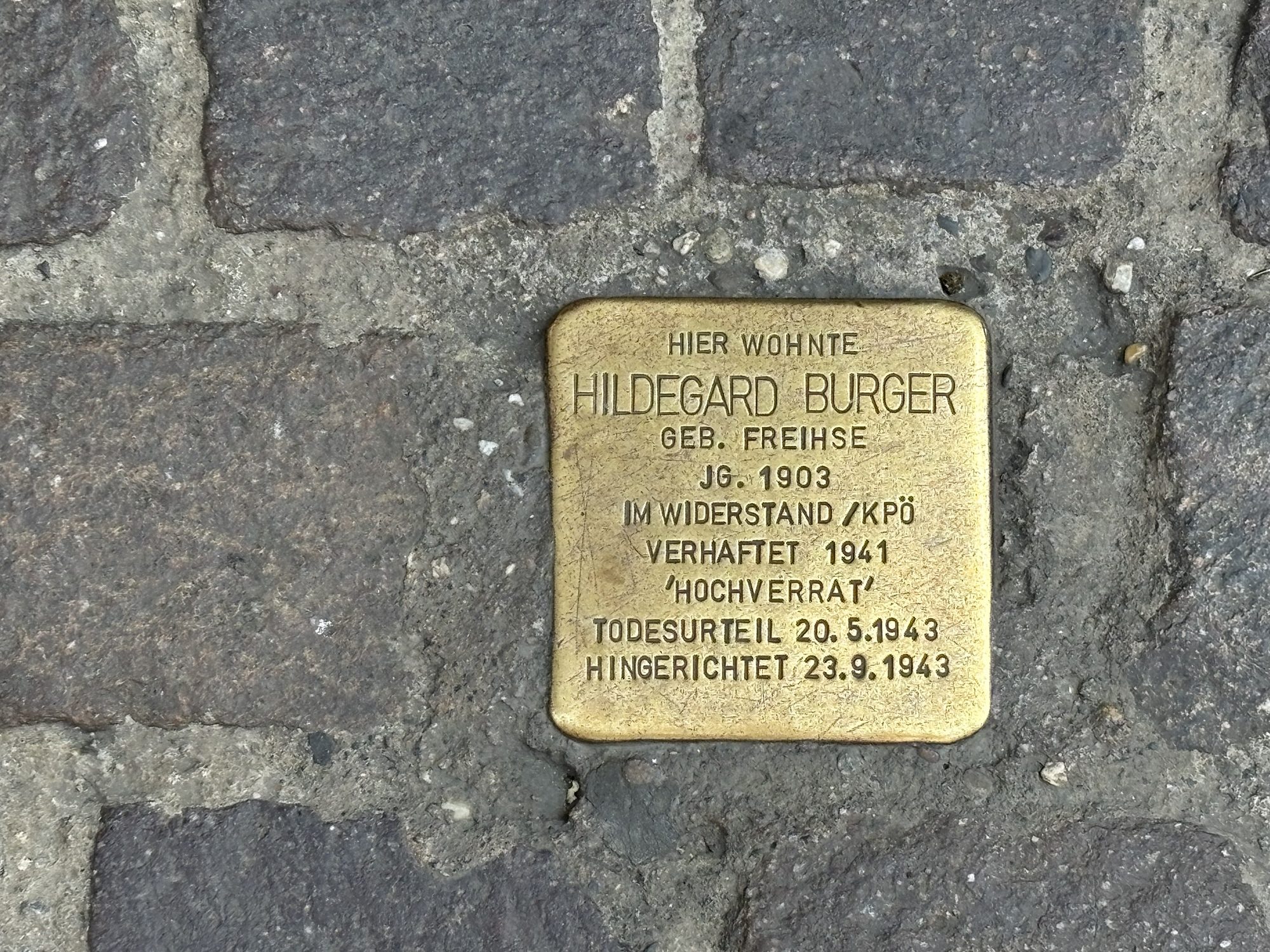
Late in the afternoon I stumble over a shiny, metallic paving stone. It’s about 10 cm square and made of brass. In fact I’ve seen these small, square stones all over Europe. They are called ‘stolpersteine’ and they are the brainchild of a German artist called Gunther Demnig. They are placed at the entrance or portal of a building where a Jewish person once lived, these are memorial stones remembering the individuals deported during the Second World War to the Concentration Camps in the east. For the majority this was a one way journey. Each stone tells the name of the person, their age, date and place of birth and most poignantly, the date and place of their death. Place names like Auschwitz, Belsen and Ravensbruck send shudders through my whole body. Despite the warm afternoon sun, I feel cold and uneasy. I read somewhere that Graz had a Jewish population of 2450 before the war, today it is just about 150. I’m reminded of Ferrara, Italy a beautiful small city with medieval walls, it’s home to one of the most elaborate Jewish cemeteries I’ve ever seen. The Jewish population in Ferrara suffered a similar tragic fate.
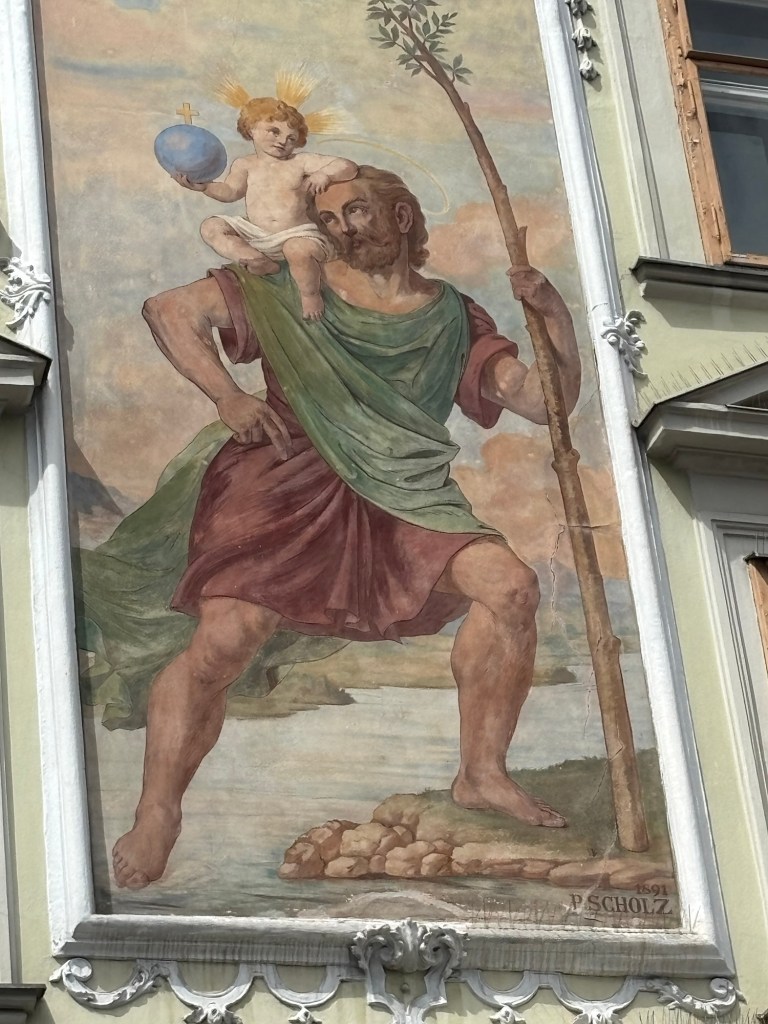
Then of course there’s St Christopher…..He has been calling me for a while now. I just didn’t respond to the call. First he appeared on the facade of Madonna dell’ Orto in Venice. Then in Southern Germany, near Mad King Ludwig’s Castle. Later I spotted him in a stained glass window in the Cathedral of Aachen and then in a small church in San Daniele, Italy. Now here he is in Graz – he’s my saint always watching over me – no wonder I like Graz. So I have to conclude that St Christopher is looking out for me. He keeps popping up to show me the way. Perhaps it’s because I’m a constant traveller or maybe it’s because I notice – I really couldn’t say! Don’t tell Alistair he’ll think I’m bonkers.
THE NEXT DAY THE JOURNEY CONTINUES – The road from Graz meanders through the province of Styria and descends gently through rolling hills to Maribor. Maribor is now part of Slovenia, but until the First World War it was part of the Austrian and later Austro-Hungarian Empire. In those days it was known as ‘Marburg an der Drau’. The town is surrounded by vineyards and borders the Drava River. I’ve heard that some Slovenian wines are winning awards in international competitions – the dry whites are particularly good. Note to self – must try one some time.
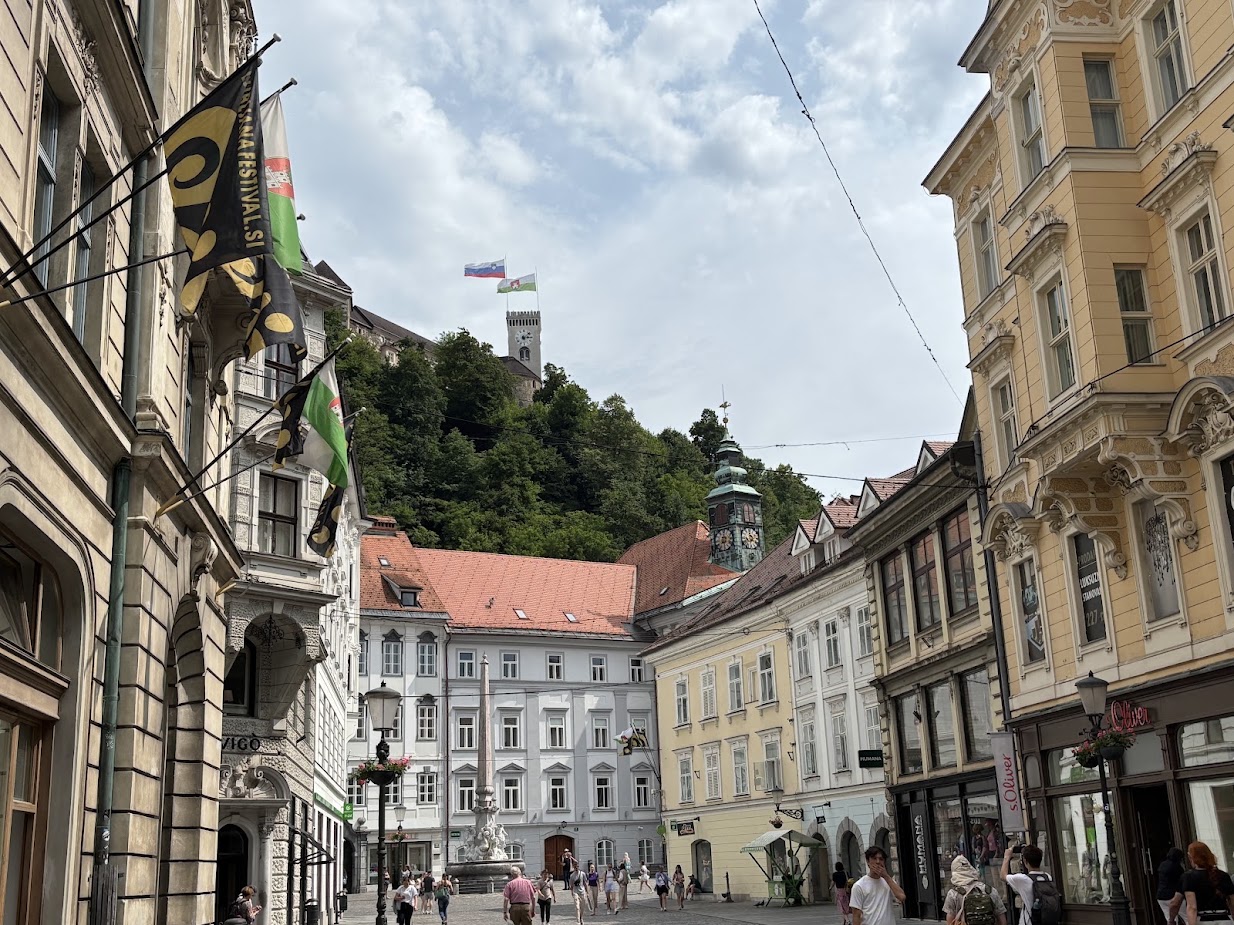
The destination today is Ljubljana, capital of Slovenia, a city with a dark past. The castle on the hill, standing at about 376 metres above sea level was an infamous prison for years, first under the Habsburgs and later during both world wars. Political prisoners were held in shocking conditions in an outdoor pen, enclosed by stone walls and with a roof of metal bars. The prison was open to the elements. In the summer the sun shone into the enclosure relentlessly, whilst in the winter the snow and rain showered the prisoners. There’s been a huge effort by the city’s tourist office to rehabilitate the image of Ljubljana Castle into a concert venue and cultural centre. But many of the locals refuse to go up there, there are too many dark memories swirling in the recent past.
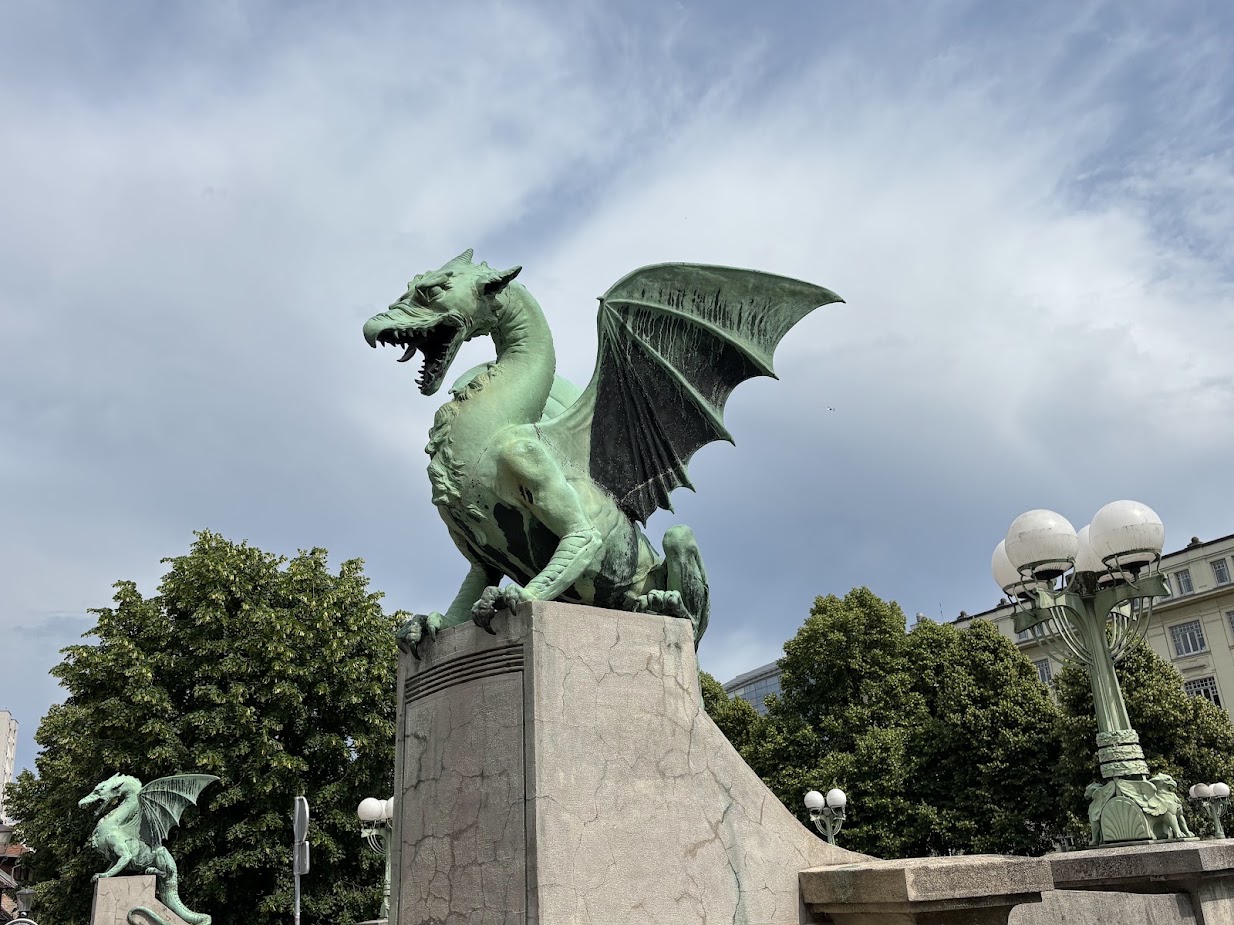
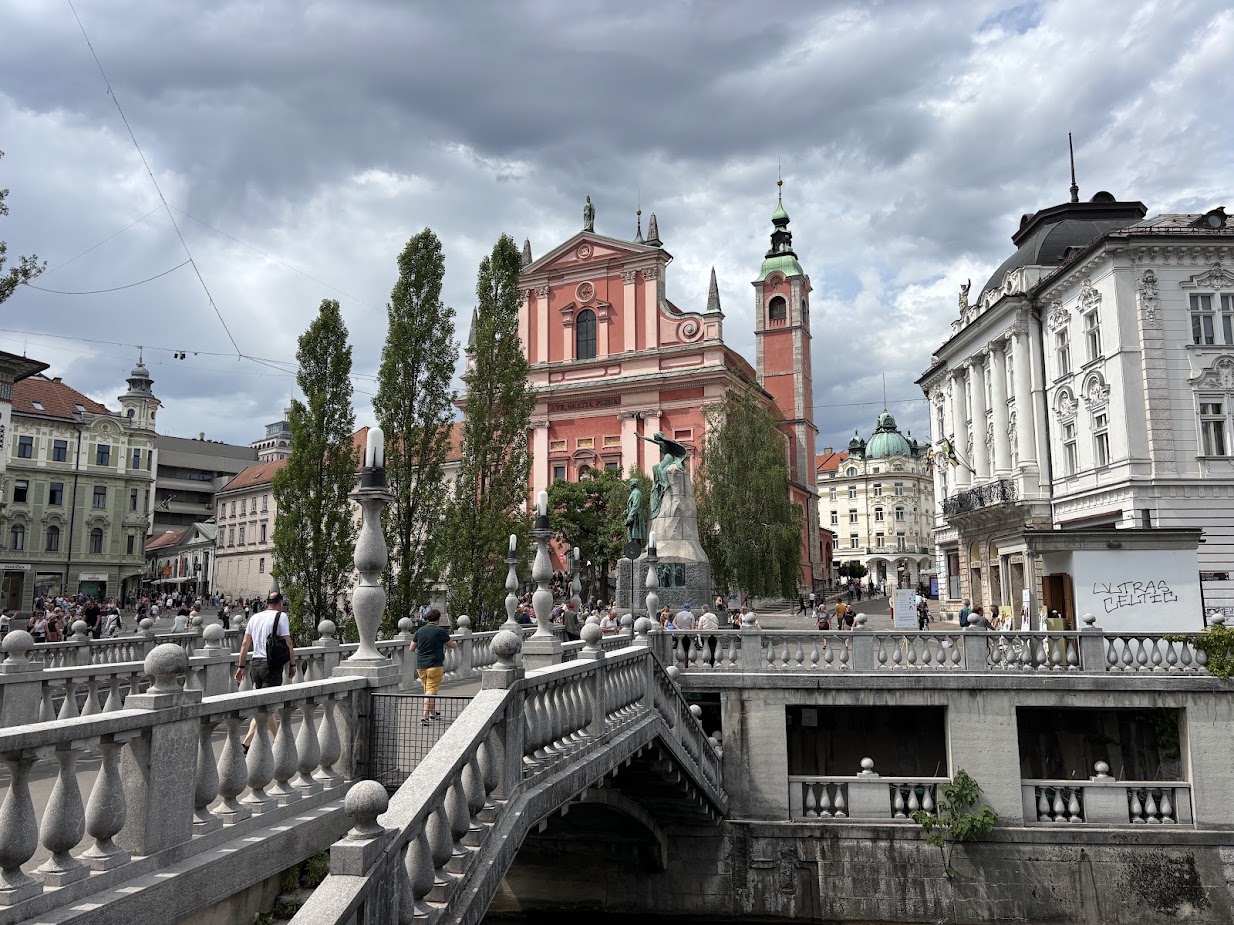
In fact that pretty well sums up the city for me, superficially it’s a city of light; cafes, bars, outdoor markets and yet… the Soviet shadow is still there in the architecture, city buildings and even the ubiquitous dragon, who somehow manages to be comic and intimidating, all at the same time. A curious unsettling feeling pervades the city of Ljubljana for me, even on a warm June day.
I’m thinking a few notes on the numerous instances of the letter ‘j’ in Slovenia might be useful here. After all it’s unusual for English speakers to see so many j’s flying around. Effectively ‘j’ in Slovenian represents an ‘i’ or ‘y’ sound in English. So Ljubljana phonetically is Loo-blee-arna. I need to get my daughter Lucy to explain this in more detail – she’s the linguist and language expert in the family. I’ll see if I can persuade her to assist!
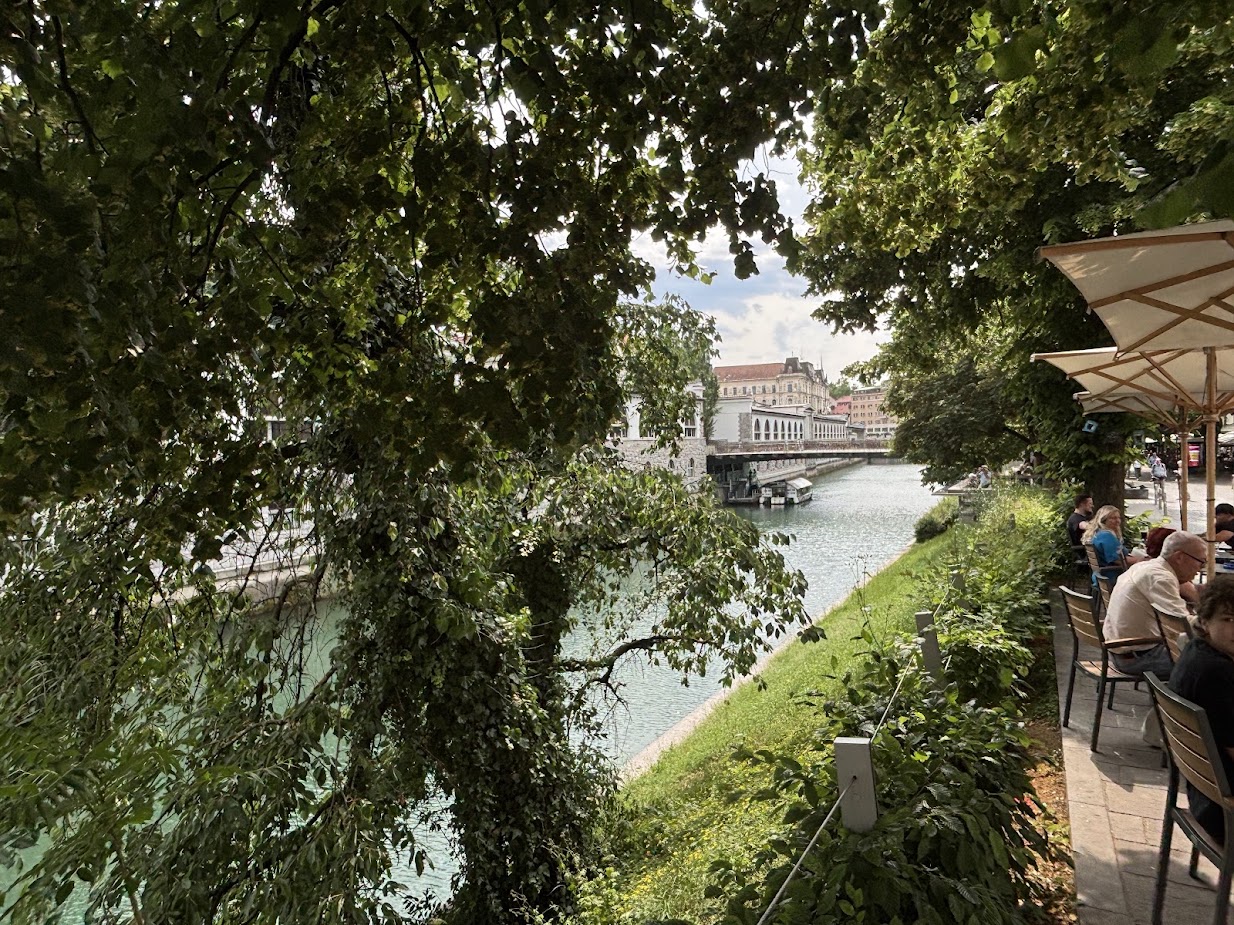
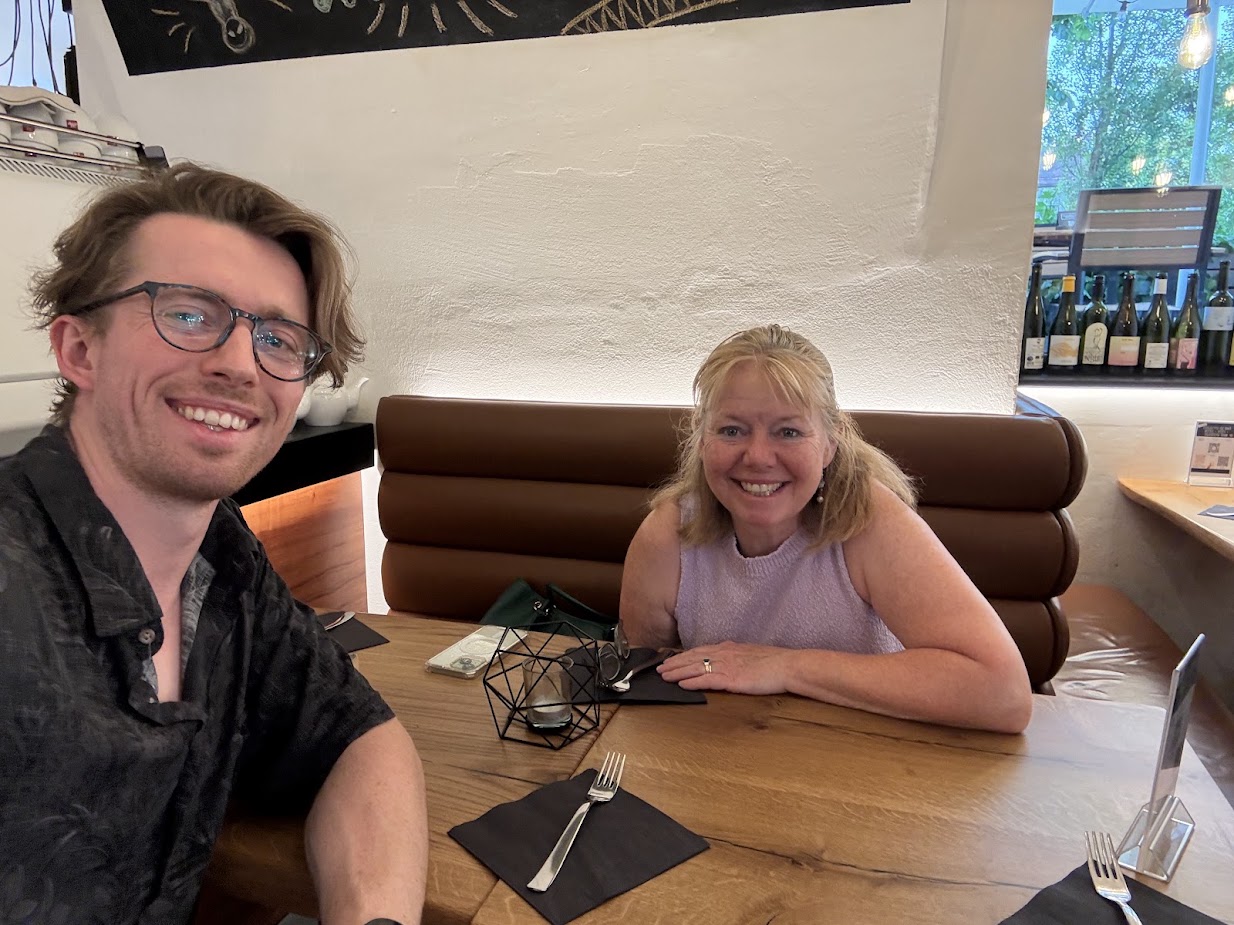
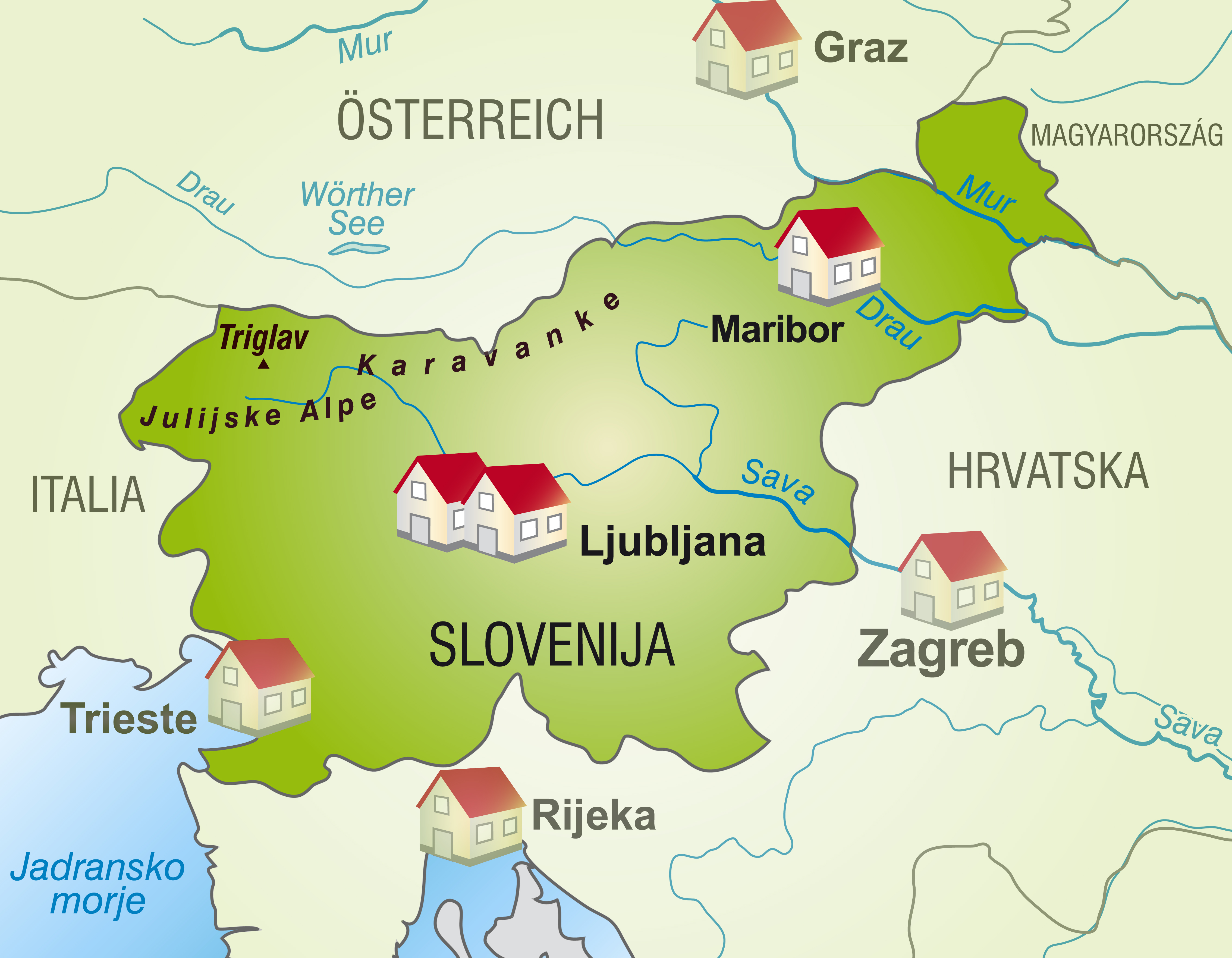
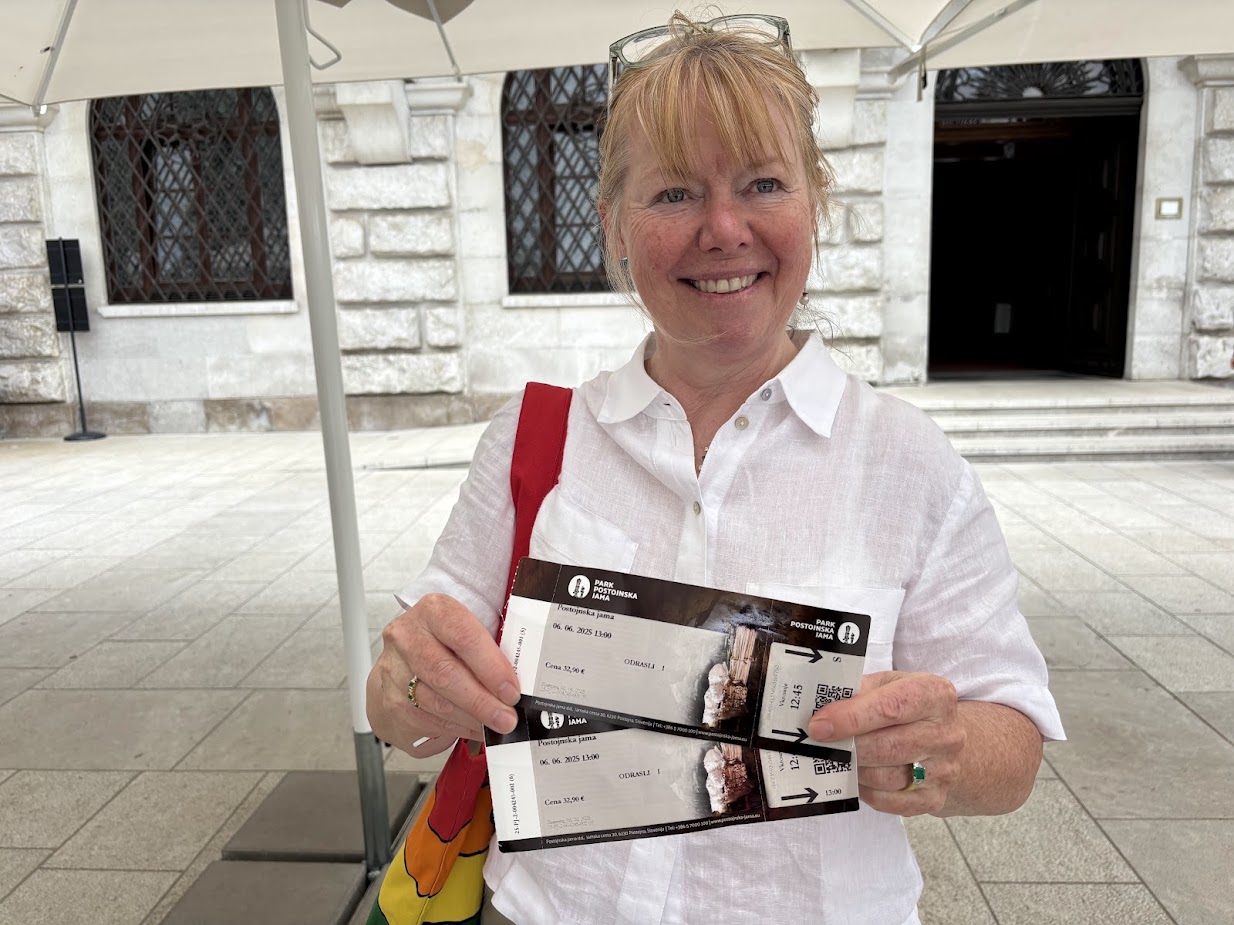
From Ljubljana it’s just an hour’s drive to Postojna Jama (and the highlight of the trip for me). Now I know it’s pronounced Postoyna Yama – Postoyna Caves. Originally called Postumia, by the Italians, this area of western Slovenia houses a vast underground network of caves, caverns, tunnels, sink holes and monumental gorges. Theses caves have been carved out of the local limestone rock by underground rivers, streams and even rainwater over thousands and thousands of years. This area is known as the ‘karst’, it’s a very specific type of limestone geology. The ‘karst’ is associated with quite barren landscapes, limestone pavements, little or no surface water and vegetation on the surface which is hardy and drought-resistant.
I visited these spectacular caves for the first time in 1980. In those days Slovenia was still part of Yugoslavia, and a Communist country. Tito was the head of state. Entry and exit into Yugoslavia was possible, but delays at the border were common and bureaucratic nonsense was convoluted and tedious. A wait to cross the border from Italy into Yugoslavia could take three hours. Bribes were often required and frequently resorted to – it was a way of circumnavigating the system. As a young tour guide it was one of my first challenges. How do you persuade the uniformed ‘confine’ officer in his military attire to allow you and your group to cross from Italy into Yugoslavia, without delay. The answer was money, the going rate was ITL 25,000 – about GBP £ 10.00 at the time.
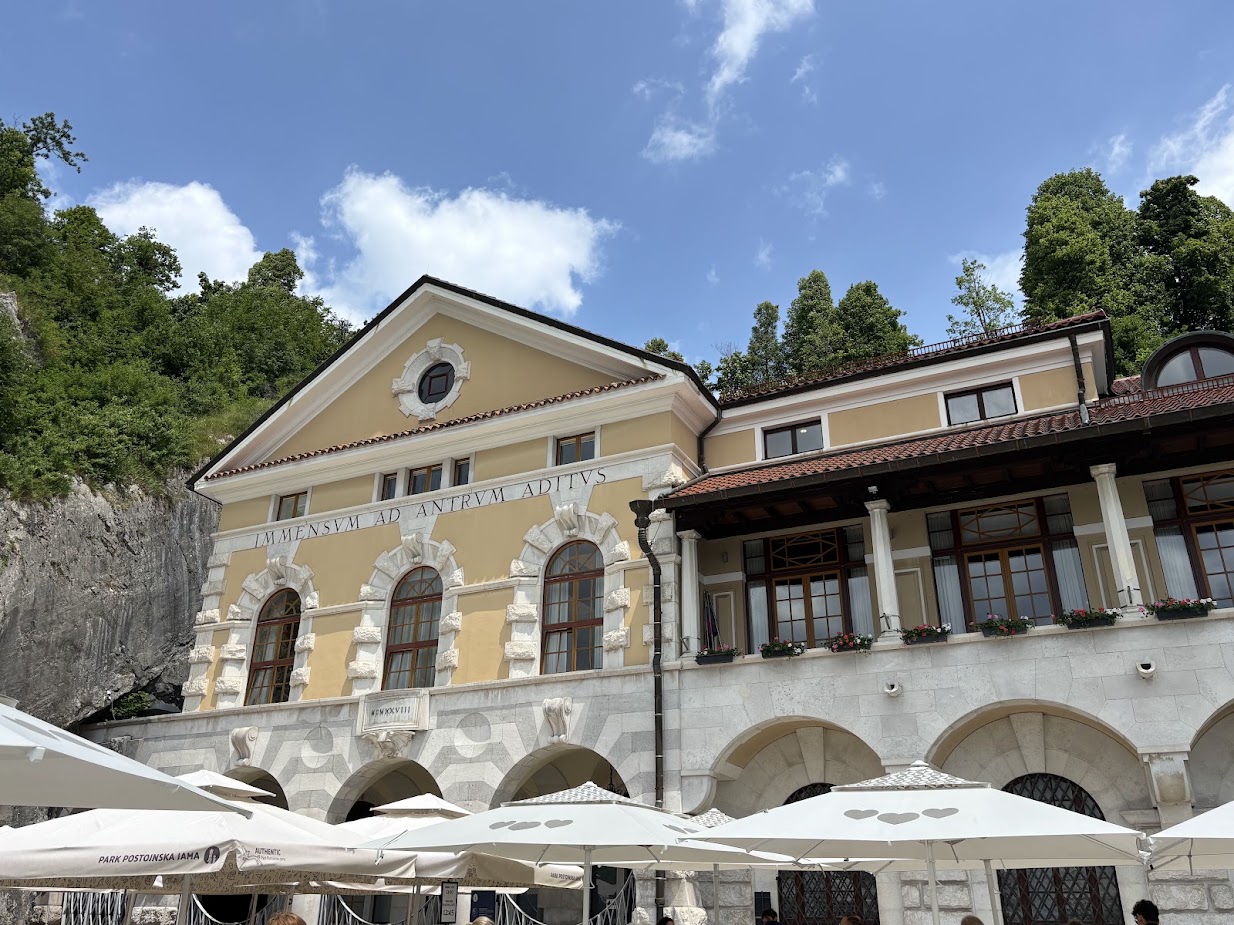
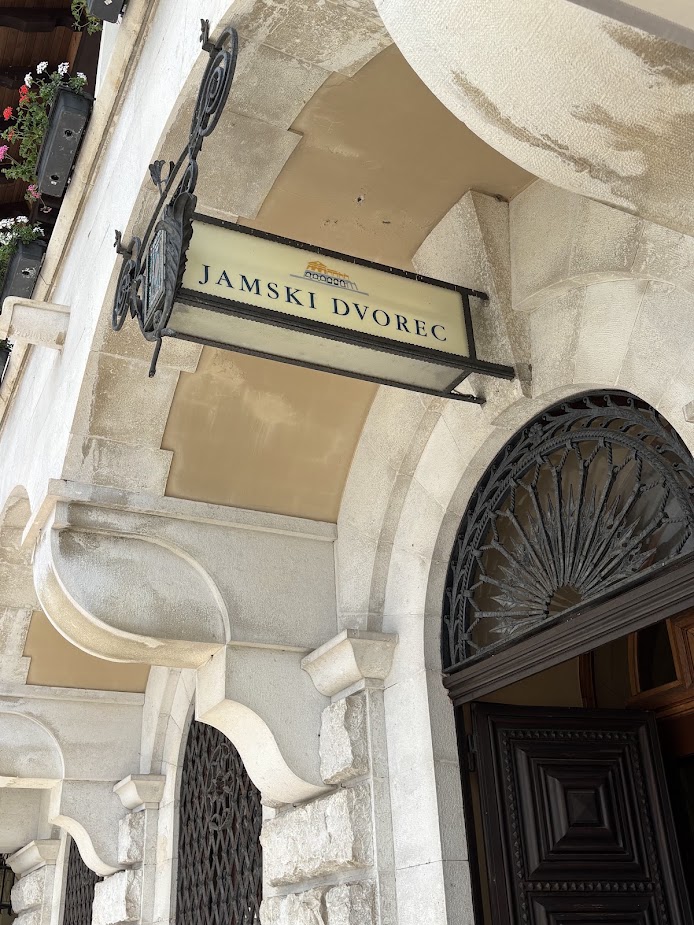
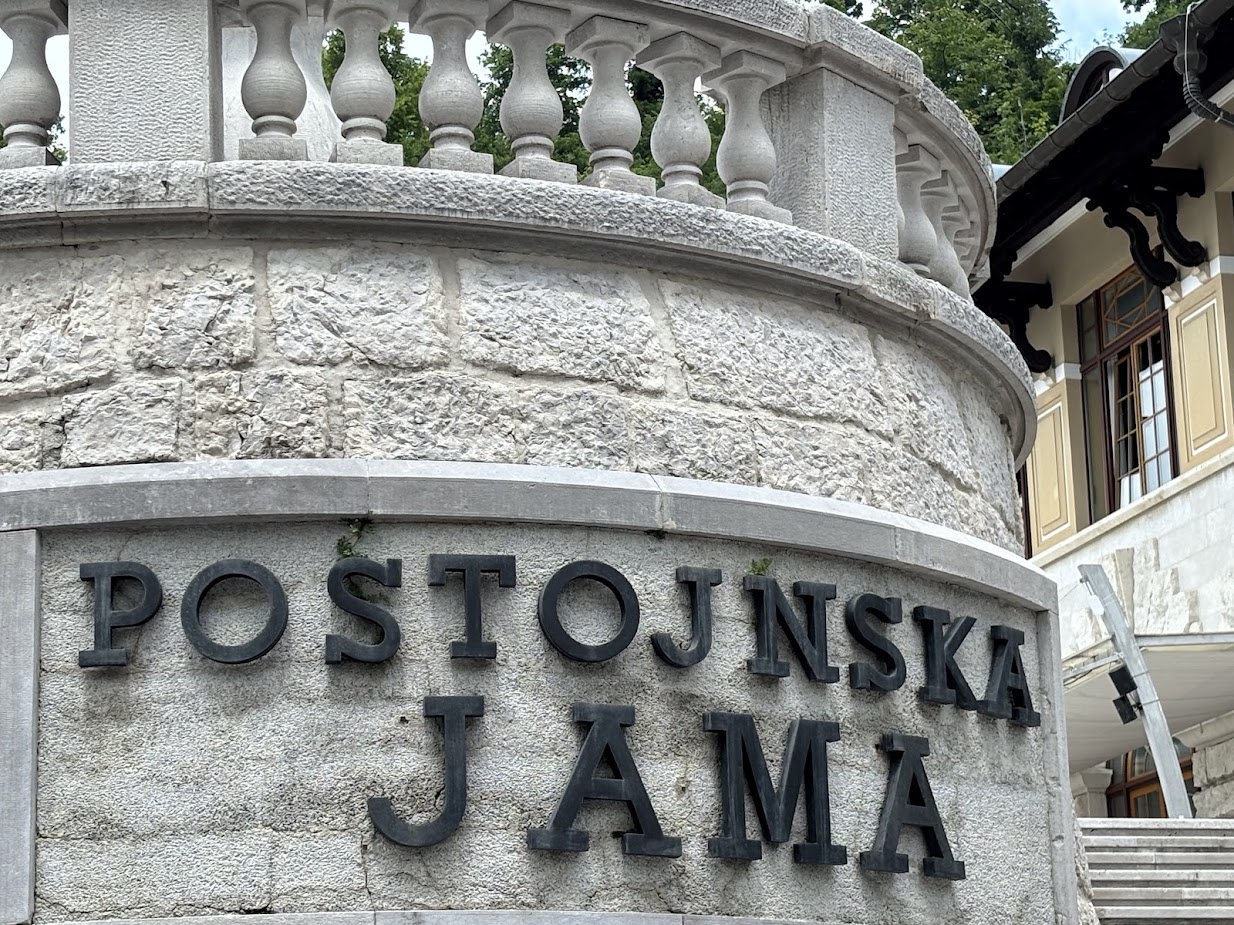
Revisiting the caves with Alistair after all these years is a wonderful feeling. The grand old entrance that originally welcomed visitors is still there. The rather wonderful 1920s era restaurant remains too. They call it the mansion, or in Slovenian ‘Jamski dvorec’. Even though the food in the restaurant in the early 80s was truly terrible, the grand staircase and polished wood panelling somehow made up for it. I remember eating my tasteless stew in architectural splendour, and that was enough.
The Empress Sisi and her husband Emperor Franz Joseph visited the Postojna Caves on March 11, 1857. Their visit was recorded as the first entry in the cave’s ‘Golden Book of Visitors’. At that time sedan chairs were set up to carry Sisi and her husband deep into the Postojna cave complex. Later an underground train was built for visitors, opening in June, 1872. It’s worth remembering that the visit to the caves 150 years later is basically the same experience that the Austrian royals had enjoyed all those years earlier.
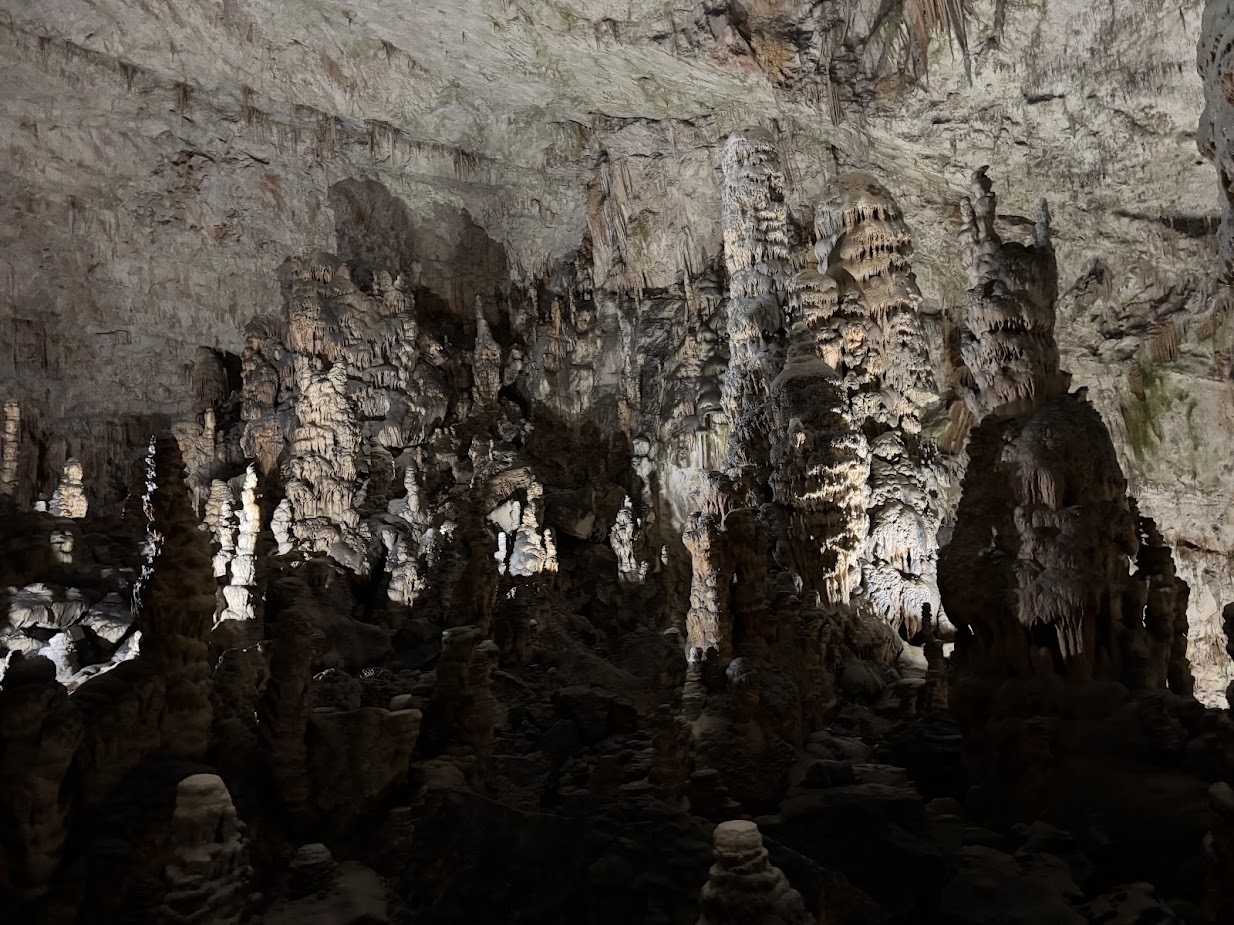
The caves haven’t changed at all, dark and damp and at a constant temperature of about 10 degrees Centigrade or 50 degrees Fahrenheit all year round. A visit to the caves starts off with a mini-train ride from the entrance, deep into the heart of the mountain, it’s a bit like being at the fun fair. The train whizzes along specially constructed tunnels until we eventually emerge in a huge underground cavern. From here we proceed on foot. The audio guide is nicely done, there are numerous stages where we stop and look around us whilst a soothing voice in a choice of about 30 languages explains what we are seeing. At the end of each ‘etape’ the recorded explanation ends with the sound of a drop of water, a gentle plop, like a raindrop. It reminds visitors that the entire cave system we are witnessing was created by water.
Firstly there was the dissolving of the limestone rock (calcium carbonate) by rainwater (carbonic acid) over thousands and thousands of years. Secondly there’s river erosion, in this case the might of the underground Pivka River which flows through the karst limestone of Postojna, eroding the river banks and deepening the river valley through which it flows. Again this process has been continuing for tens of thousands of years.
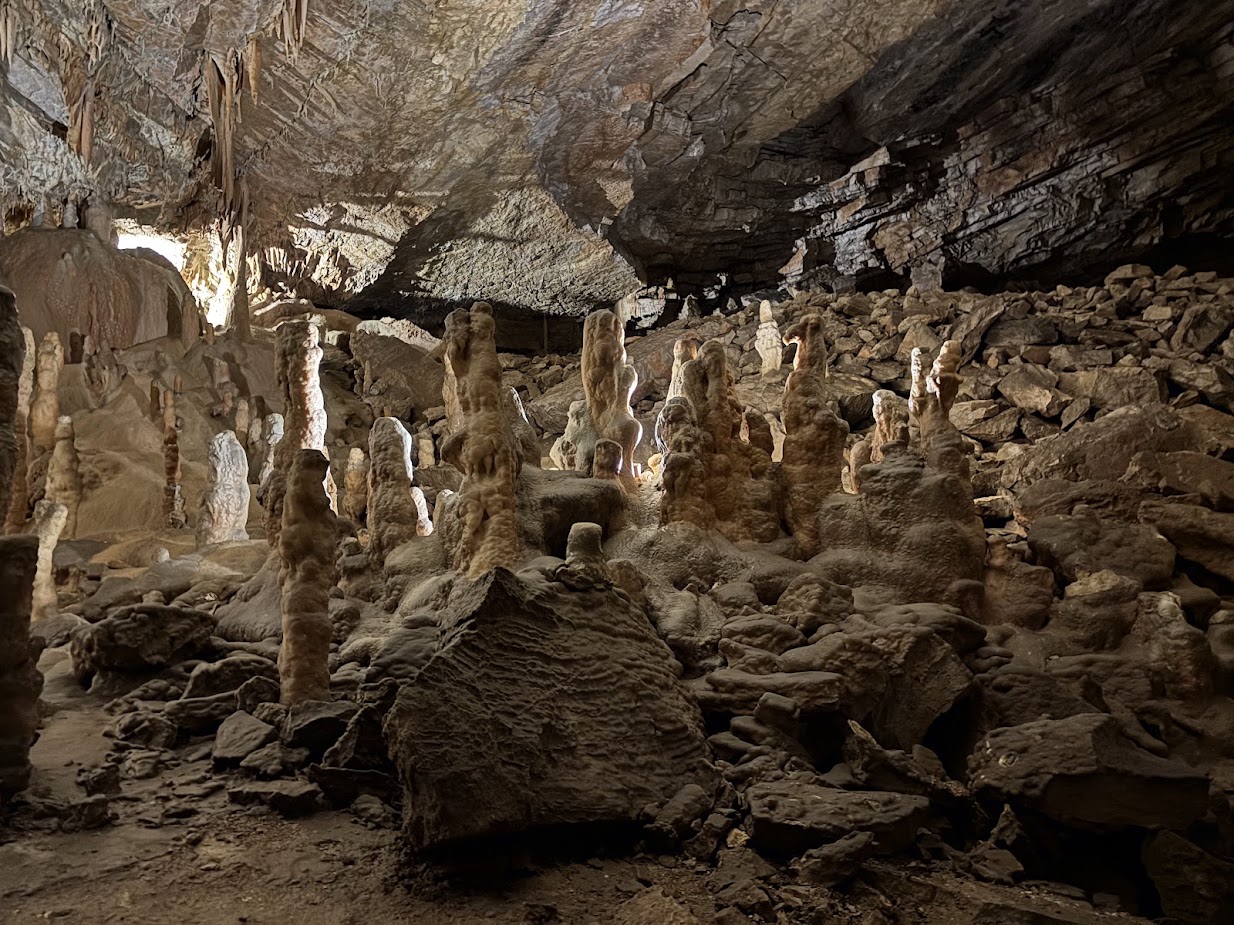
Then, as the caves were formed and enlarged, deposits of calcite would begin to form. These calcite deposits are the solid material left behind when the rainwater has percolated through the rock, above our heads, and then evaporated. Calcite creates, over millennia, stalagmites, stalactites and calcite curtains. The Postojna cave complex is at least three million years old. Some of the stalagmites are more than 500,000 years old.
In these limestone areas there is little or no surface water. Instead rainwater percolates through the rock, under gravity, until it hits an impermeable layer, in the case of Postojna this rock is called ‘flysch’, here the water sits and accumulates creating underground pools and ponds.
The combination of the permeable limestone, which is easily eroded by rainfall and rivers, sitting on top of an impermeable rock layer creates the unique conditions for the development of a karst landscape. This is why Postojna has one of the largest cave complexes in Europe. It’s not the biggest cave complex in Europe but it is the most visited – probably because of the train and its long history as a tourist attraction. The length of the cave complex so far discovered is almost 25 kms in length – there’s almost certainly more still to be revealed.
The Postojna cave system is fascinating for me as a geographer, but it’s not just about the limestone and the caverns. There’s a very unusual sightless amphibian ‘Proteus Anguinus’ that lives in the pools and stream of this underground world. The creature known locally as an ‘olm’ is a cave-dwelling salamander, similar in appearance to a newt, with colourless skin giving it a white or pinkish appearance. The ‘olm’ can live for up to 100 years and is perfectly adapted to its dark, underground environment. They feed on worms and tiny crustaceans. These small vertebrates grow to about ten inches (20 cms) in length. They are naturally very timid and don’t like noise or (unsurprisingly) bright lights! Back in the 1980s you could see the olms swimming around in shallow pools, in their natural habitat, so close that you could almost touch them. Now the only olms on view are in a huge aquarium, dimly lit and containing about a dozen individuals. The glass tank, which is designed to protect them makes me feel like I’m in a zoo. The poor creatures are housed in a confined area and gawked at all day by visitors. Seeing the olms in the tank makes me feel uncomfortable, surely a more free-range approach is possible. I need to investigate the conservation programmes going on at the caves.
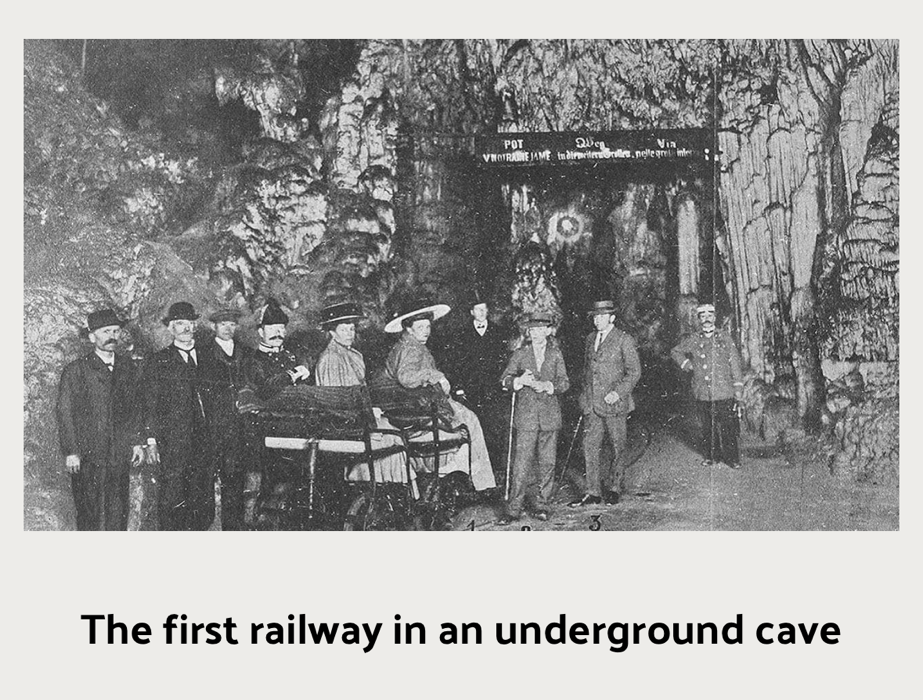

The photo (left) shows early visitors to the Postojna Caves c. 1857 and The olm – sketch by Gaston Bonnier, 1907 (right)
The scale of the Postojna cave system is very impressive, one of the underground caverns is so large that they claim you can fit Milan Cathedral inside – with room to spare. From time to time they have concerts and theatrical performances within the vast cave complex. However the modern concert-goer might be deterred by the chilly and damp environment (10 degrees) and the constantly dripping water from the ceiling; drip, drip, drip – especially after heavy rain. The caves also have an underground post office – the only one in the world allegedly. It was opened in 1899 and enabled visitors to send a souvenir postcard to their friends and loved ones stamped with the postmark of the Postojna Caves. The record number of postings took place in 1904, Whit Sunday weekend to be exact, when almost 14,000 postcards were sold each with a special postmark. I guess the Postojna Cave network and its post office was the ‘must do’ visit of the day.
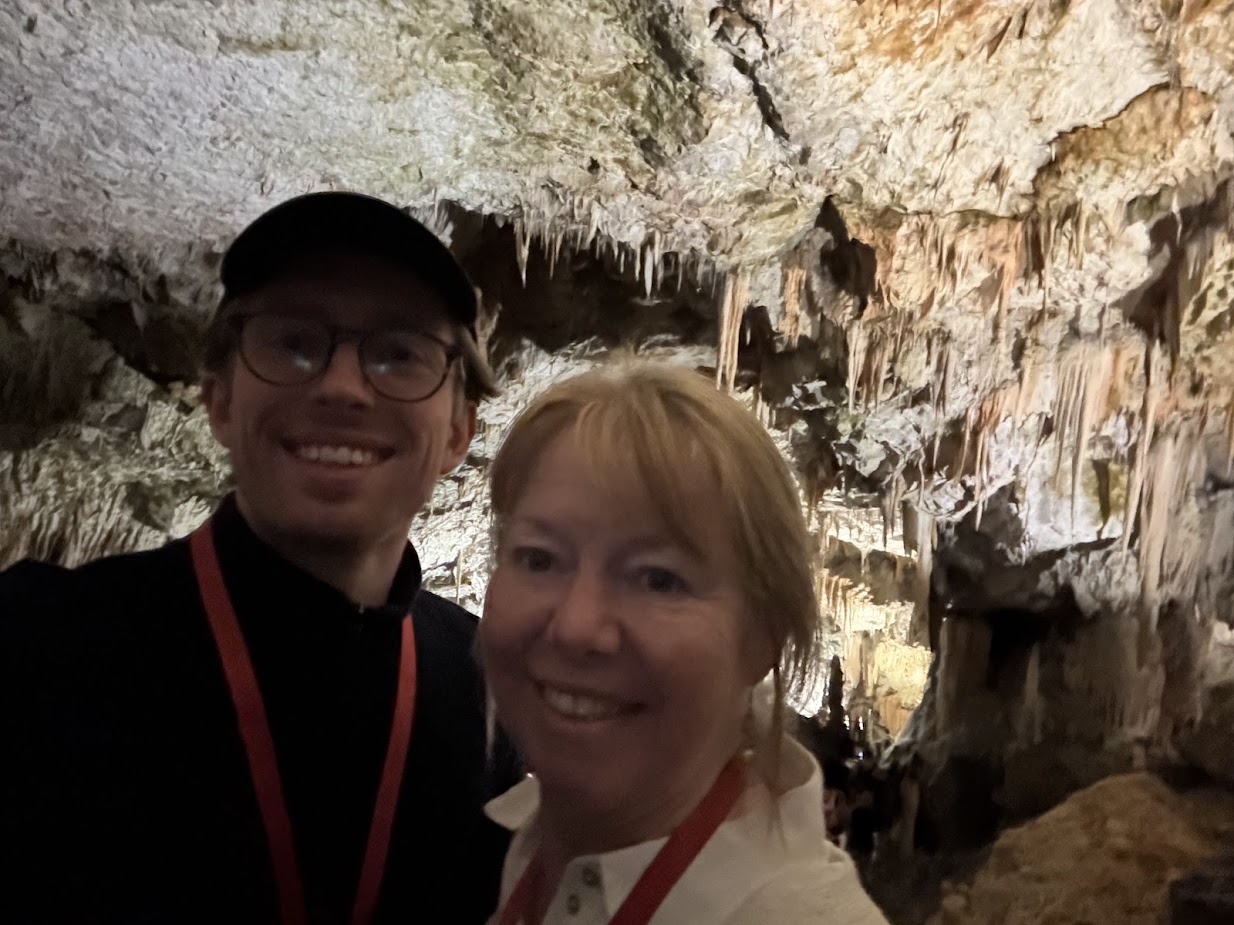
I think it’s true to say that the Postojna cave visit is a truly immersive experience, by the time Alistair and I emerged into the sunlight, blinking and rather chilly we couldn’t help but feel sorry for the ‘olms’ we’d just left behind. On the other hand they are perfectly adapted to their subterranean habitat, whilst we humans are not. For us it was quite liberating to breathe in fresh air, enjoy the warm sunshine and feel the light breeze on our faces.
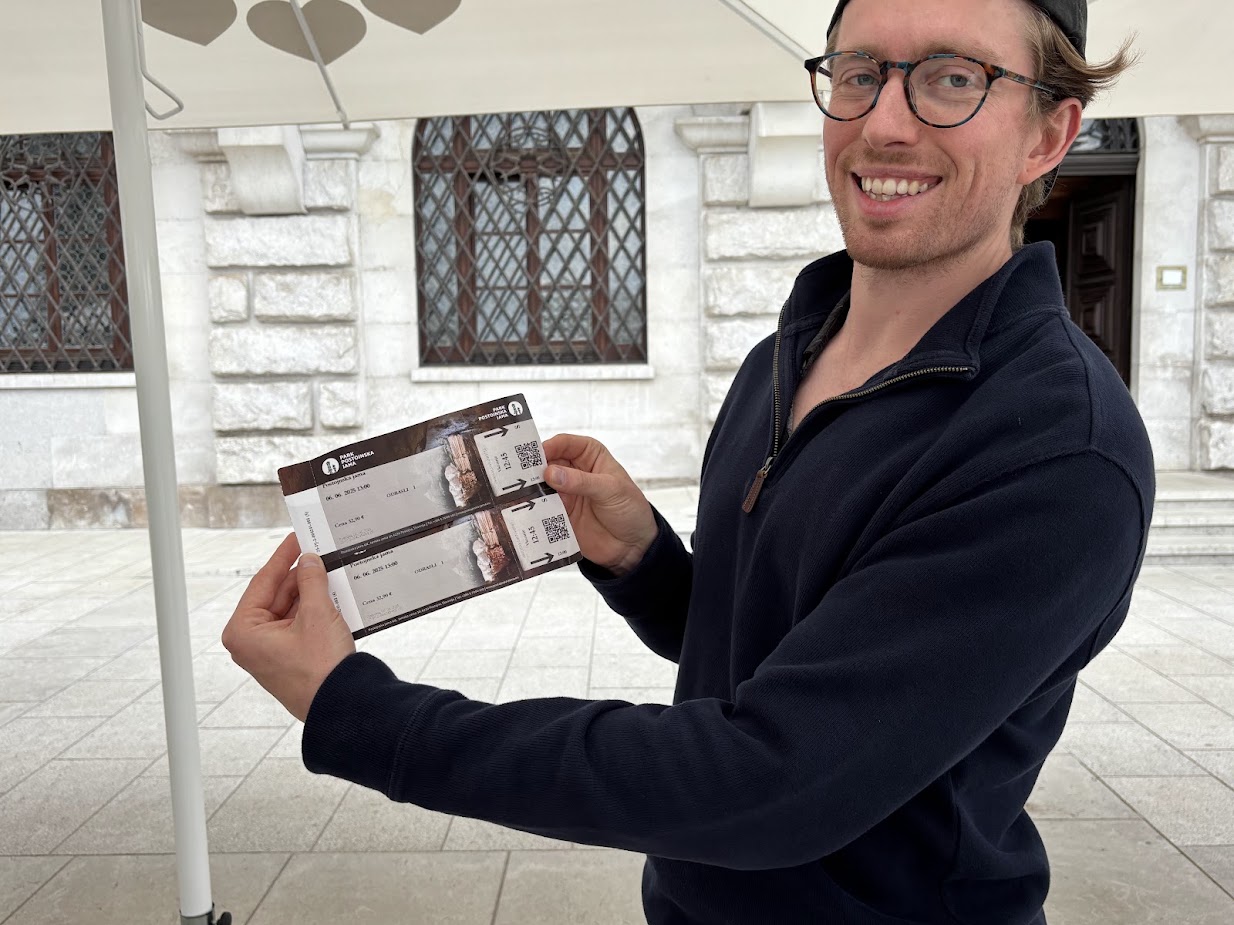
After a quick stop for ice-cream we were back on the road, the Adriatic Sea in our sights (well almost) and the end of our journey. Another 30 kms across the karst plateau of Slovenia before we encountered the border with Italy. The words of Cliff Richard’s ‘We’re all going on a summer holiday’ was ringing in my ears.
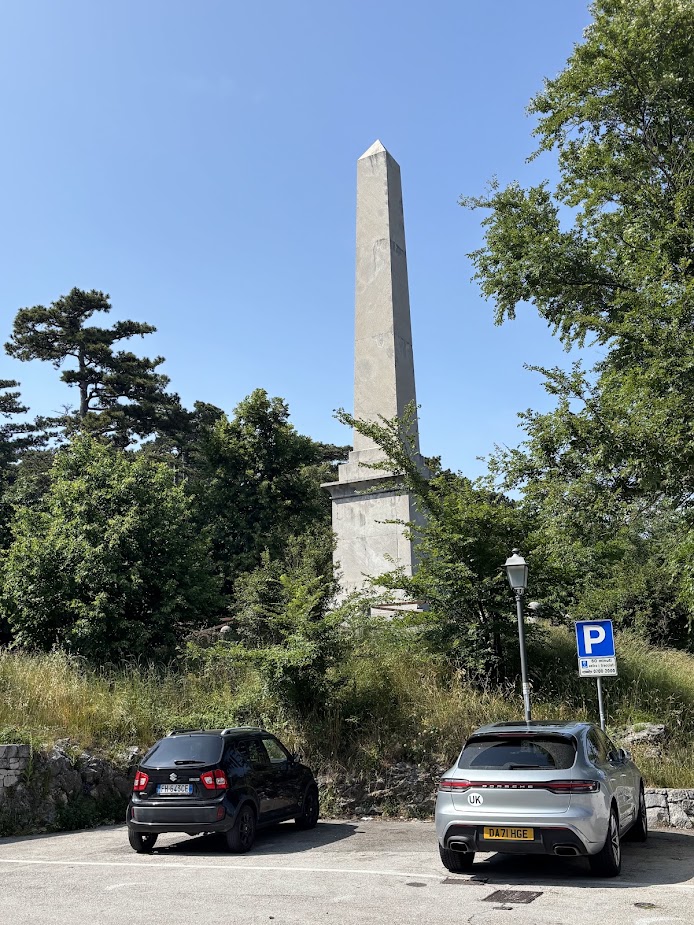
An hour later we were descending gently towards the Bay of Trieste, the border with Italy looms. A series of poorly maintained and semi-abandoned customs booths line the roadside. It’s a rather dismal welcome to Italy. However there’s light on the horizon, there’s the Adriatic Sea and the obelisk at Opicina.
This would have been the end of the road for the Habsburgs making their way, by horse and carriage, from Vienna to Trieste. They could pause here, knowing that the arduous journey was nearly over. Panoramic views and the satisfaction of coming to the end of a long and exhausting journey. The city of Trieste, their destination, below. Just like us they were travellers perched on the edge, the abyss between journey and journey’s end.
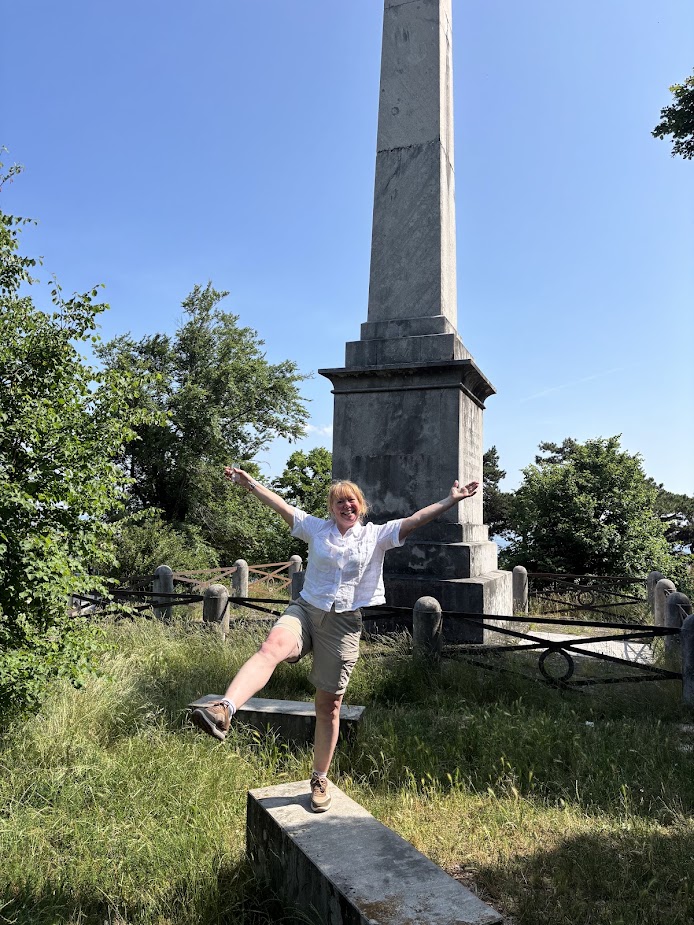
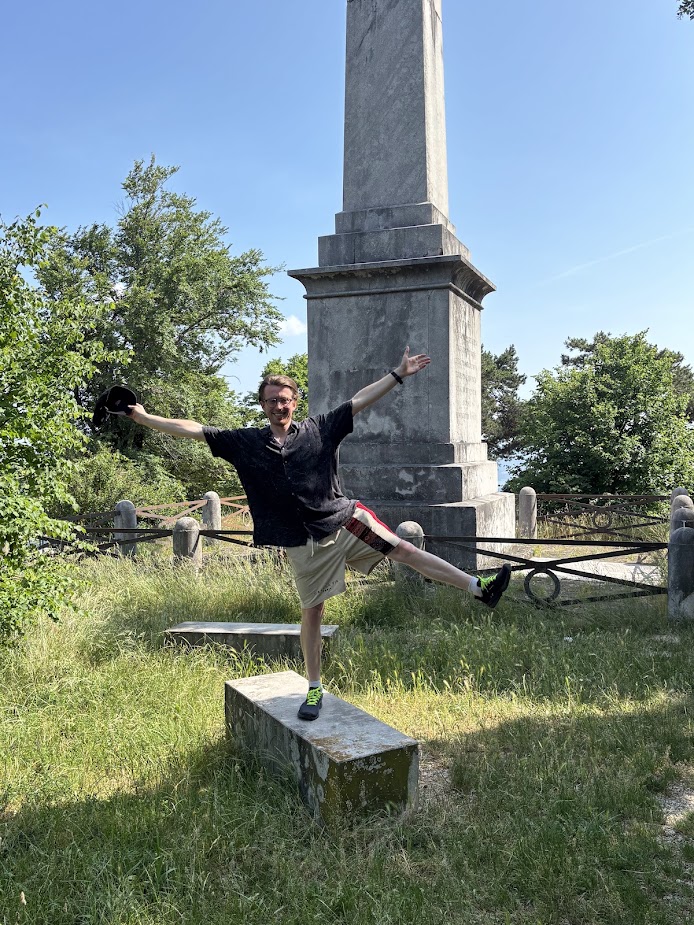
OPICINA – Pausing at the Obelisk built in 1830 by the Habsburgs to celebrate the completion of the modern road from Vienna to Trieste is actually the key moment of this road trip for me. I’ve entered a liminal space between land and sea. The limestone plateau of the karst, behind me, the infinite possibilities of the Adriatic Sea in front of me. It’s a threshold, a little bit like ‘L’Infinito’ the poem by Leopardi (Italy’s equivalent of Keats or Shelley).
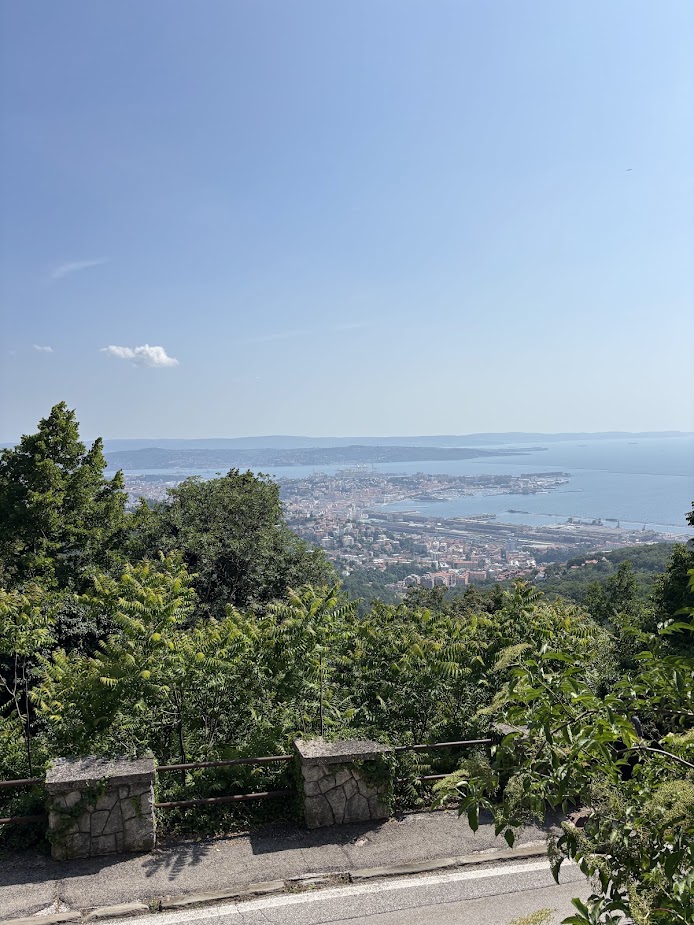
The panorama of Trieste below, with the shadows of the limestone caves and caverns all around. The sparkling welcome of the Adriatic Sea, blue-grey on the horizon, with the wooded hillsides of the escarpments hiding thousands of secrets. This is a border land, an area of ‘confine’ and division. Here frontiers have been fluid, ever changing for generations.
I’m at a threshold here, on the edge. I’m occupying a liminal space between highland and lowland. I’m standing on top of the limestone plateau that fringes the coastline above the city of Trieste. This is where Jan Morris writes of ‘quickening her step, enticed by the city below, wanting to arrive there as quickly as possible, to immerse herself in the city that awaits’…
My emotions and instincts are the opposite. I want to observe every detail of the littoral below me. To soak in and note the shape of the coastline, the number of the docks, the trellis of railway lines, every building, every architectural style, to imagine the lives of the Triestini going about their daily business.
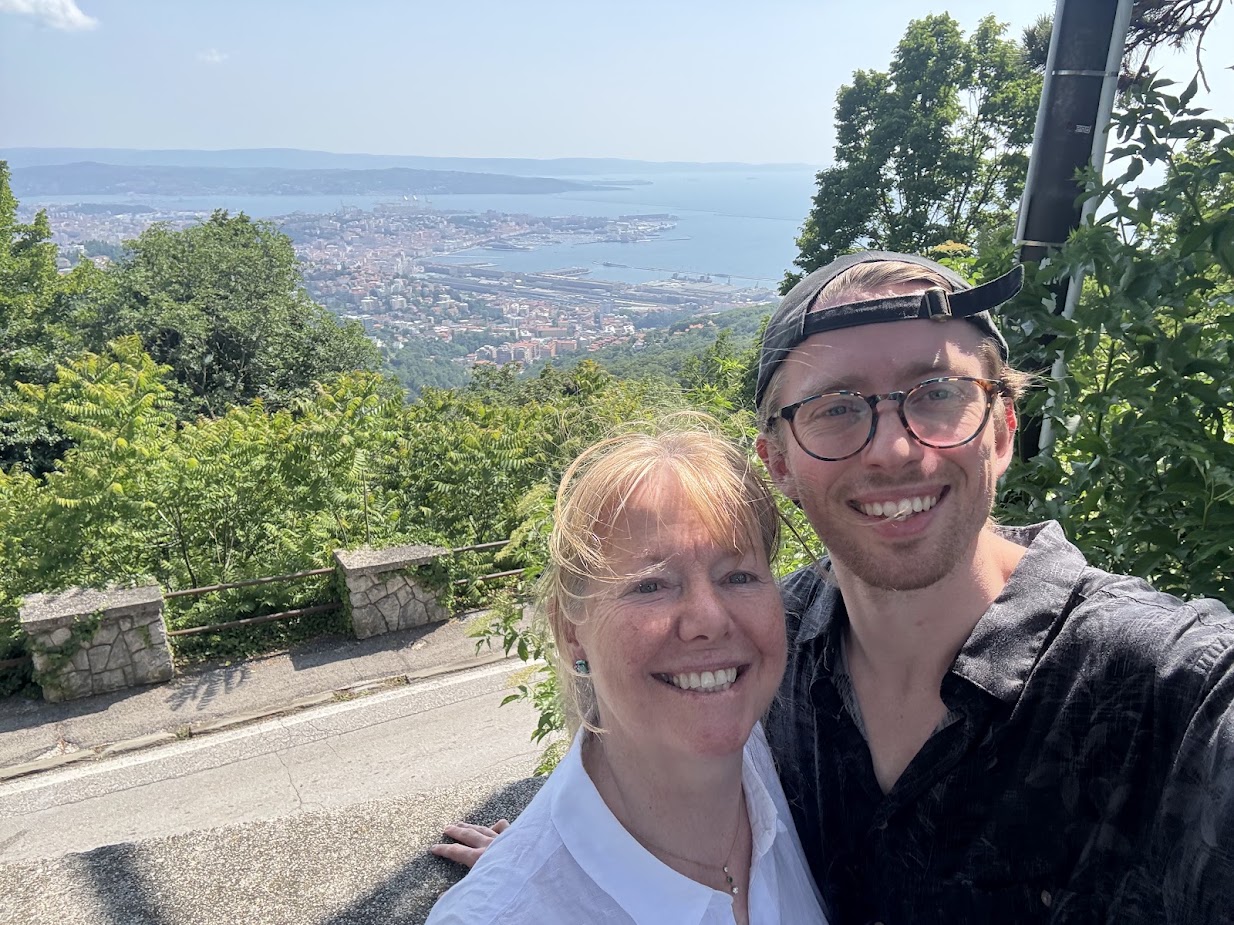
The city of Trieste is at my feet, laid out like a model village. I can see the docks and the railway tracks, the waterfront and the piers. I can see the coast road following the shoreline from Miramare all the way to the border with Slovenia. Trieste lies before me embracing the northern fringes of the Adriatic Sea. From the ship building yards of Monfalcone to the fishing village of Muggia, the city cocoons the Bay of Trieste in a warm, protective shawl of grand buildings, churches and offices, apartment buildings and warehouses. This is a city of trade, I can see that from here. The bay is filled with ships waiting to load or unload cargoes. I’m on the edge and I’m looking down. I’m actually hesitant to proceed, I like it here, absorbing the view, memorising every detail of the panorama.
I strain my eyes to see as far as I can, directly ahead of me is the Bay of Trieste and in the distance the small fishing village of Muggia, beyond are the hills of Slovenia and the coastline of Istria. One hundred years ago there was a seaplane service here, that operated flights from Trieste and Portorose to Turin, a journey of 600 kms, with numerous stops along the way. I’m imagining climbing into a voluminous sea plane, that takes off ‘on water’ using the surface of the sea as a runway. It’s amazing to think that exactly 100 years ago, such an ambitious feat was a reality.
When Jan Morris wrote of ‘Trieste and the Meaning of Nowhere’ I found the title intensely annoying. I’d actually characterise the city of Trieste as the centre of everywhere. This flashpoint city that straddles Western Europe and Mittel Europa. It’s the gateway to (what we used to call) The Balkans. The obelisk of Opicina is our triangulation point. This is the beginning.
Notes:
- This is the first chapter of a ‘Journey’ I started in my mind many years ago. The ‘Journey’ began to take shape in June 2025 when I travelled from Vienna to Trieste with my son Alistair. The second chapter is coming soon…..
- I’ve referred to various places, items, buildings in this chapter that have been the subject of articles that I’ve written on my blog ‘The Educated Traveller’ here are the links for further reading:
- St Christopher – patron saint of travellers
- A lasting memory – stolpersteine… – an important memorial to the holocaust
- Trieste – Italy – a brief history of a port city
- Trieste – Miramare Castle and Maximilian – The fairytale castle of Miramare
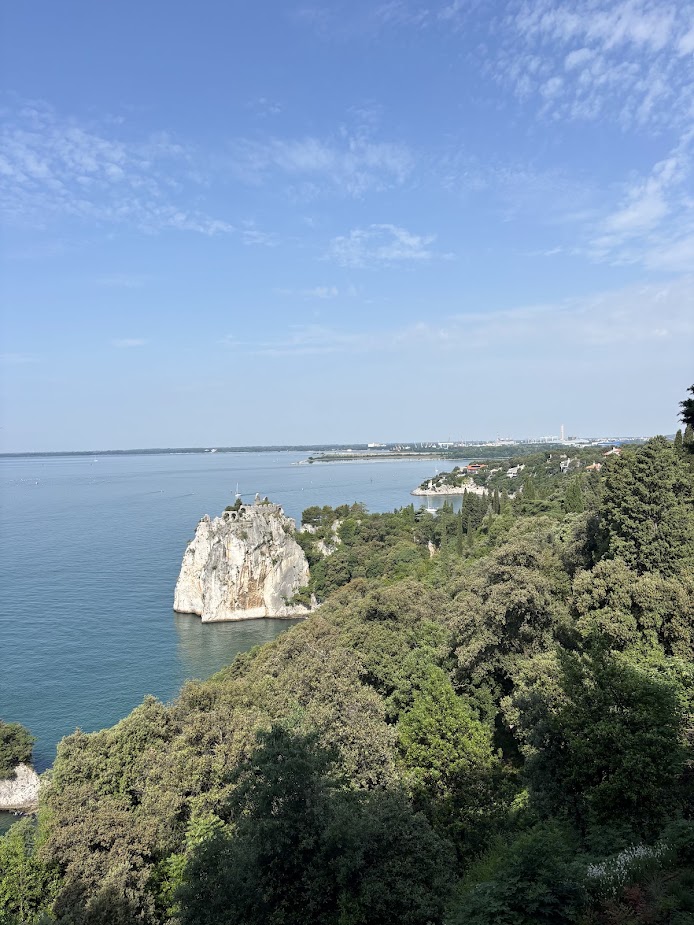
- Duino Castle Adriatic Sea – a fabulous medieval castle
- The Seaplanes of the Adriatic… – those magnificent men (and women) in their flying machines
Così tra questa
Immensità s’annega il pensier mio:
E il naufragar m’è dolce in questo mare.
Quotation from L’Infinito, Leopardi (1819)
August 2026


Hi, Janet,
I have just spent the best part of 45 minutes reading to, and sharing with, Margaret, your learned, evocative, erudite, nostalgic and (for me) even more relevant than usual journey. It brought back so many memories for us, enhanced (of course) by the brilliance of your writing – we really felt as if we were there with you and Alistair, as you journeyed over, to and through all those places which hold so many memories for us (especially Schönbrunn, which was one of the highlights of the trip which The Educated Traveller arranged for us (and Simon & Pip Schanschieff) all those years/decades/centuries (!) ago.. Even though I may have forgotten the actual year, the trip was one we won’t ever forget, and your account this week brought back so many memories for us.
However, I know that you wouldn’t expect me to hand you totally unreserved and fulsome bouquets without a singled brickbat (!) – so if only to reassure/warn you that I do always read every single sentence, word and letter of your Educated Traveller Accounts, I must congratulate you on nearly concealing the only tiny (presumably deliberate) error to see if it could escape the gimlet eye of your keenest and most pedantic reader – and I have to tell you that, in that respect, you failed!! (In case your grammatical hiccup wasn’t just a temporary mental lapse, as it surely must have been, I refer of course to your provocative statement (highlighted in yellow in the 4th paragraph from the end of your exhilarating account describing your visit to Opicina, as per the copy below), and which prompts the reader (well, at least, this reader!) to enquire exactly who had stood you on top of the limestone plateau?! It’s a pity that you never underwent the joy of “Murky” Mallaher’s English lessons at School; he was obsessive about the transitive verbs being used instead of intransitive ones, and I still have a vivid recollection of the impact of his ruler upon my 15-year-old knuckles for committing the identical sin!! (They don’t call me “The King of the Pedantics” for nothing!!
But it is unfair of me to chide you for such an infinitesimal lapse during such a truly impressive and gripping magnum opus, so please overlook this neaqrly-totally unwarranted criticism and bask in the praise and thanks you so richly deserve for this tour de force!!
I look forward to your next contribution, which I am sure will not arouse my pedantic internal Cerberus from its kennel, and apologise for my failure to keep it on its leash on this occasion!!
Luv,
John
LikeLiked by 1 person
I’d expect nothing less from you Prof Johnny – gratefully received insight and erudition as usual x
LikeLike
What a super wonderful trip this must have been! ________________________________
LikeLiked by 1 person
It was really wonderful and enriching too!
LikeLike