Lorenzo Lotto was a prolific Italian painter of the 15th and 16th centuries. Born in Venice around 1480 he died in Loreto, a town in the Le Marche region of Italy around 1556. His works are scattered across Northern Italy and can be found in Venice, Asolo, Bergamo and Treviso. Lotto moved between Venice and Le Marche where he undertook commissions in Recanati, Cingoli and Loreto. He spent his final years as a lay monk in the monastery at Loreto which was an important pilgrimage destination from the 13th century onwards.
LOTTO was influenced by fellow artists Giovanni Bellini and Giorgione both of the Venetian school. His style was bright and bold, often portraying numerous saints and worthy members of the community. He frequently included elements of the Venetian countryside in his paintings; green pastures and rolling hills. His depiction of Venetian landscapes is often seen to be similar stylistically to both Giorgione (c.1477-1510) and Bellini (1435-1516).
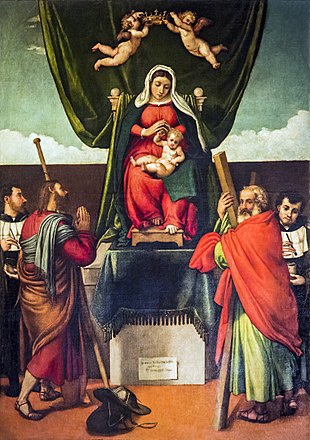


LORENZO LOTTO was born in Venice and painted in Venice and also on the mainland for the first couple of decades of his life. He painted numerous religious scenes including many church altarpieces. During his long career he received many commissions from wealthy individuals, religious groups and trade bodies – for example the Confraternity of Cingoli who commissioned the spectacular Madonna of the Rosary (below). His paintings were often highly detailed, containing figures of saints, bishops and scenes from the life of Jesus and Mary. Lorenzo Lotto’s version of the ‘Annunciation’ (below) shows an angel carrying a single lily to announce to Mary that she is ‘expecting a child’ an event frequently portrayed by a messenger, usually an angel, kneeling or hovering on the threshold of a renaissance style villa.

Lotto travelled over much of Northern Italy, during his life, eventually he settled in Le Marche painting exceptional canvases in Cingoli, Recanati and Loreto. His painting ‘Madonna of the Rosary’ is one of the richest and most complicated works I’ve discovered in a long time (see below).

MADONNA DEL ROSARIO – This painting hangs in the Church of San Domenico, Cingoli, Marche and was commissioned by the Confraternity of Rosario in 1539. The central focus of the painting is a fabulous Madonna in luscious rich blue robes, holding a cherubic baby boy. On the left San Domenico is praising the child, whilst Mary Magdalen and possibly Thomas Aquinas look on admiringly. On the right hand side Exuperantius – patron saint of Cingoli offers a model of the town to Mary, whilst Catherine of Siena and Peter of Verona look on. Below the Madonna and Child there are three small children, one is the infant John the Baptist whilst the other two are cherubs, spreading rose petals. The level of detail in the painting and the humour and mischief in the cherubic faces, as they throw the rose petals is charming and delightful. Especially when we consider the painting dates from the 1530s (500 years ago).
DETAIL – Above the Madonna is a tree of life with medallions representing various events in the life of Christ from birth to crucifixion and to resurrection. Each of the medallions offers us a miniature vignette or short story from the life of Jesus. In the 16th century such a visually rich and descriptive painting would have been a powerful teaching tool amongst a population that was largely illiterate.
LORENZO LOTTO spent many years in Le Marche and settled eventually in Loreto – which is a magical city for me. It’s a gorgeous hilltop town with a magnificent basilica and far reaching views across the Adriatic Sea. Lotto was a religious man and perhaps he was attracted to Loreto because of the legend associated with the town. The story goes as follows, in about 1295 a host of angels carried Mary’s house, the childhood home of Jesus from Nazareth in the Middle East, to the lush green hillsides of Le Marche half way down the Italian peninsula.
SANTA CASA – Mary’s very simple brick house became known as the ‘santa casa’ (holy house). Despite the improbability of a group of angels carrying this small building from the Holy Land to the coast of Italy, I just love the idea of the cherubic angels balancing the house on their white fluffy wings……and in all honesty this is probably my favourite Christian myth. Needless to say the arrival of the house was regarded as a miracle in Italy and Loreto has been a place of pilgrimage ever since. To this day the ‘santa casa’ sits inside the Basilica of Loreto encased in a highly decorated marble shrine. The Basilica was remodelled and enlarged over the centuries to provide a suitable setting for this most exceptional of relics, the house that Jesus lived in. Bramante one of the most important architects of the 16th century was brought in from Rome to create a spectacular marble structure to support the ‘holy house’, he also worked on the entrance and facade of the basilica. Today the Basilica is known as the ‘Santuario della Santa Casa’ (Sanctuary of the Holy House). The sparkling white marble facade of the Basilica reminds me of St Peter’s in Rome.


LORENZO LOTTO had a long and prolific painting career, he was commissioned as a young man, to paint a polyptych, a complicated and large altarpiece by the Dominican monks of Recanati featuring the Virgin and child flanked by various saints. When Giorgio Vasari, art critic of the day saw the painting he commented on Lotto’s exceptional skill and attention to detail, likening his work to Giovanni Bellini and Giorgione.
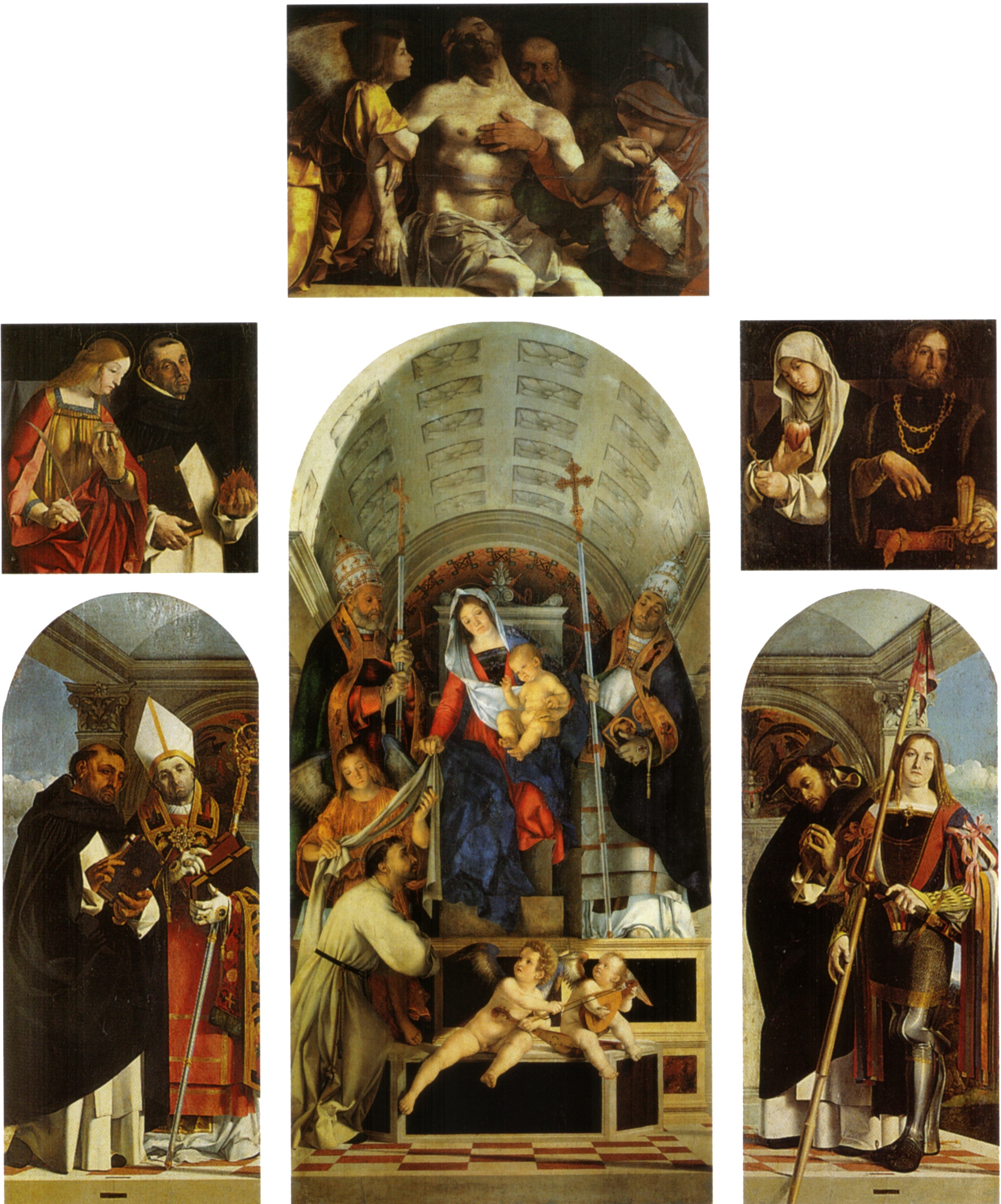
LOTTO’S Recanati Polyptych – which means a painting with many panels, in this case six, is a masterpiece of originality and story telling. It shows very clearly the fashion in the 16th century to reproduce Christian stories in a Renaissance setting. Elaborate settings, fine clothing, architectural details (arches, pillars etc) enrich the backgrounds. The panels that Lotto painted are as follows:
- Madonna with Child, Angels and Saints (center lower panel)
- Saints Thomas of Aquino and Flavian (left lower panel)
- Saints Peter of Verona and Vitus (right lower panel)
- Saints Lucy and Vincent Ferrer (upper left panel)
- Saints Catherine of Siena and Sigismund (upper right panel)
- The Deposition (top, centre panel) taking Jesus from the Cross
Saint Dominic is portrayed in the central panel while receiving the white scapular (an item of clothing) from the Virgin. Next to Dominic are two little musician angels playfully observing events.
Meanwhile back in Venice towards the end of his career, Lotto produced two more important paintings:


Lotto’s ‘Crucifixion and Pieta’ found in the Church of Santa Maria Pieta, Telusiano, Monte San Giusto, Marche – c. 1530
This richly detailed Crucifixion (above) is an incredible medley of brilliant colours, movement and theatre. When I look at this painting I see a curious mixture of Giorgione, Veronese and Giovanni Bellini all rolled into one. This amazing ‘Crucifixion’ hangs in a church in the province of Macerata in the Marche region of Italy. Just look at the complexity and depth of this painting – complete with the grieving virgin in the foreground. Painted around 1530 and to be found in the church of Santa Maria Pieta, Telusiano, Monte San Giusto, Marche.
Lorenzo Lotto had an exceptional career he was prolific for more than five decades from the early 1500s to his death in 1555. As a deeply religious man his work always had a strongly religious theme and his fondness of saints, often depicted in significant numbers makes me wonder what the collective noun for a group of saints could be…A clutch perhaps or possibly a gaggle…..
Thinking about Lorenzo’s work has made me want to return to Le Marche as soon as possible to observe at first hand the Madonna del Rosario in Cingole and the Recanti Polyptych. Now I’m going to have to add ‘The Crucifixion’ to my list.
Notes:
I’ve written various articles about saints including:
- The legend of St Lucy – Santa Lucia in Italy – 13th December is her Feast Day
- Sant’ Apollinare in Classe
- Saint Catherine
- San Giorgio Maggiore
- Christopher – patron saint of travellers
- St Catherine of Alexandria
To join me on one of my unique journeys in Italy check out www.grand-tourist.com my web site to see what’s coming up next.
Happy reading and even happier travelling!!
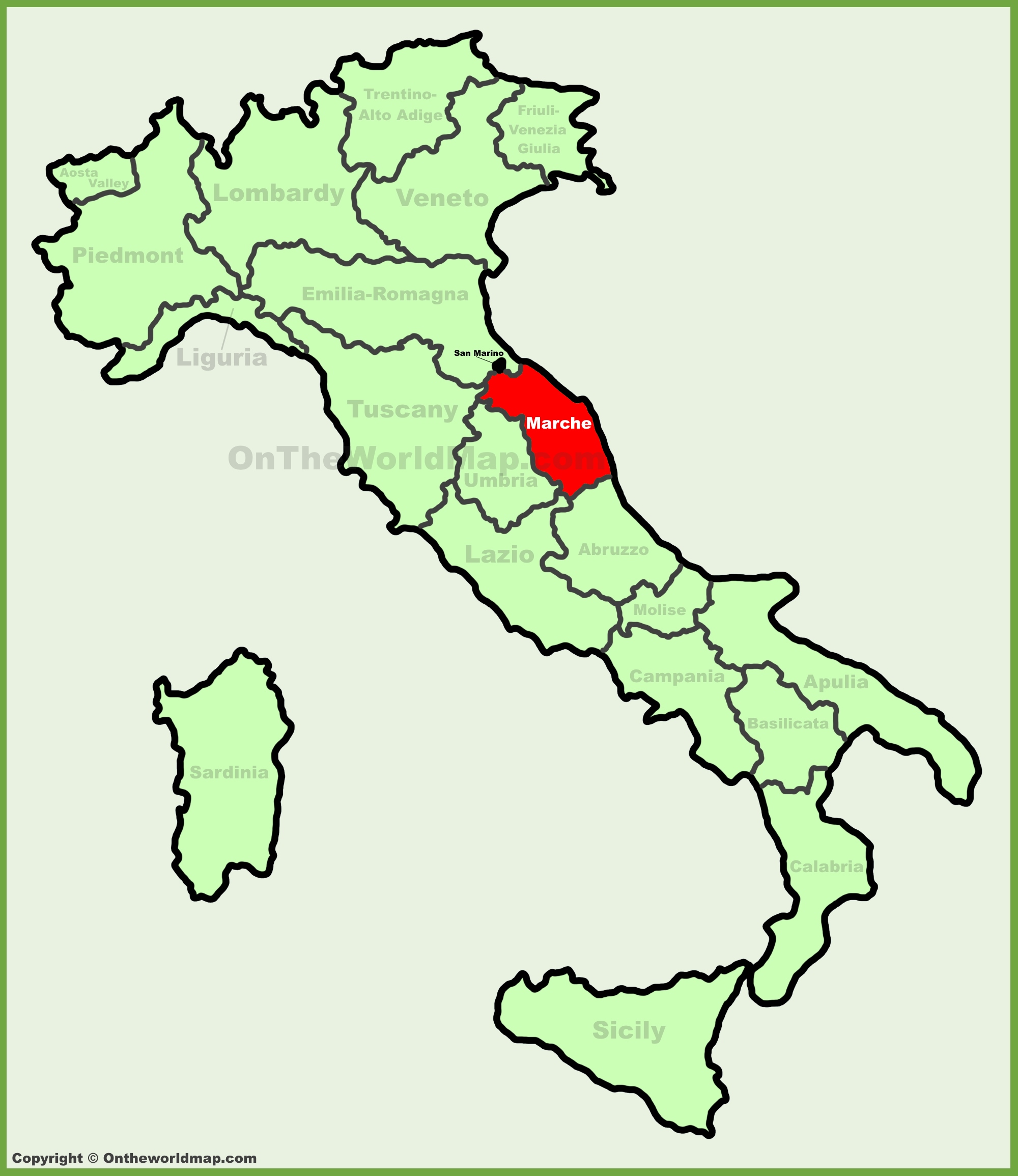
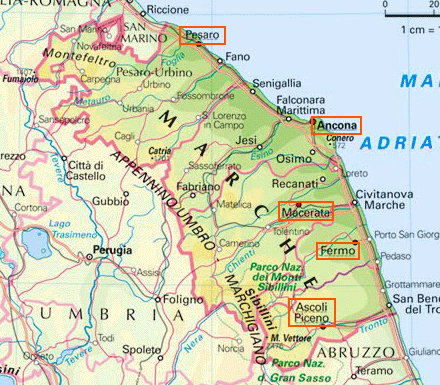
Location – Le Marche region is located on Italy’s east coast. It is a beautiful area of mountains, hills and lush green river valleys. The coastline of Le Marche extends along the Adriatic Sea from Pesaro in the north to San Benedetto del Tronto in the south. To discover more of this fabulous region – visit the colourful and nicely designed regional website: Le Marche Turismo

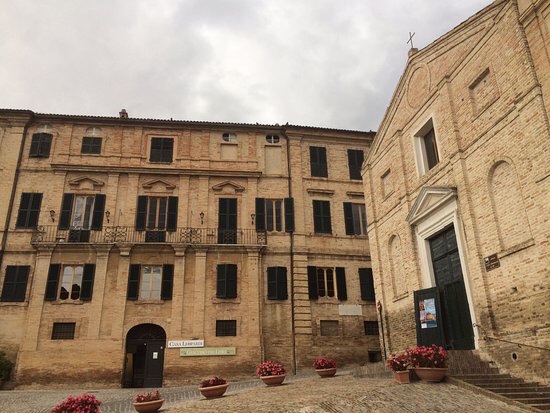
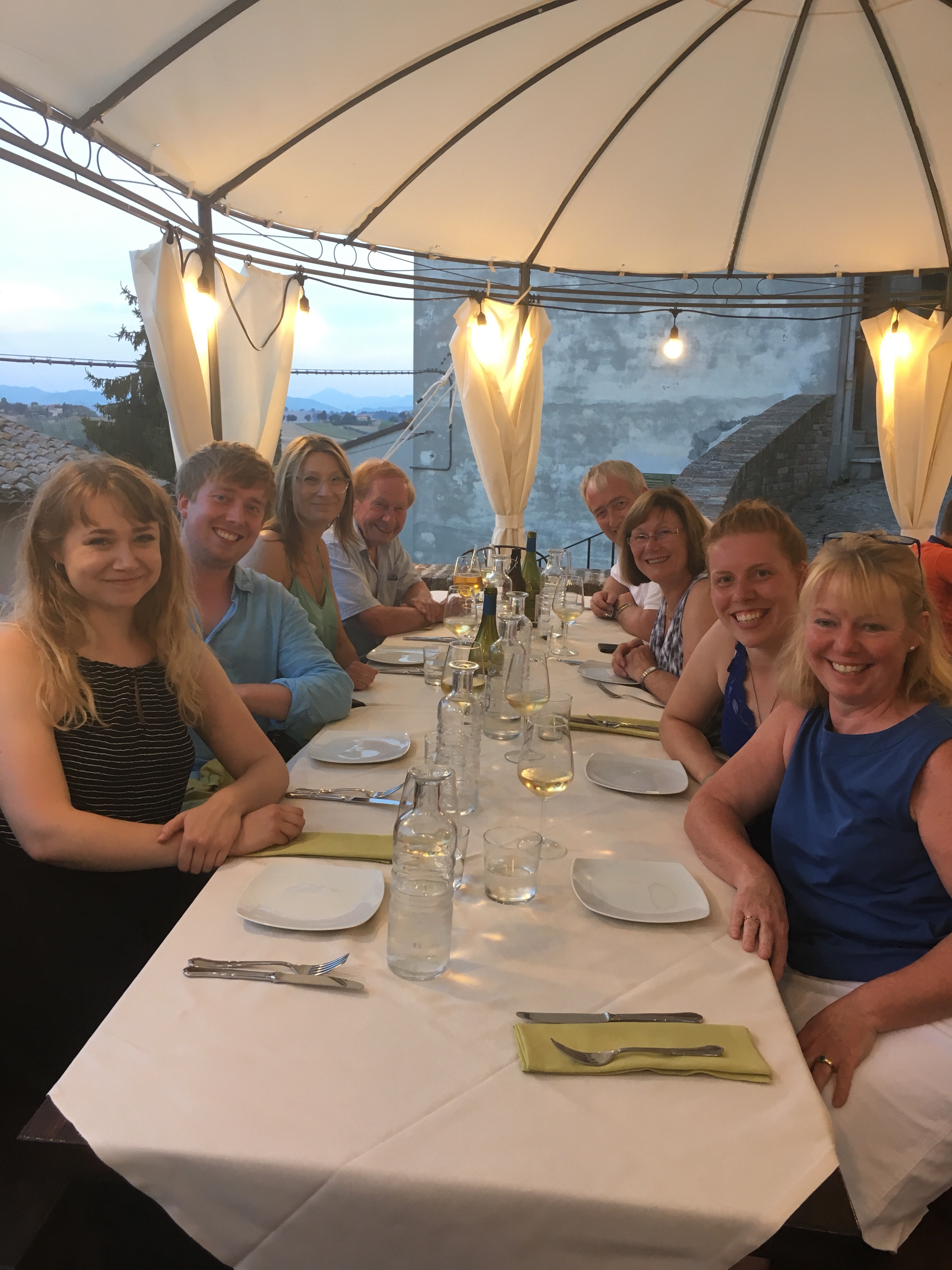


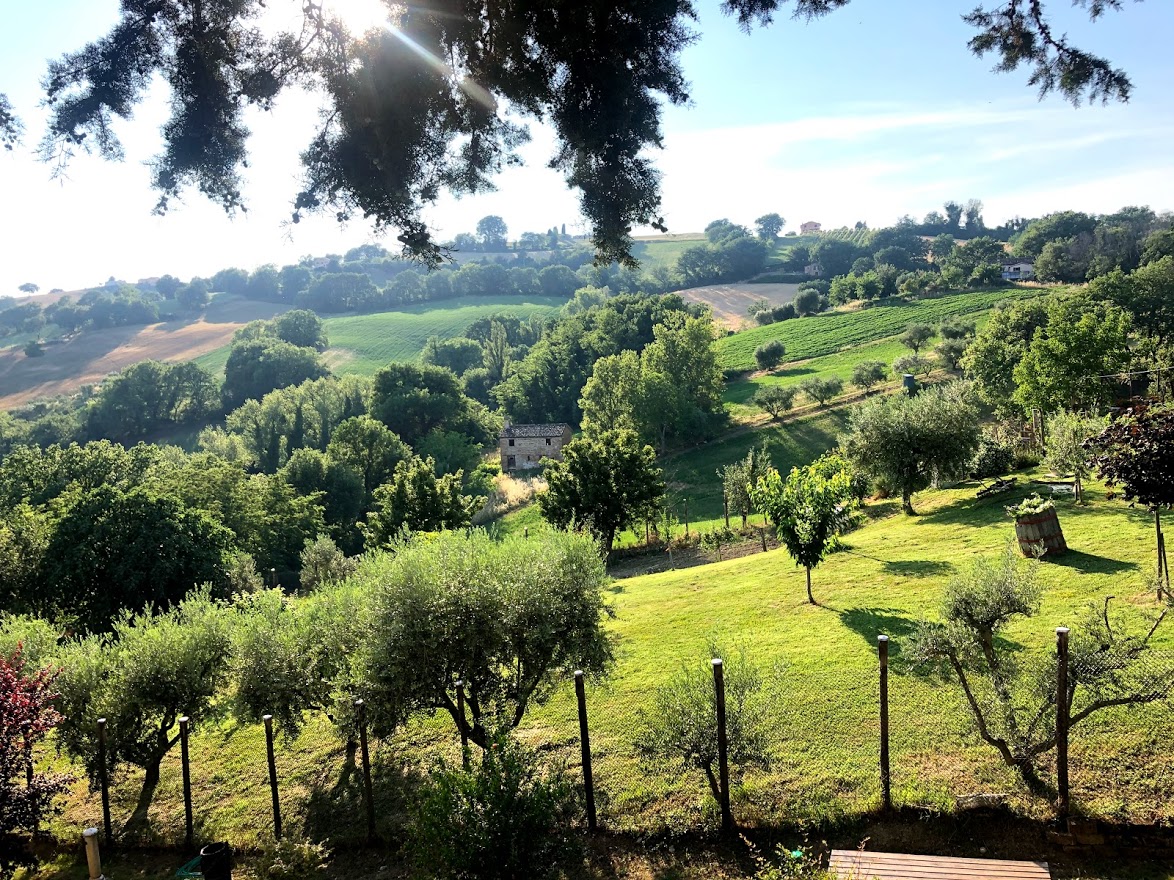

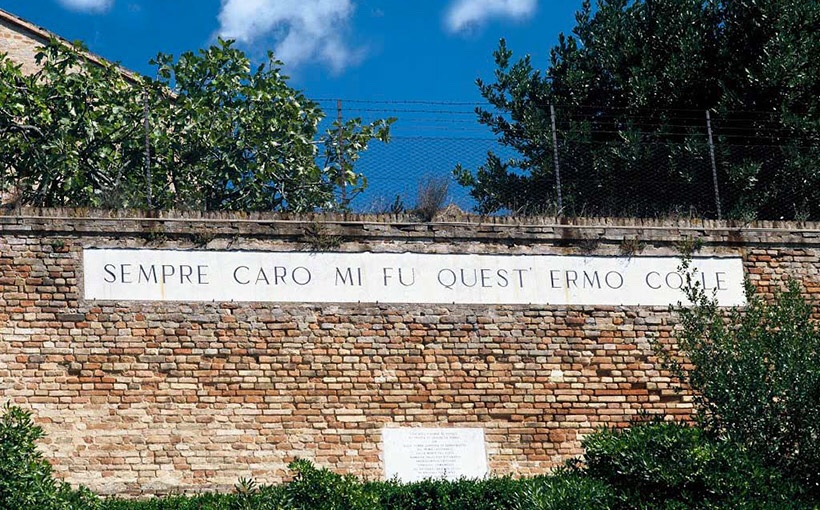

To read more of L’Infinito – Leopardi’s most famous poem – check out my article about Recanati: The Italian Countryside – Recanati – home of poet Giacomo Leopardi the poem starts with the line,
- ‘…Sempre caro me fu quest’ermo colle…”
- ‘Always so dear to me these beautiful hills….’
- Looking at the pictures above you can see why Leopardi was so captivated by his Marche countryside.
25th November 2021
POST SCRIPT: Lorenzo Lotto famously tried his hand at painting portraits (they say he did this in an attempt to rival Titian). The portrait of wealthy merchant Andrea Odoni below is a perfect example.
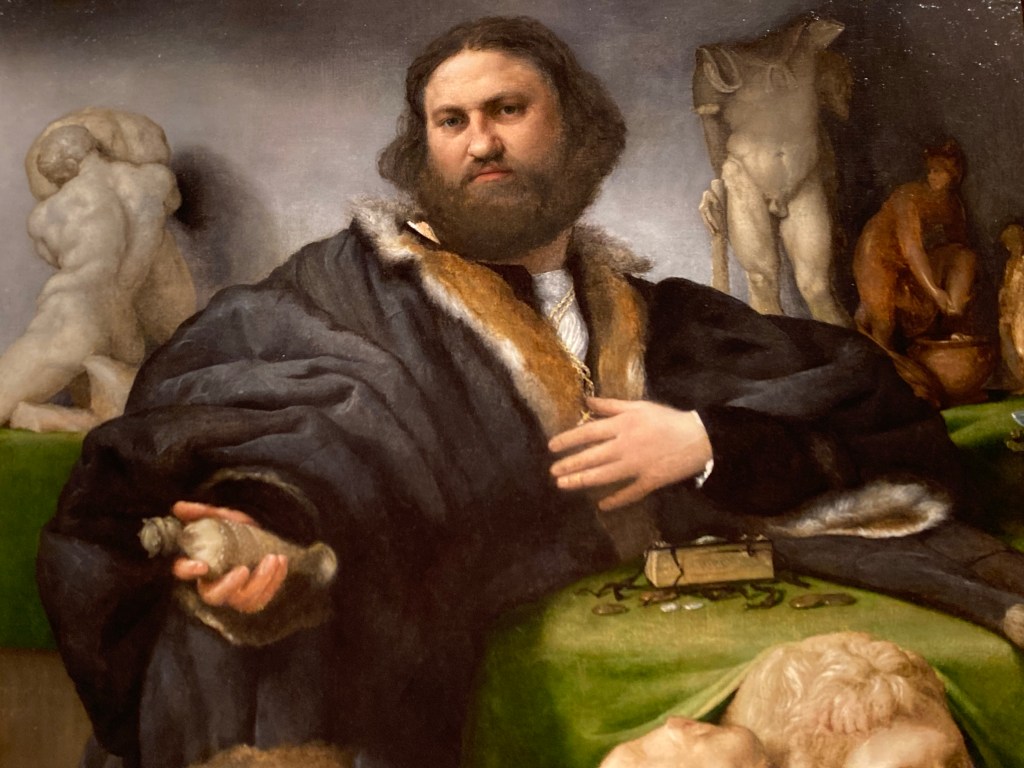
Andrea Odoni was a Venetian merchant – not a nobleman – traders and merchants were known as cittadini and were often very influential and important to the city of Venice. In the portrait Lotto paints Odoni surrounded by classical sculptures implying he is a man of taste and learning. He probably wasn’t! Although he was almost certainly one of the risk-taking traders who brought tremendous wealth to the city of Venice.
Updated: January 2025

 The Educated Traveller
Love the video of Loreto – a hidden gem. Especially loved the dragon fountain!
LikeLiked by 1 person
An enjoyable tour through the work of one of the lesser known artists of the Venetian school. I’ve seen only a couple of his works in Italy and I was very glad to see your reproductions.
LikeLiked by 1 person
Thank you Marie I’m glad you enjoyed it – I am very taken by the Madonna del Rosario – so rich and complicated and so full of character and depth.
LikeLike
The blue robes are sumptuous – amazing painting skill.
LikeLiked by 1 person
And again! How DO you do it, Janet – maintaining such a constant flow of fascinating, informative and educational blogs? I hope you are going to collate them into a Magnum Opus on “The CAFÉ* History of Italy – *(The Culture, Art, Food and Educational History) – it would certainly be a best-seller!
Thank you again for yet another tour de force!
John
LikeLiked by 2 people
I am your humble servant Lord Eaton x
LikeLiked by 1 person
The name is catchy!! J x
LikeLike
I’ll settle for the usual 2% of the Royalties…..
LikeLiked by 1 person
Please check your e-mail for ‘royalty payments policy’
LikeLike