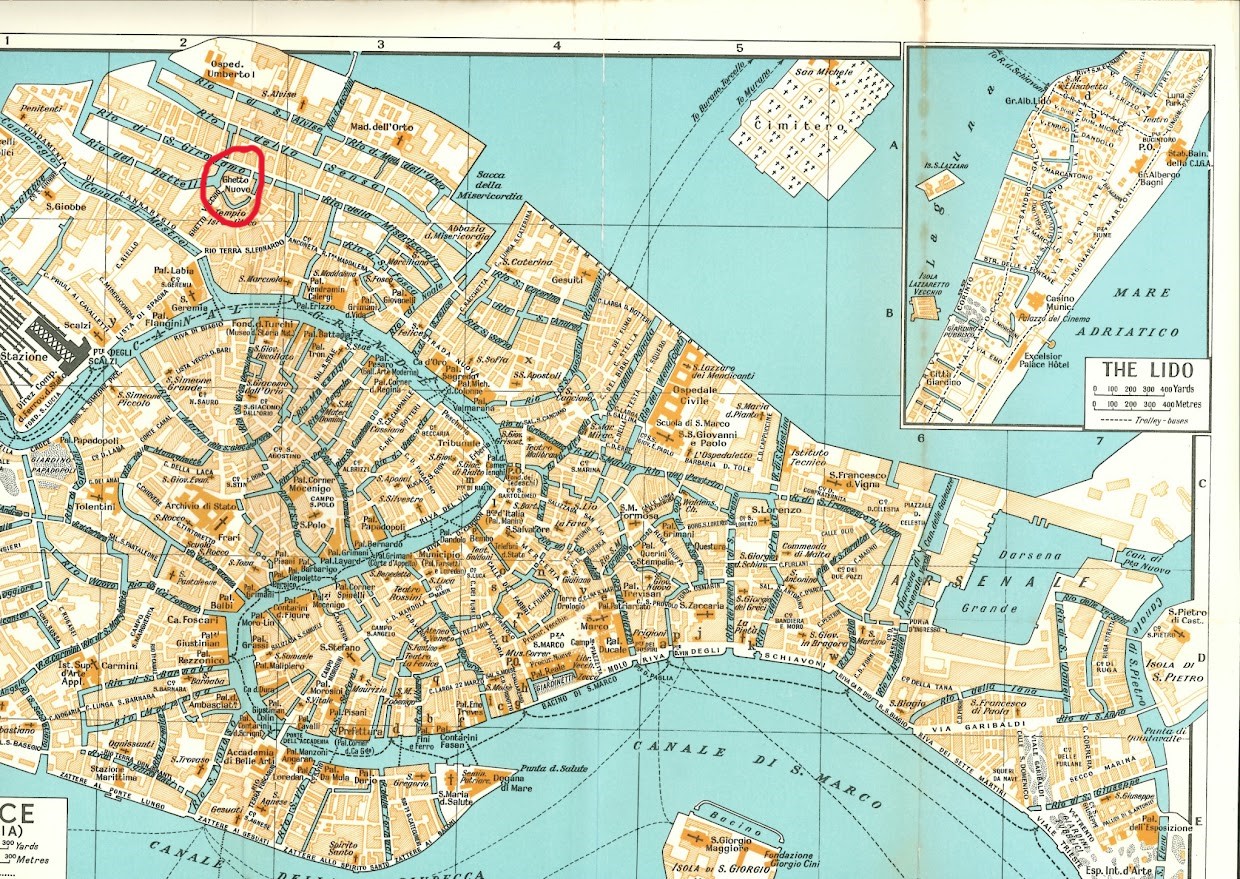
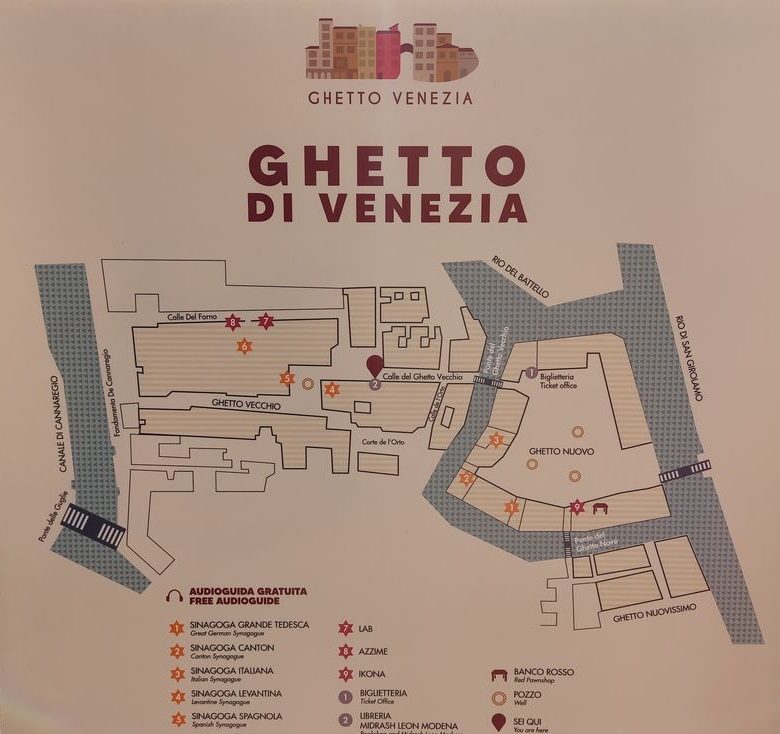
The Jewish Ghetto, Venice is located in Cannaregio district (circled in red on the map) – Guglie vaporetto stop
Venice was a city of merchants and trade. For centuries the Venetians controlled the trade routes of the Mediterranean Sea from the Adriatic to Alexandria and Cyprus to Constantinople. Venice was a cosmopolitan city with Armenians, Greeks, Turks and Germans all welcome to trade with the Venetian Republic. When Shakespeare wrote ‘The Merchant of Venice’ around 1598, he was writing about a cosmopolitan city that was at the crossroads between the west and the east. A city where ships and luxury goods arrived daily, where trade and business was at the heart of city life. Venice was a city that fascinated the drawing rooms of Europe, a place of canals and palaces, luxury goods from the east, and great wealth. Venice was magical, exotic and cosmopolitan.
Jews had been arriving in Venice for centuries. For the most part Venice welcomed these new arrivals for practical and financial reasons. After the Battle of Chioggia (1379-81) when Venice nearly lost control of the southern lagoon to their maritime rivals Genova, the Venetian Republic was seriously short of cash. In 1382 the Republic invited ‘people with funds’ to come and live in the city. Many of those who arrived in Venice as a result of this invitation were Jewish. A few years later, in 1386 a piece of land on the island of Lido was designated as the first Jewish cemetery in the city. The Jewish cemetery still exists to this day.
Jewish people arrived in Venice in a series of waves, often escaping persecution in other parts of Europe, especially from Germany, Spain and the Levant (Near East) and also Southern Italy. A good example of this is the Spanish Inquisition of 1492, which systematically removed anyone who wasn’t Catholic from the Iberian Peninsula creating a stream of arrivals of Sephardi Jews into Venice. Jews were attracted to Venice as a city known as a cosmopolitan trading hub with strong business links to Constantinople, Greece, Egypt and the East. It was also a city where Jewish people were tolerated and even welcomed within a strict legal framework.
In the early 1500s Venice was short of money once again. Times were hard. The War of Cambrai was a coalition of the Pope, France and Spain fighting again Venice. It was fought in Northern Italy and designed to limit Venice’s territorial power (1508-16). This campaign had left Venice’s coffers seriously depleted. In addition streams of refugees (many of them Jewish) were arriving in Venice from besieged cities like Padova, Treviso and Brescia. The government recognized that Jewish merchants and traders could inject valuable cash into the economy and stimulate trade. Any economist will tell you that money supply is vital to growth in any economy. The Venetians needed money. At the time, in the early 16th century, Catholics were not allowed to lend money and charge interest for that money. That was the sin of usury. So the pragmatic Venetians found a solution.
The Venetians decided to welcome Jewish refugees into Venice, but with certain restrictions. On 28th March, 1516 the Jewish ghetto in Venice was officially established. Doge Leonardo Loredan and the Venetian Senate signed a decree declaring that all Jewish residents of the city (about 700 at the time) plus those arriving from the mainland, were legally required to live in the Ghetto Nuovo (New Ghetto) in the Cannaregio district of the city. The Venetian Senate defined an area, a small island in fact, surrounded by water where Jewish people in Venice were required to live. This area was far from San Marco, it was a district of workers and workshops, metal-workers, stone masons and carpenters. The Ghetto was in the shadows of a metal foundry. The area was clearly defined and surrounded by water. There were gates that were locked every night at sunset. The gates were opened each morning at sunrise. The Jewish population were allowed out of the ghetto during daylight hours to go about their business in Venice, however they had to be back in the ghetto before nightfall.
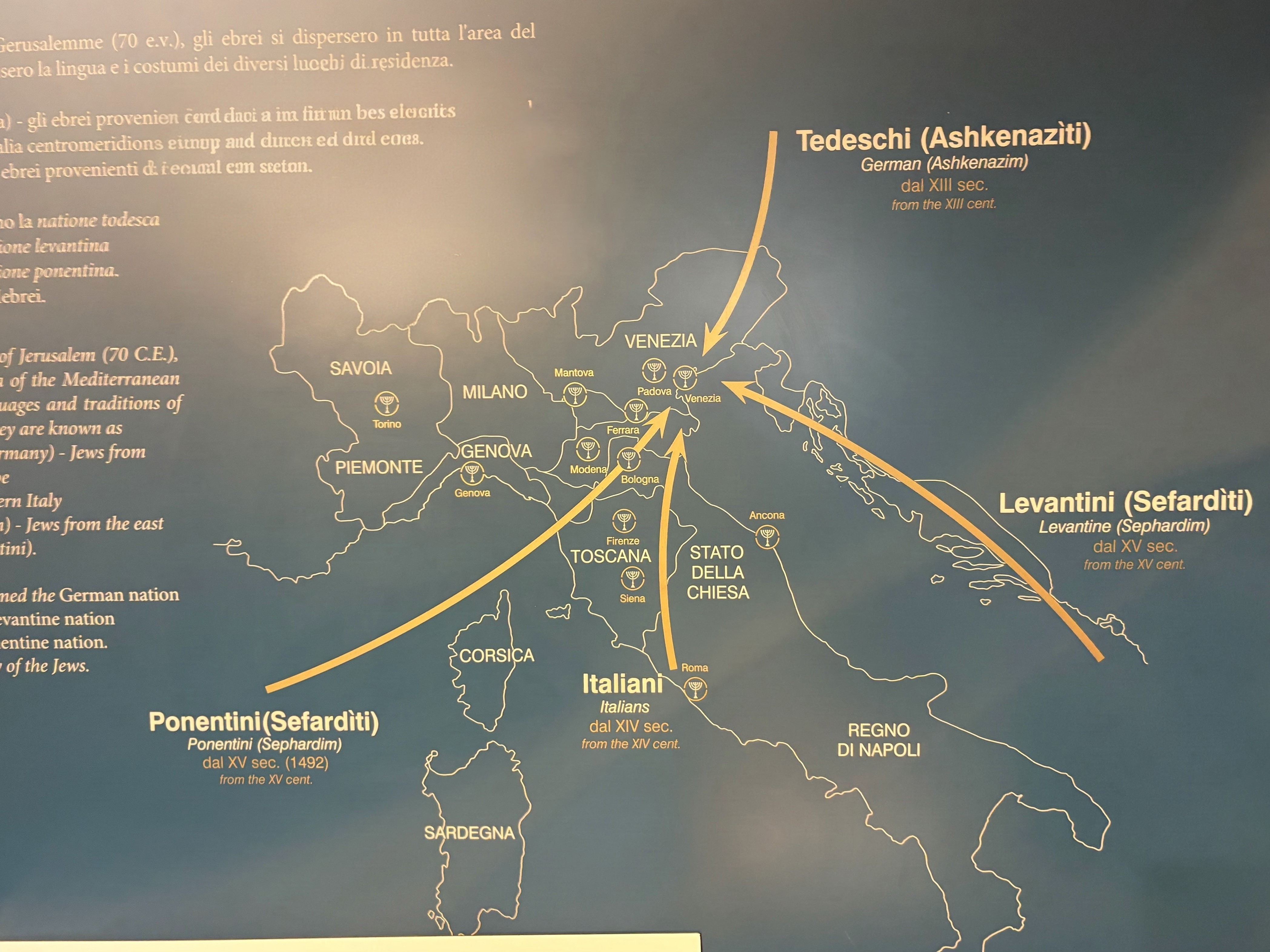
The term ghetto comes from the Italian-Venetian word ‘gettare’ meaning to cast or throw or make (something in metal). As recently as the 1980s in Venice tokens were required for the telephone – these tokens were known as ‘gettone’…. meaning metal pieces/coins. Luisella Romeo an expert local guide in Venice has suggested that the German pronunciation of ‘gettare’ adding an ‘h’ making the sound more guttural and becoming ‘ghettare’ gives us the term ‘ghetto’. This derivation of the word from ‘gettare’ to ‘getto’ to ‘ghetto’ seems very likely because the first wave of Jewish settlers in Venice came from German territories ie people living north of the Alps (see map below). Over time the term ‘ghetto’ came to be used globally to describe a segregated area where a particular group of people live within a city.
Venice was the first place in Europe to create a segregated area for Jewish people to live and this was the first time the descriptor ‘ghetto’ was used. Since then the word ‘ghetto’ has been used to describe a neighbourhood in a city where a particular ethnic group makes up the majority of the population, for example Harlem, New York or the Warsaw Ghetto in Poland.
The Ghetto in Venice was chaotic and over-crowded. At its peak the Ghetto had a population of about 5000 people, living in a tiny area of Venice. Buildings had to expand upwards to accommodate new arrivals. Even today when you visit the Ghetto you can sense the crowded, densely packed apartments, where families would have shared a kitchen and a bathroom. Buildings were extended upwards, to five, six, seven, eight floors making them the first skyscrapers in Italy.
Whilst Jewish people were being persecuted in other parts of Europe, the canny Venetians realised that accepting and welcoming Jews was financially beneficial to the Venetian Republic. Jewish bankers and money lenders could provide essential credit services to a city that needed cash. At the time it was claimed that only the poor used the services of the Jewish money lenders, but of course, that was not the case. The creation of the Venetian Ghetto was a pragmatic solution for the trading city of Venice.
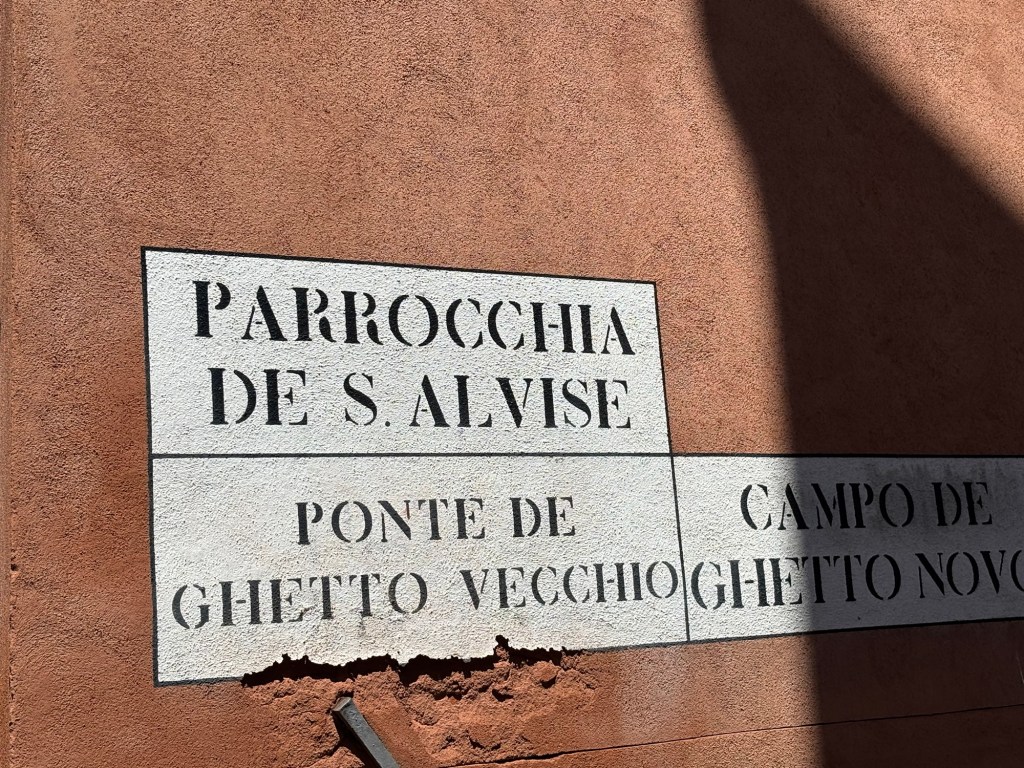
LIFE IN THE GHETTO – Venice allowed freedom of faith to the Jewish people within the ghetto. However strict Venetian laws prevented any form of ostentatious or easily visible places of worship. So the Jewish synagogues were hidden from the street. The synagogues, known as scuola (scuole), had to be discreet and were built on the higher floors of existing buildings. The scuole (literally schools, meeting places, community centres) were the first port of call for newly arrived Jewish families. The scuole were not just places of worship they offered support, advice and help for newcomers. The ghetto was a multi-lingual community, German, French, Italian, Spanish, Greek, Yiddish and Venetian dialect were spoken here. As each new wave of refugees arrived in Venice they built their own synagogue.
The first synagogue to be built was the Scuola Grande Tedesca (Great German Synagogue) built from 1528-9 and located in the Campo Ghetto Nuovo. It was built on the top floor of an existing building – it can be identified by 5 arched windows. It is a striking yellow building in the main campo – the first and oldest of the ‘ghetto’ synagogues. It was built by the Ashkenazi Jews (they arrived in Venice from Central and Eastern Europe). Tedesco(a) means German in Italian, however the term when used by Venetians describes any person coming from north of the Alps – including Germany, Austria, Switzerland or even Poland and Hungary.
It’s important to remember that the synagogues were meeting houses and community centres as well as places of worship. They were gathering points for new arrivals and served as a welcome centre and information hub.
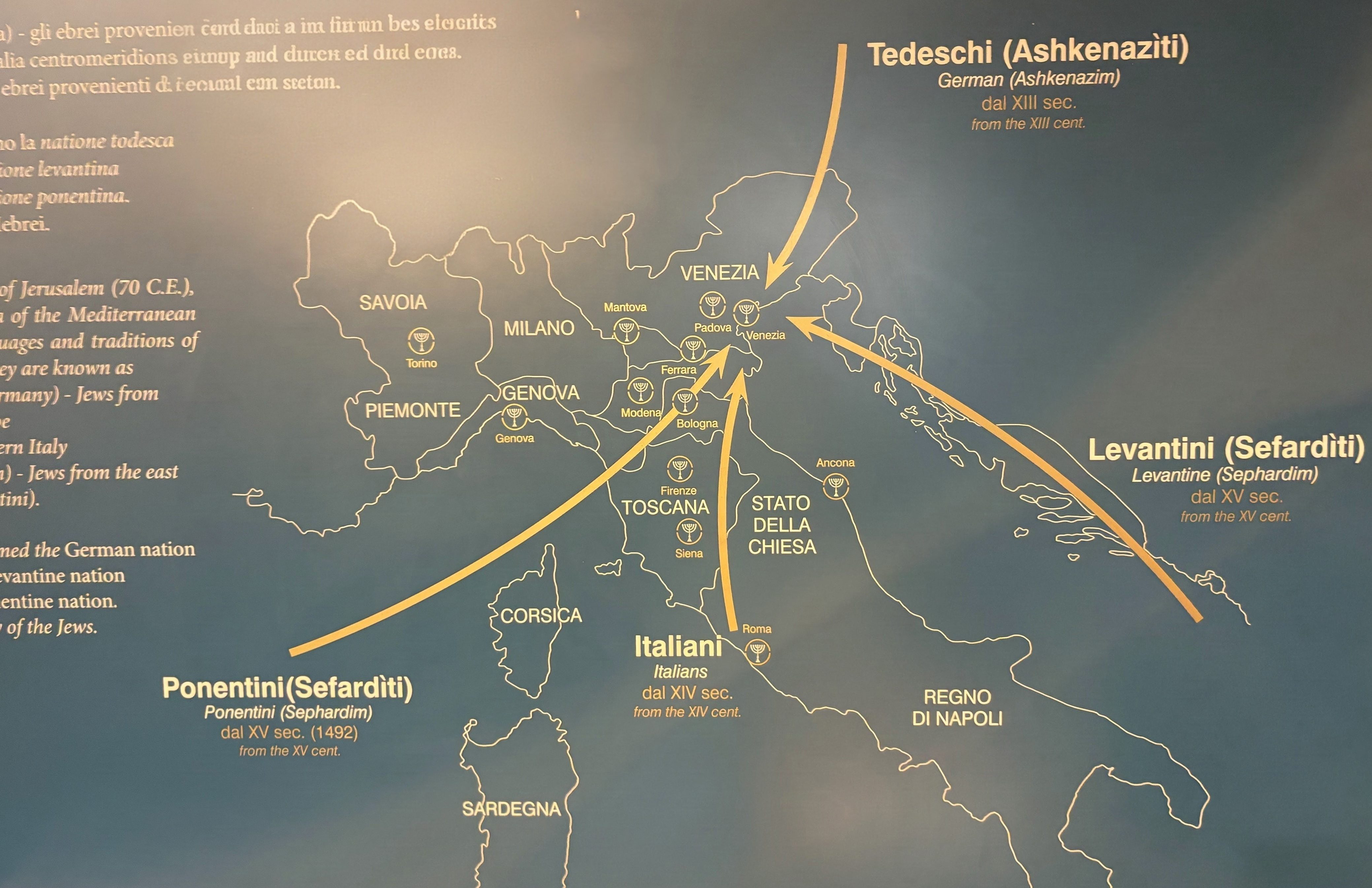
The map below shows the main migration streams into the Venetian Ghetto from north, south, east and west. First arrivals were the Tedeschi (Ashkenazi Jews) from north of the Alps, arriving from the 1300s. Next came the Italian Jews from Rome, Ferrara and Modena in the 1400s. They were followed by the Ponentini (Sephardi) Jews from Spain and Portugal. Lastly there was the Levantine Sephardi Jews arriving from Constantinople, Greece and the Levant. As each group arrived more housing was needed and another scuola (synagogue) was required.
There are a total of five synagogues in the Venetian Ghetto:
- 1528-9 – Scuola Grande Tedesca – German synagogue (Ashkenazi Jews)
- 1531 – Canton Synagogue or French Synagogue for Jews arriving from Southern France. Canton = corner in Venetian dialect. The Canton Synagogue was built in the corner of Campo Nuovo.
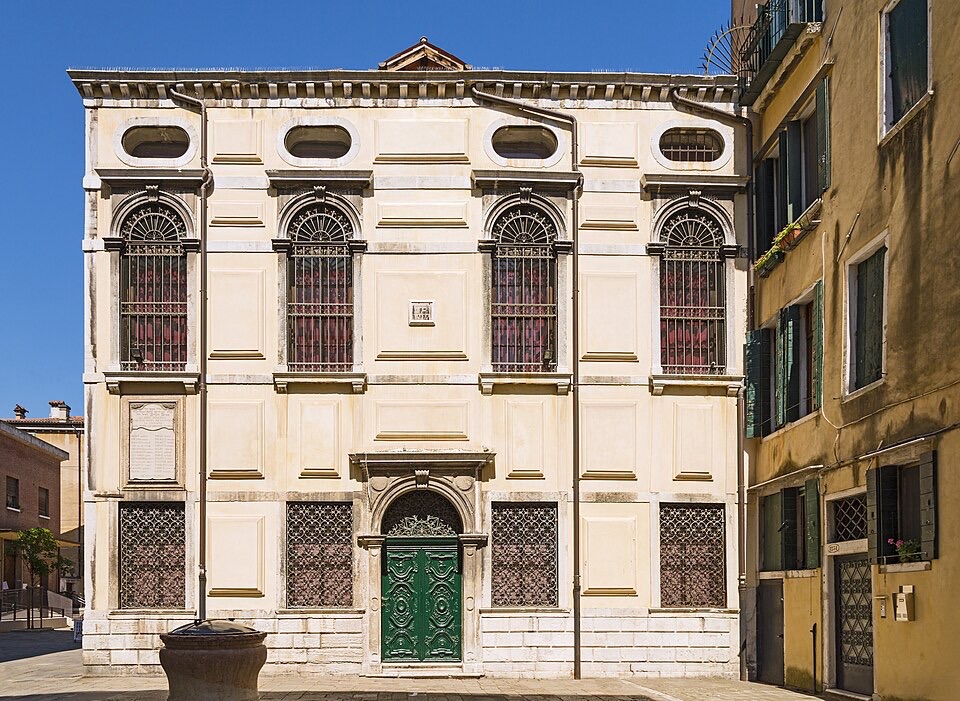
- 1555 – Italian Synagogue – you can see the Octagonal Cupola above the buildings on the west side of the campo
- All three of these synagogues were concealed within existing buildings, on higher floors.
- The philosophy was that the synagogue was high up with nothing between the worshippers and the celestial heavens. Therefore making it closer to God.
The Levantine and Spanish synagogues were different – they were built in more prominent locations before the bridge into the original ghetto. This area known as Ghetto Vecchio was set aside as an area for Sephardic Jews.
- 1541 – Levantine Synagogue – built by Jews arriving from the Middle East. These were Sephardic Jews arriving from the Ottoman Empire and the Venetian colony of Corfu. They were mostly successful merchants and traders. The synagogue was rebuilt in 1689 to a Baroque design. There is even a heating system! It is still used in winter by the local community.
- 1555 – Spanish Synagogue – established by Sephardic Jews who fled the Iberian Peninsula in the 1490s and came to Venice often via other European cities including Amsterdam, Ferrara, and Livorno. They arrived with valuable networks of business partners throughout Europe. This synagogue was rebuilt by Baroque architect of the day Baldassare Longhena in 1635. It is still used in the summer months as a place of worship. There is a secret garden inside the synagogue complex.
Professions and restrictions:
The Venetians controlled Jewish activities very strictly. There were a variety of jobs and professions that the Venetians allowed the Jews to participate in – as follows:
- Money lending – this could be large loans for a ship’s cargo or a small micro-loan for a baker or tailor to buy supplies, flour or materials. Jews were allowed to lend money and to charge interest. Interest rates were fixed by the Venetians.
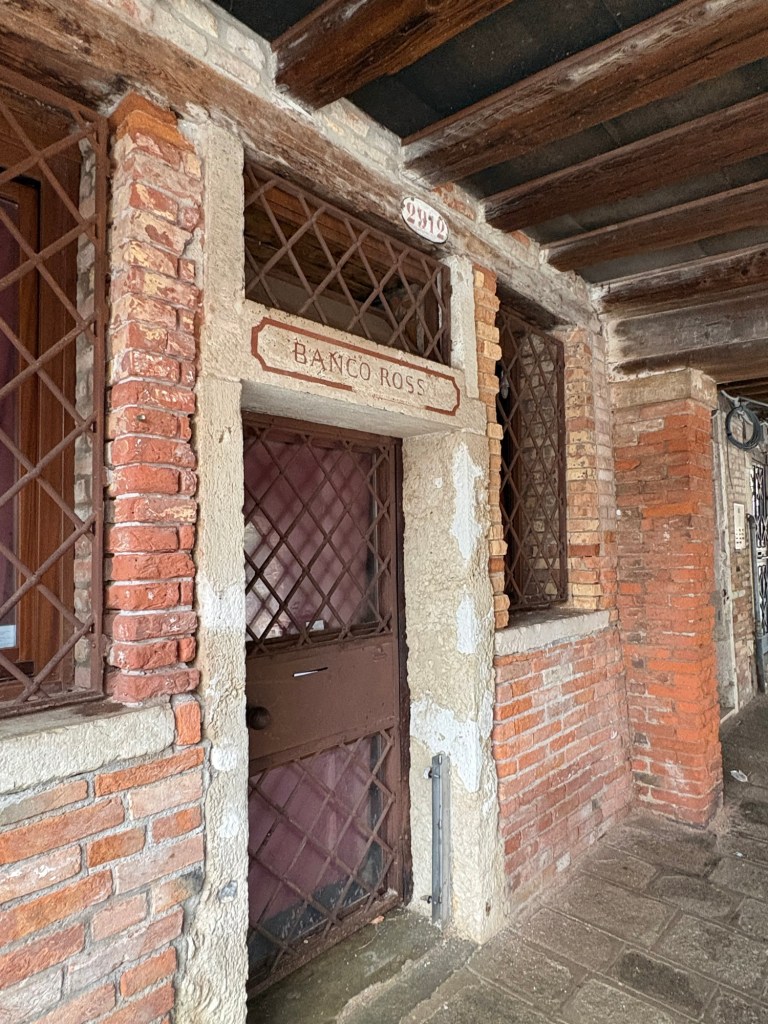
- An official Pawn Shop known as Banco Rosso – based in the Ghetto – this was a regulated pawn shop that offered cash advances in exchange for goods; jewellery, silver, bed linen. Customers received a red receipt to record their transactions – hence the name ‘Banco Rosso’. Once again any interest charged was subject to Venetian interest rates.
- Selling of second-hand goods ‘Strazzaria’ in Italian meaning ‘rag trade’ (literally)
- International and local commerce – especially for established Levantine and Sephardic merchants
- Medicine – practicing medicine both inside and outside the ghetto (with special permission) was allowed.
- Textile trade – buying, selling and dealing in fabrics, materials, cloth
- Tailoring, garment-making and seamstress activities
- Baking and kosher food preparation.
Restrictions:
- Property ownership by Jews was not permitted.
- Venetian landlords owned the properties that the Jews lived in. The Venetians controlled the rents.
- Jewish people had to live in the Ghetto, this meant tall buildings crammed into the ghetto with many floors.
- Population density was much higher per square foot in the Ghetto than elsewhere in Venice.
- At its peak the population in the Ghetto was 4-5000 people.
- Jewish people were permitted to leave the ghetto for work – during the day. By law they had to return before sunset.
- The gates of the Ghetto were locked at sunset and opened at sunrise.
However air flows freely and ideas float on the wind:
MUSIC IN THE AIR – In Venice the wind direction is most frequently from the north-east and the sound of music travels. Just 200 metres from the Ghetto was the Convent and Church of Sant’ Alvise. People living in the Ghetto would have heard the nuns singing and the sounds of their brand-new organ floating on the air into the ghetto. Choirs of voices and music would have poured from the doors and windows of the Misericordia – just 700 metres away. The Jews living in the ghetto would have heard this music. As the Jewish community became established in the Ghetto a Venetian composer called Benedetto Marcello (1686-1739), who was not Jewish, attended services at several of the Venetian synagogues. He was inspired by various melodies that he heard coming from the Ashkenazi and Sephardic traditions – he included them in one of his musical publications in 1724. Marcello was a younger contemporary of Vivaldi. I like to think that church music from Christian Venice blended with Cantorial singing from the synagogues to create the Baroque style of music pioneered by Vivaldi and later by Bach.
PRINTING AND BOOKS – By the 1550s Venice was one of the most important printing and publishing cities in Europe. The printing industry in Venice at its height had more than 200 presses operating in the city. Thanks to Daniel Bomberg, it was THE global capital of Hebrew printing. Daniel Bomberg (1483-1549) was a Christian printer he worked with rabbis, scholars and others in his Venetian publishing house. As more Jews arrived from different corners of Europe and the Eastern Mediterranean the demand for printed pamphlets, books and Jewish texts grew. Bomberg printed the first Rabbinic Bible (Mikraot Gedolot) and copies of the Babylonian Talmud and the Jerusalem Talmud. Printing and books represented knowledge and ideas. The more people read the more informed they became and ideas spread on the winds of the lagoon. Leon of Modena, an influential scholar and writer was born in Venice, he was from a respected French family who had migrated to Italy to escape persecution. Leon was a scholar and writer, for many years he was the ‘cantor’ or singer in the synagogue. Venetians would come to hear his sermons. His ‘History of Hebrew Rites’ was published in Venice by Giovanni de Paoli, printers, in 1621. Every time a pamphlet or book was published in Venice about Judaism it consolidated and deepened Venice’s special relationship with the Jews of the Ghetto.
PHILOSOPHY, INTELLECTUAL DISCUSSIONS – Sarra Copia Sullam (1588-1641) was the daughter of a wealthy Jewish family. She was highly educated and read widely. She hosted a literary salon from her home in the Ghetto. Writers and thinkers from Jewish and Christian backgrounds, from all over Venice, would attend her ‘salons’ to listen to and participate in the conversations and philosophical ideas being discussed. When criticised for her conversations and correspondence with men she wrote and published her own rebuttal, justifying her actions and her thoughts. Sarra Copia was one of the most respected Jewish women in Venice her ‘Manifesto’ of 1621 published by Giovanni Alberti was a serious accomplishment of the time.
MEDICINE – Jewish doctors were in demand throughout Venice. Nearby Padova University (part of the Venetian Republic) allowed Jews to study medicine and be awarded degrees. One of the most famous Jewish physicians was Solomon Conegliano (1642-1719). He received an under-graduate degree and a doctorate from Padova. After his studies he returned to Venice to teach medicine. Solomon was greatly respected and admired by the Venetian Senate, he and his brother Israel acted as envoys and diplomats for the Venetians in Constantinople. They were awarded full citizenship of Venice as a reward. One of Solomon’s students was Tobias Cohn, the author of an encyclopedia, printed in Venice in 1707 and reprinted many times. Cohn represents the body as a house, with various floors serving different purposes (below). Tobias Cohn (1652-1729) considered Solomon to be one of the greatest physicians and philosophers of his time.
EVERY DAY – Then there’s the other relationships, the every day human interactions that happen at the market, at the school gates, at the bakery. The Jewish seamstress who gets to know her wealthy aristocratic lady customer, as she pins and hems the lady’s latest ball gown. The Jewish doctor who saves the life of an eminent Venetian’s child, when all else has failed. The Jewish Baker who bakes bread for the poor family who live next door in Cannaregio. Simple daily interactions that unite communities and cross the barriers of religion and social standing; just straight forward human decency. Whatever the rules imposed by the Venetians, they couldn’t control the ideas and conversations floating on the breeze. Even the Hebrew pamphlets and booklets printed in the thousands by Venetian printers found their way into the drawing rooms of the palaces on the Grand Canal, introducing new ideas and different ways of thinking to the educated elite.
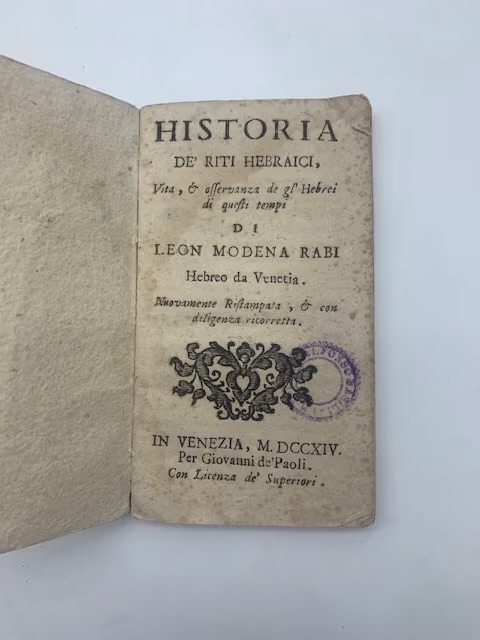
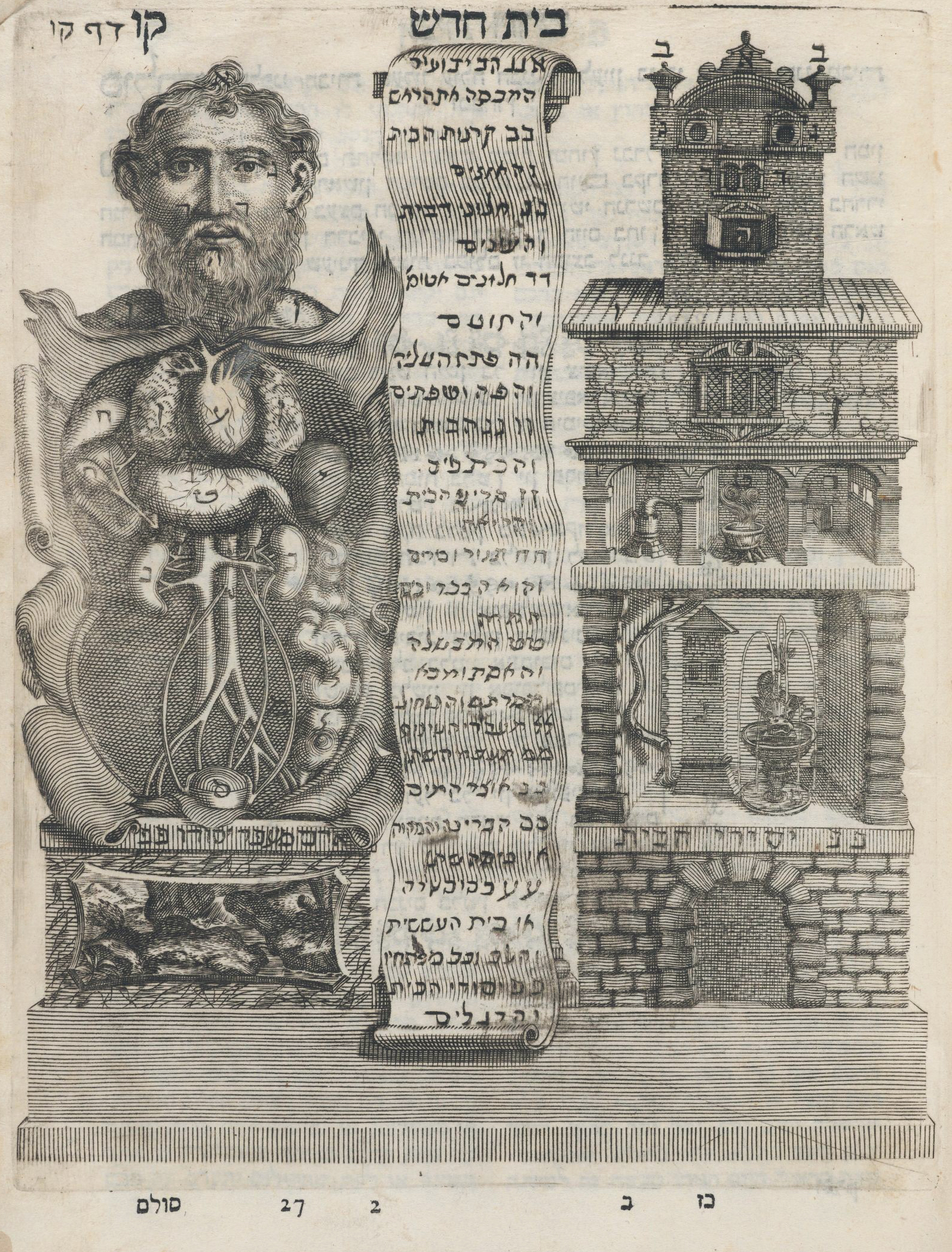
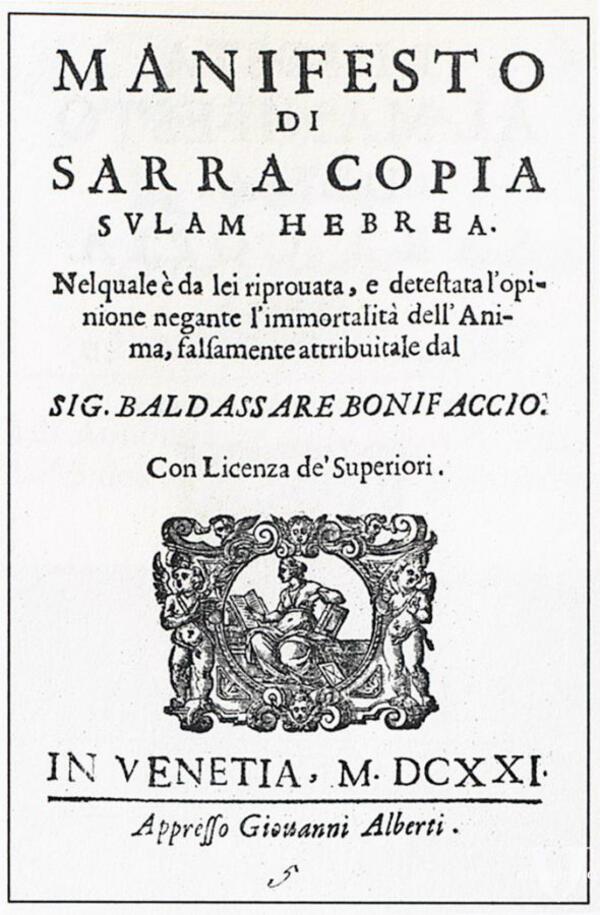
Leon of Modena – Jewish History (left), Tobias Cohn – The House of the Body, 1702 (centre), Sarra Copia’s Manifesto (right)
THE JEWISH community in Venice included writers, thinkers, teachers and doctors. Then there were the merchants, business owners and diplomats. These individuals were accomplished and successful. Over the years, little by little the Jews were assimilated into the fabric of Venice and many Venetians were eager to learn and share their culture and opinions. The Venetian composer Benedetto Marcello was inspired by Jewish chants in the synagogue. The Venetian Senators relied on Jewish envoys like Solomon and Israel Conegliano to represent them in Constantinople. I’m sure that Jewish writers in the Ghetto like Leon de Modena were impressed by the printers in Venice, for example Daniel Bomberg, who were prepared to print their Jewish texts. Venice had a special relationship with the Jewish population, it was nuanced and complicated and usually pragmatic. Several times the popes in Rome demanded that Jews be excluded from all areas of public life. The Venetians responded by watering down Rome’s demands or ignoring them completely. Venice was a trading city and Jewish merchants were vital to the economy of the Venetian Republic. In Venice business and commerce always came before religion – much to the annoyance of various popes.
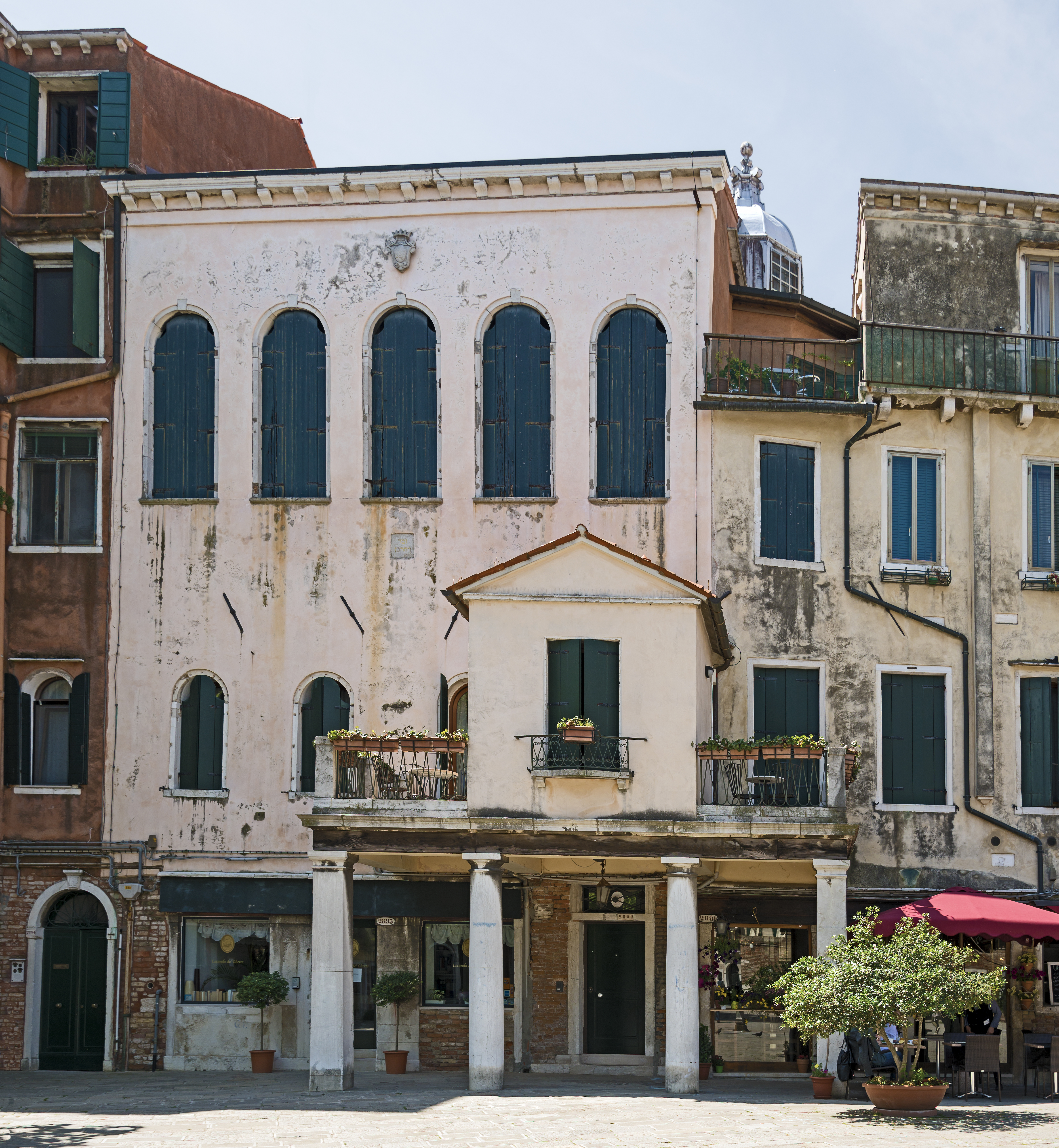
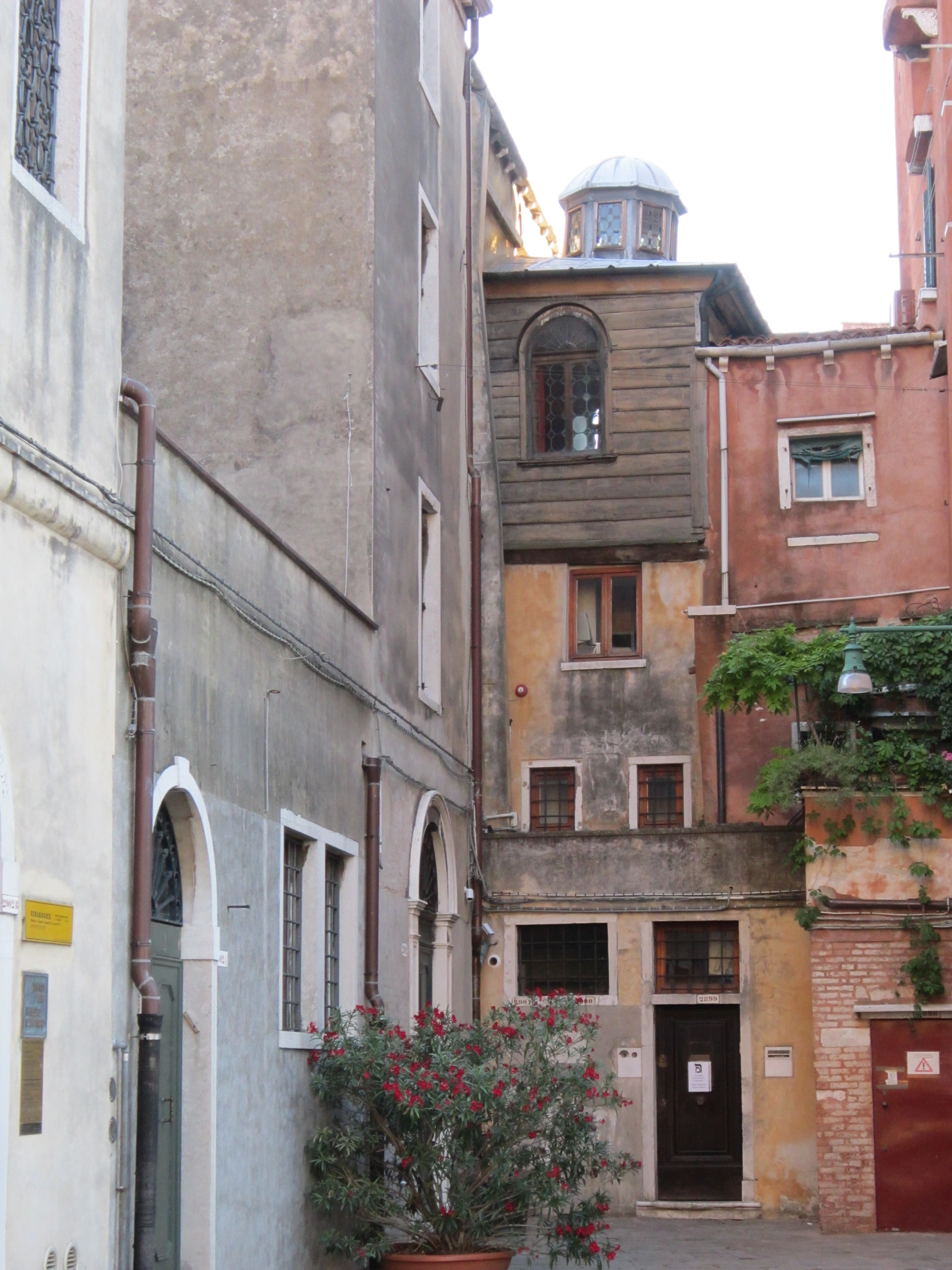
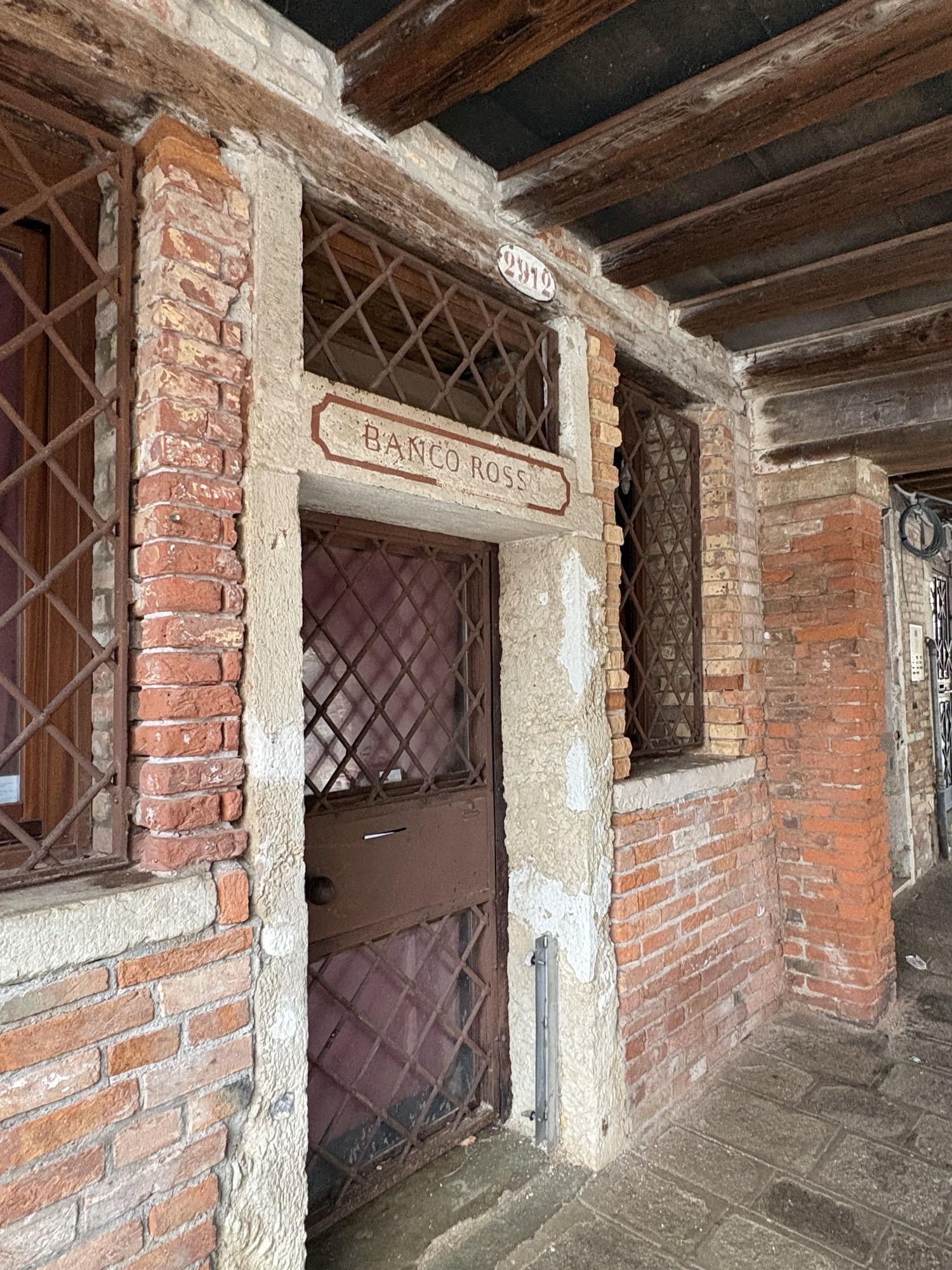
Italian Synagogue and Canton Synagogue – each with arched windows and Banco Rosso office
NAPOLEON – When Napoleon arrived in Venice in 1797 it was the end of an era. He dissolved the Venetian Republic which had existed for almost 1000 years and he organised the ‘opening’ of the Ghetto and the removal of the gates. The reality was that by 1797 far fewer Jewish people lived in the Ghetto – probably around 1500. Those that remained were mostly poor. Anyone who could afford it had already left, to move to other parts of Italy or further afield. However the abolition of the Ghetto meant the remaining inhabitants could live wherever they chose (or could afford) in Venice.
The nineteenth century was a period of change for Venice. The once mighty Venetian Republic was no more, Venice was part of the Austrian Empire and the port of Trieste, just 120 kms east of Venice and an Austrian territory for centuries boomed whilst Venice declined. Jews from Venice moved to Trieste where business opportunities were greater. In fact it wasn’t just Jews who moved to Trieste, Venetians too made the move. Pasquale Revoltella, born in Venice, moved as an infant with his family to Trieste in 1797 – when the Republic fell. Revoltella went on to become one of the most important entrepreneurs in the city of Trieste. Meanwhile, Venice and the Venetian Ghetto stagnated.
The early years of the twentieth century were tumultuous for Europe, The Great War of 1914-1918 and the poverty and depression of the 1920s and 30s created ideal conditions for the rise of Fascism. When Mussolini passed the ‘Race Laws’ in Italy in 1938 this was a disaster for the whole peninsular. In Venice many Jewish people left the city and headed to the mountains, often travelling under fake names. Others headed to the port cities of Genova and Marseille desperate to catch a transatlantic ship across the Atlantic. The situation was dire. It is estimated that around 1400 Jews lived in the Ghetto by 1939.
The story of Italian Jews in Italy in the Second World War is a tragic one. The Italians were instructed to deport Jews by their German Allies, however these instructions were rarely followed. It wasn’t until the second half of the war that German troops started to systematically round up and deport Italian Jews, mostly to Auschwitz. In Venice deportations of Jews from the Ghetto took place from November 1943 to August 1944. A total of 280 Jews were deported, mostly elderly people. This was a terrible national tragedy and remains a scar in the Venetian Ghetto to this day. The awful truth is that Jewish people were being put on trains, bound for the concentration camps in the final months of the Second World War. Allied forces were already marching north through Italy but it was too late for the Jewish families living in Ferrara and Modena and Venice.
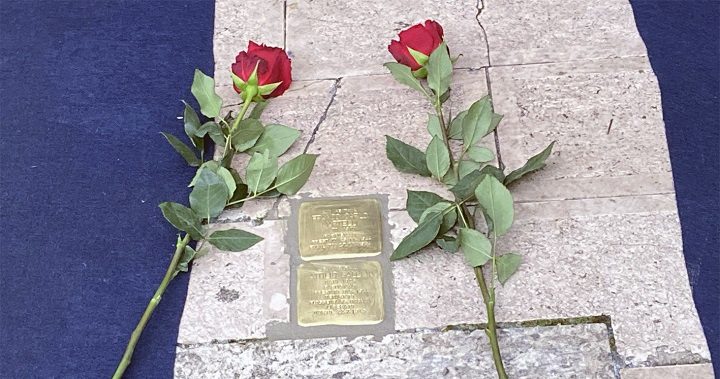
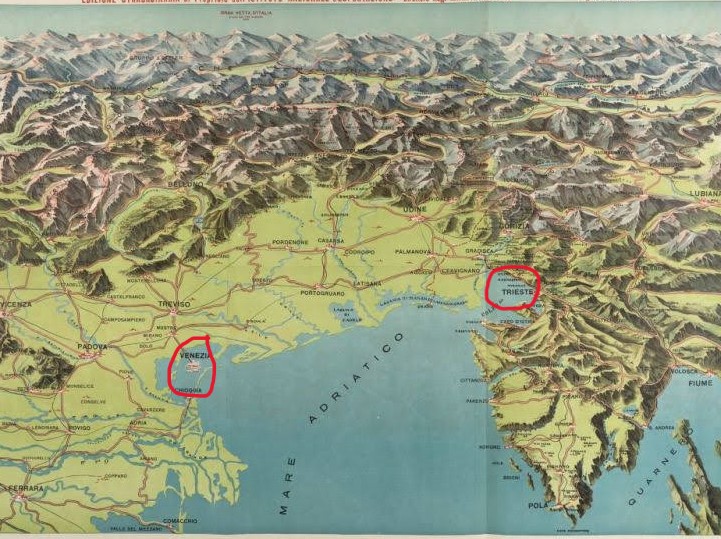
Stolpersteine, memorial stones (left) see article below. Relief Map of North-Eastern Italy (right), Venice and Trieste (circled)
TODAY – a very small number of Jewish people live in the ghetto, probably less than 100. However, the population of Jews in Venice and Mestre (terraferma) is about 500. Visitors to the Ghetto today will notice immediately a group of young Jewish men who have set up shop almost next door to the original ‘Banco Rosso’. They engage passers-by in conversation. These guys are part of Chabad, an Orthodox Hasidic Jewish movement with a deeply religious emphasis. Since 1940 Chabad’s international headquarters have been in Brooklyn, New York. The Chabad members in the Ghetto are keen to engage Jewish visitors and energise secular Jews in the faith. Ironically in the days of the Venetian Ghetto, Hasidic Jews did not live here.
THE BRAND NEW JEWISH MUSEUM has just opened in the Venetian Ghetto. It opened at the end of October, 2026. It’s been years in the making. The museum incorporates three synagogues and a selection of films, displays and information boards. It is quite an accomplishment. The main entrance is on Campo Nuovo next door to the Scuola Grande Tedesca (German Synagogue). At ground level there are films and information boards. Visitors then go upstairs to the second floor to access the German Synagogue. This was the the first synagogue to be established in the ghetto. It was built in 1528-9. The interior sanctuary is elliptical in shape and features an elliptical women’s gallery. It has been beautifully restored and is used occasionally for religious ceremonies. Next the visitor moves through several rooms and then up two more floors to access the Canton Synagogue. This was the synagogue built in the corner of Campo Nuovo, high above the square in 1531. Again it is a pleasure to see this place of worship integrated into the new museum. Visitors then proceed down several floors, through several rooms and then up several more floors to the Italian Synagogue (1555) with its Octagonal Cupola and impressive wooden carvings. I’d strongly recommend a visit next time you are in Venice.
VENICE’S relationship with the Jewish population over the centuries has been complicated. The Venetians demonstrated a mixture of pragmatic tolerance followed by sporadic enforcement of restrictive laws often dictated by Rome. However the Venetians were always independently-minded and they liked nothing better than to keep Rome and the popes at bay. From time to time Rome would demand that Venice restricted the activity of the Jewish population, Venice would respond by either ignoring the demands or rewriting them to remove the sting in the tail (much to the annoyance of Rome). The Venetians have always been creative thinkers and the dynamic Ghetto of the 16th and 17th centuries offered new ideas, discussions and debates that enriched the cultural life of Venice. This is the city that exerts a magnetic attraction to art lovers, history buffs, architects and lovers of literature. Venice is a city that was shaped by the waters of the lagoon and the wits of the Venetians. The Jewish population in the Ghetto played a key role in the city’s cultural development and should always be remembered and respected as a result.
Notes:
- In the 1990s the ‘stolpersteine’ project originated in Cologne, Germany. ‘Stolpersteine’ means stumble stone. It was the idea of Gunter Demnig – a German artist. The idea is to mark the last place a Jewish person lived, before they were removed by force during the Second World War. A brass plaque is placed in the pavement close to the home of a deported person. The idea has been very well supported in Italy. You’ll see these ‘stolpersteine’ in the Ghetto in Venice, in Rome and in Ferrara.
- I’ve written about the ‘stolpersteine’ here: A lasting memory – stolpersteine…
The brand new Jewish Museum in Venice is well worth a visit: www.museoebraicovenezia.it
- Related Reading – I’d strongly recommend ‘The Garden of the Finzi Contini’ ‘ a novel by Giorgio Bassani. It’s a lyrical tale of a group of young Jewish friends living in Ferrara, Italy in the 1930s. I’ve written about the book and its magical setting of Ferrara – perhaps start here with my article about The Jewish Cemetery: Ferrara – The Jewish Cemetery
Popular articles from The Educated Traveller blog:
- History of the Grand Tour
- The Medici – Art, Power and Politics…..
- Venice – there’s treasure in every church
- The origin of Jewish names: Many Jewish families took the name of the city in Italy where they first arrived. For example: The Bassano Family (Jewish Musicians) made their way to England and the Court of Henry VIII in the 1530s (from Bassano, Italy). Then there’s Leon di Modena (family originally settled in Modena) then they moved to Venice.
- Lastly – The House of the Body (pictured in the article above) is an allegorical design comparing the organs of the body to the divisions of a house, from Tobias Cohn’s Ma’aseh Toviyyah (1708) – Houghton Library, Harvard
Further reading / information:
- www.savevenice.org – for charitable and restoration projects in Venice
- www.ghettovenezia.com – for general information on Venice Ghetto
- www.jwa.org – The Jewish Women’s Archive – fantastic historical resource.
- www.educated-traveller.com – tales from Italy, The Alps, Mediterranean by Janet Simmonds
A NOTE ON THE AUTHOR – Janet Simmonds writes about history, geography and art in Italy, The Alps and Mediterranean. Janet is an Art Historian and a Geographer. A graduate of the University of Oxford, she has a special interest in Venice and the history and art of the city – especially The Grand Tour era. She works as a guest lecturer in Italy for university groups and private individuals. She works in Venice, Oxford and London.
Janet also runs a specialist travel company www.grand-tourist.com offering exceptional journeys in Italy, Greece, Turkiye and British Isles.

November 2026


Ps hope you realised the typo? “Average” should have read “avid” – damned predictive text!!
Sent from Outlook for iOShttps://aka.ms/o0ukef ________________________________
LikeLike
Hi, Janet
I’m currently sitting in a cardiac rehabilitation Ward in Leeds General infirmary, where I am just waiting for Margaret to collect me after an unplanned short sojourn Following an equally unplanned heart attack last Tuesday – All I needed, in view of somewhat hectic Pre-Christmas social program lined up for the next few weeks!
However, my purpose in writing to you now is not so much to elicit your sympathy as to invite you to bask in the admiration and gratitude of one of your most average readers and fans And to accept yet another bouquet for your truly brilliant and fascinating article on the Jewish Ghetto. I think it is one of your – correction, THE – most brilliant And fascinating articles on a topic which has been always one of all consuming interest to Margaret and me. Beautifully written, informative and educational and a gripping read – perfect recuperation activity!! At which point, Margaret has literally just arrived a minute ago, in order to ensure my official discharge and return home, so I had better comply with instructions, but will look forward to picking up with you again in due course.
In the meantime, all best wishes from both of us. Love, John
Sent from Outlook for iOShttps://aka.ms/o0ukef ________________________________
LikeLike