The Sanctuary of Fortuna at Palestrina
About an hour to the east of Rome is the small town of Palestrina, it was known as Praeneste in Roman and pre-Roman times. The Sanctuary here was dedicated to Fortuna Primigenia – the god or goddess of first born children. Newly born infants were brought here to be blessed in the hope that they would be strong and healthy and survive into adulthood.
Today this small town in the foothills of the Appennini Mountains is home to one of the largest and best preserved sanctuary temples in the Roman world. The site consists of a vast series of terraces rising up the hillside. It was here that the Latini people and later the Romans came to worship their gods. Important people including military leaders, soldiers, politicians and diplomats would make the journey from Rome to Praeneste to seek the advice and wisdom of the gods. The site is similar to Delphi in Greece, where Greek citizens would travel to the Temple of Apollo to ask the advice of the oracle. Here at Praeneste the wisdom of the god Fortuna Primigenia was requested.
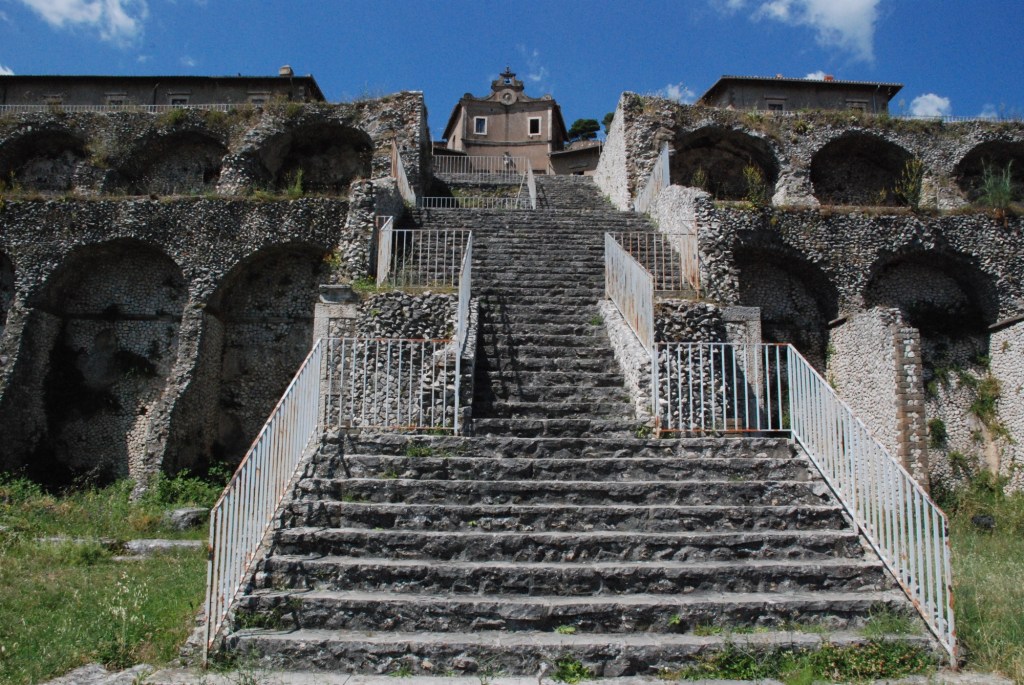
A veritable stairway to heaven – looking up from the lower terraces www.educated-traveller.com
Praeneste was a place of worship and a Sanctuary dedicated to the god Fortuna Primigenia. It was the largest and most important in Ancient Rome. The site was made up of a series of eight terraces excavated from the hillside with a dominant location visible for miles across the Roman countryside. The heart of the sanctuary was a grotto or cave fed by a natural spring it was here that visitors came to ask the gods for wisdom and inspiration. It was also here that an exceptional floor mosaic was found depicting the River Nile flowing from its source in the Ethiopian highlands to the Mediterranean Sea. The mosaic, originally a floor decoration in the Sanctuary gets a mention by Pliny in his ‘Natural History’. According to Pliny the military commander Sulla commissioned the Palestrina mosaic around 100 BCE. Pliny referred to the mosaic as the ‘lithostratum’. We now know that the River Nile mosaic was one of a pair of mosaics. The second mosaic, known as ‘The Fish Mosaic’ remains in situ in the cave and is in a very poor state of repair.
Reconstructions of the temple complex (below) show the monumental scale of this incredible site. For context, Palestrina is about 20 miles south of Tivoli, and 30 miles east of Rome, it is located at the point where the plains of Lazio meet the foothills of the mountains. Here there was always a water supply, the crucial element in Rome’s development.
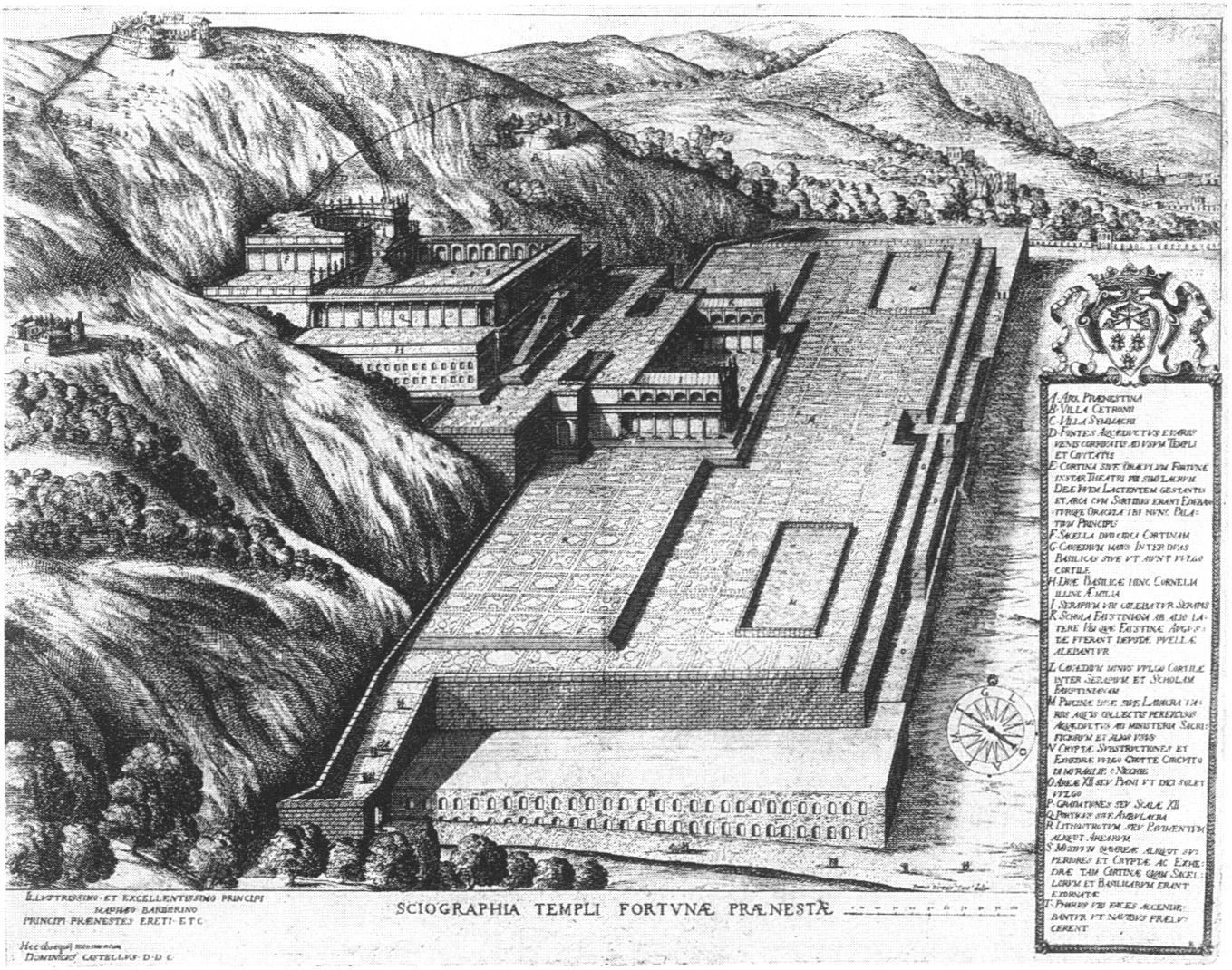
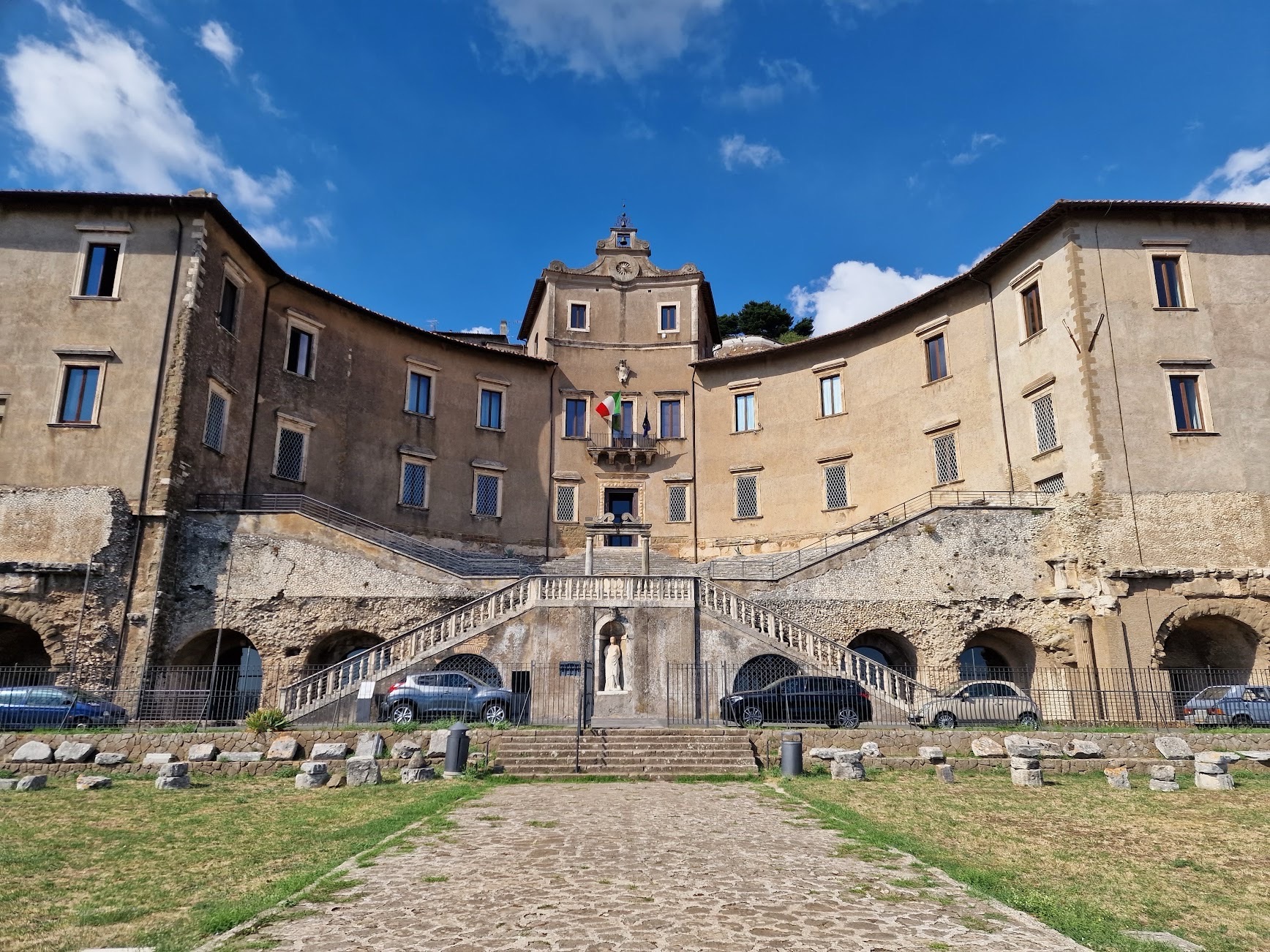
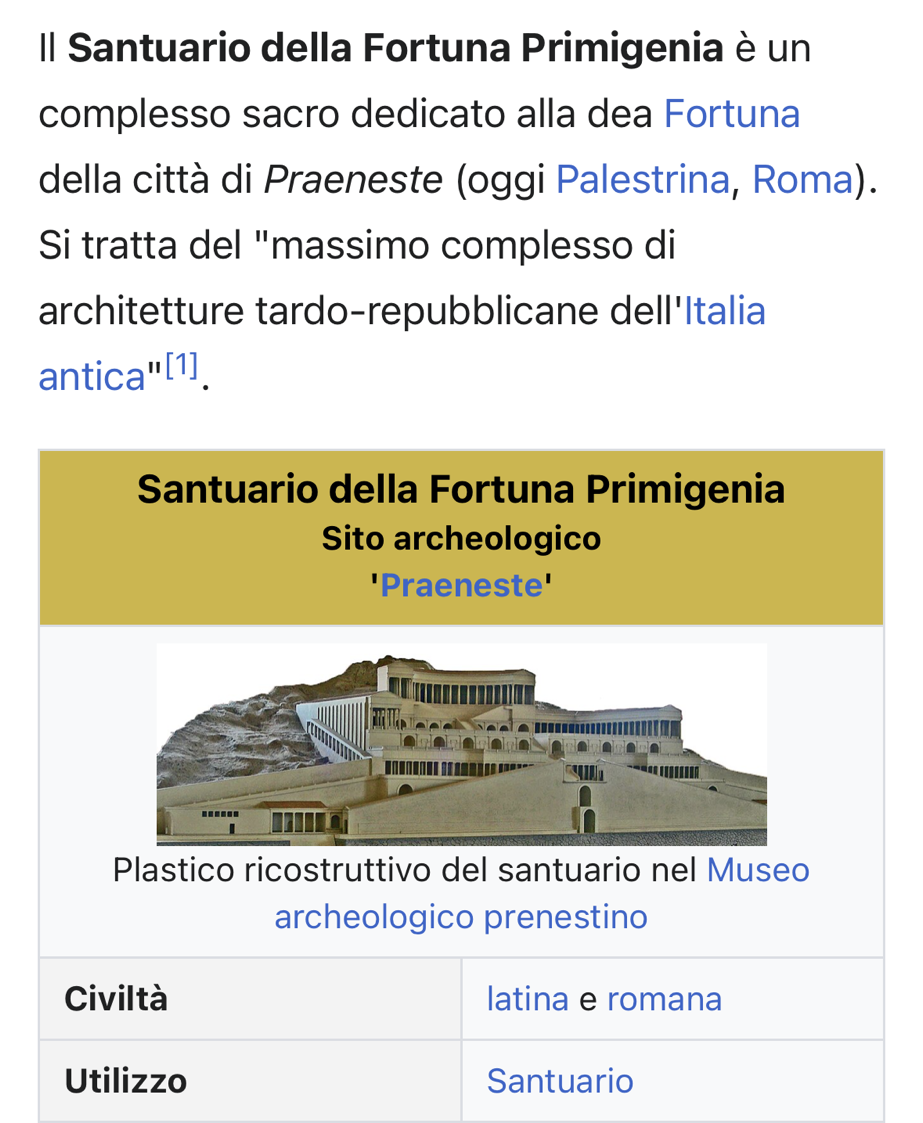
Above left – JM Suarez (1655) Praenestes antiquae libri duo (Rome) etching by Domenico Castelli. Centre Palazzo Barberini Colonna. Right – model of sanctuary site (Museo Archeologico Prenestino)
THE NILE MOSAIC – the Nile Mosaic was mentioned by Pliny in his ‘Natural History’ so we know that the mosaic was ‘known’ by Romans before the eruption of Vesuvius in 79AD. The Mosaic was then ‘rediscovered’ centuries later, in the early 1600s by Federico Cesi. Cesi had married into the wealthy Colonna family from Rome and the Colonna family were the landlords and owners of the town of Palestrina. They’d built a luxurious palace on top of the ruins of the Sanctuary and ‘found’ the Nile Mosaic in the process. In terms of an architectural palimpsest you can’t do better than Palestrina. A pre-Roman sanctuary, that later became a Roman sanctuary and then centuries later the imposing site is used by the Colonna family to build a vast renaissance villa.
The extensive and imposing Roman sanctuary site was probably abandoned in the 4th Century AD when Christianity became the official religion of the Roman Empire and paganism was looked down upon. At that time stone from the temple site was reused in the construction of newer buildings. Consequently the foundations of the Colonna Palace are effectively the sanctuary stones reused. When visitors arrive in Palestrina today the first thing you notice is a very grand renaissance palace, built, quite literally on top of the terraced sanctuary site. An amazing feat of engineering and a complete disregard for what had gone before.
The Nile Mosaic itself has had a tumultuous journey; rediscovered in the early 1600s, sold to Cardinal Andrea Peretti in 1624, it was ripped up from the sanctuary floor, broken into pieces and moved to Rome. When it was transported to Rome it was damaged in the process. This was the renaissance equivalent of looting. Then in the 1640s one of the Barberini family married into the Colonna family and acquired Palazzo Colonna. He moved the mosaic back to Palestrina, damaging the mosaic yet again in the move. Poor old Palestrina, during the Second World War this beautiful historic town was bombed and the destruction of houses revealed more of the Roman sanctuary (perhaps a good thing)! Since 1953 the Nile Mosaic has been displayed, very beautifully, on the top floor of the Barberini Colonna Palace, which is now The Archaeological Museum of Palestrina. The mosaic has been reassembled and restored – very sympathetically actually. If we compare the Nile Mosaic’s fate with the sister mosaic of ‘The Fish’ which remained in its original location then actually the Nile Mosaic was fortunate. The Fish Mosaic is in very poor condition, the colours are faded, large parts of the mosaic have disappeared. For years the floor of the Sanctuary was used as a lime kiln and the damage to the mosaic was extensive.
However first let’s talk about the Nile Mosaic or if you want to be ridiculously pretentious let’s call it the ‘Mosaico Nilotico’.
The Nile Mosaic is vast, it measures about 4 metres by 6 metres and was the decorated floor of the Roman Sanctuary dedicated to the god Fortuna Primigenia. It is the earliest example of a Roman mosaic depicting a ‘Nilotic’ scene. Nilotic is a fancy way of saying ‘about the River Nile’. Scholars believe it is the mosaic referred to by Pliny the Elder in his ‘Natural History’ as the lithostratum. According to Pliny the military commander Sulla commissioned the Palestrina mosaic around 100 BCE. So that puts the mosaic at about 2100 years old. A detailed and colourful mosaic, created two millenia ago.
The mosaic provides a vivid, top-to-bottom view of Egypt during the Nile flood, moving from the upper Nile in Ethiopia/Nubia, teeming with exotic animals, to lower Egypt, featuring a busy, detailed, and civilized landscape filled with temples, reed boats, and Greek-style soldiers. It is believed that the mosaic was created by craftsmen from Alexandria in Egypt. It is made up of at least 4 million tesserae (tiny tiles) each one about a fingernail in size. The mosaic is displayed on a slightly inclined wall in a room at the top of the Colonna Palace. It consists of a series of vignettes telling stories about life on the River Nile. The mosaic is richly detailed, filled with animals, people, rocky outcrops, temples and reed houses.
In the photo showing an arched gazebo (below) there’s a group of people enjoying a party, complete with a musician playing a lyre and three diners, reclining on sofas. Each of the characters has a mug in hand, probably wine. Above them bunches of grapes hang from the ceiling. The arch is covered in leaves and vines offering shade to the party guests. The trellis is very realistic, it looks like bamboo, stretched and bent to make an elegant arch. Surrounding the diners are various fishermen in reed boats, the scene is one of industry and productivity, these boatmen are going about their daily work in the bountiful waters of the River Nile. It’s important that we remind ourselves here that we are looking at a mosaic created at least two thousand years ago. We know that craftsmen from Alexandria, Egypt created this Nile mosaic, perhaps the party is a reference to Plato’s ‘Symposium’ an essay discussing philosophy, eloquence, beauty and platonic love.
The detail in the Nile Mosaic is quite exceptional. It’s worth spending a bit of time looking at the details below, especially the reed hut with the stork-like birds sitting on the roof. Then there’s the soldiers outside the temple, celebrating a victory perhaps. Their shields and weapons piled up on a table whilst they enjoy themselves. Throughout the mosaic life is being lived, this is not a static panorama, quite the opposite. The Nile mosaic offers the viewer a glimpse into life on the River Nile two millennia ago. In terms of information and detail this is probably the most important large mosaic surviving in the Italian peninsula today.
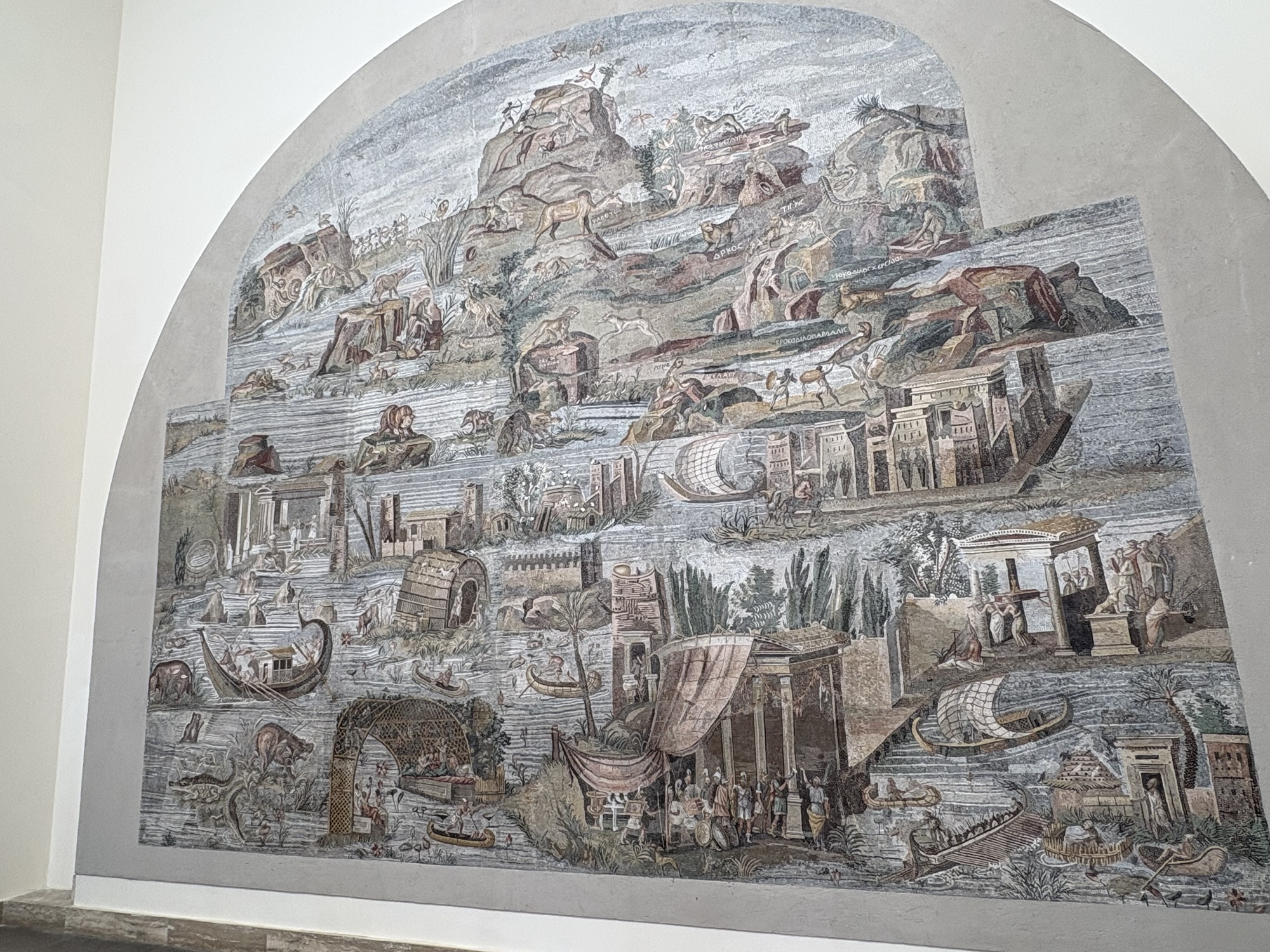
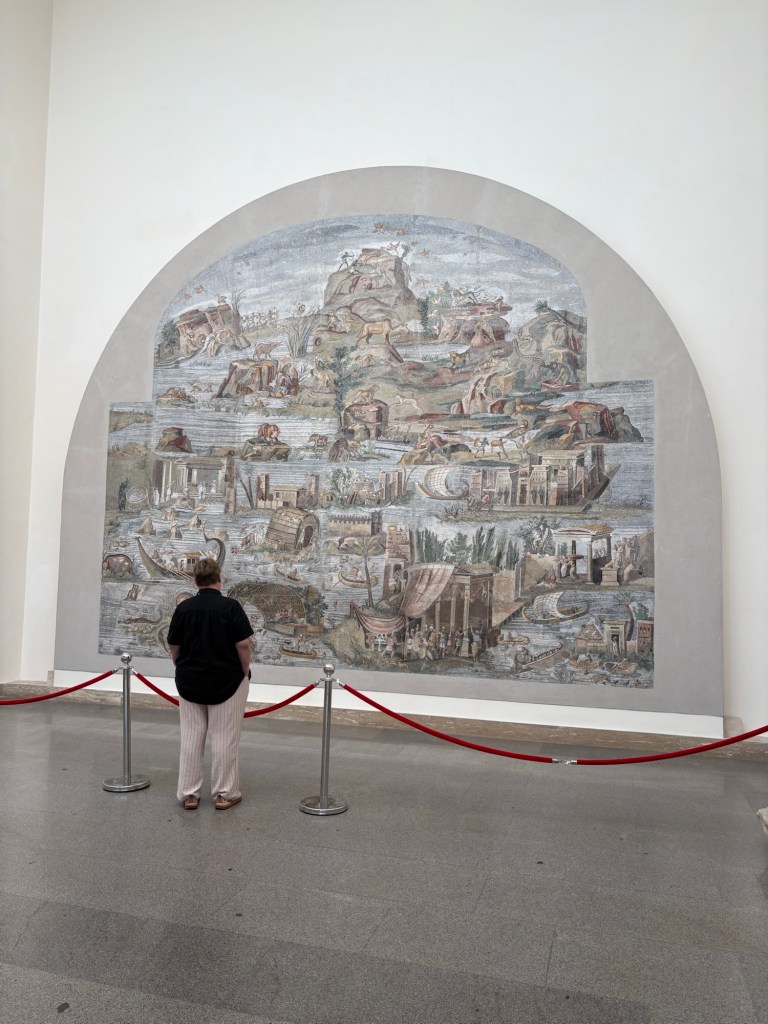
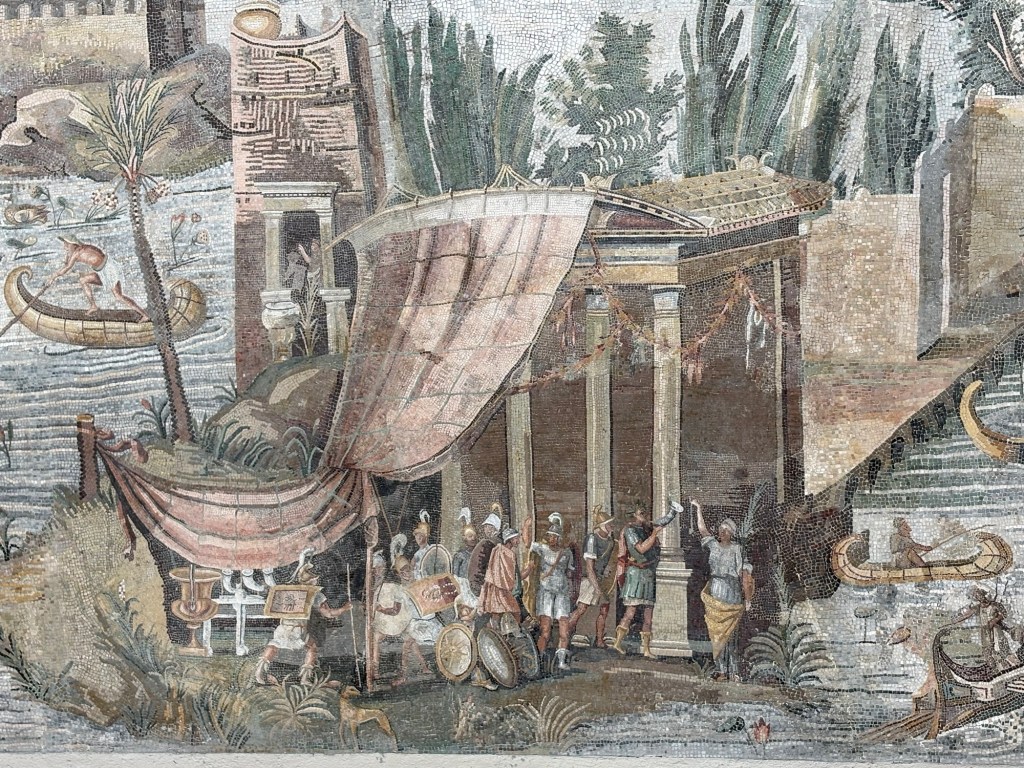
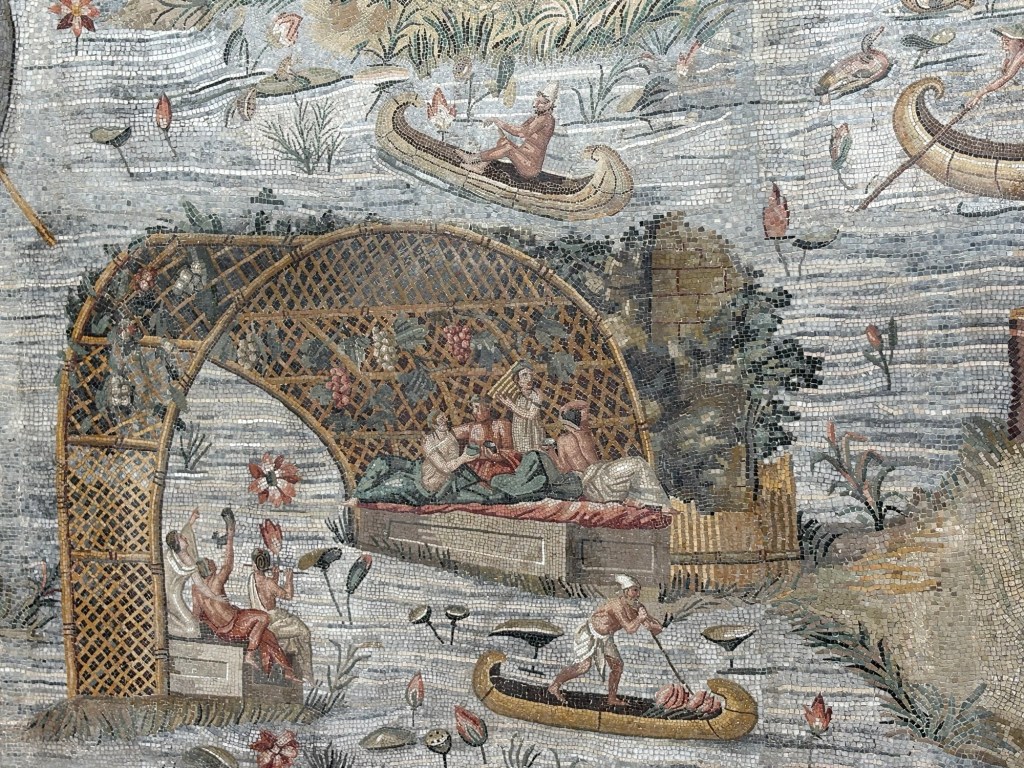
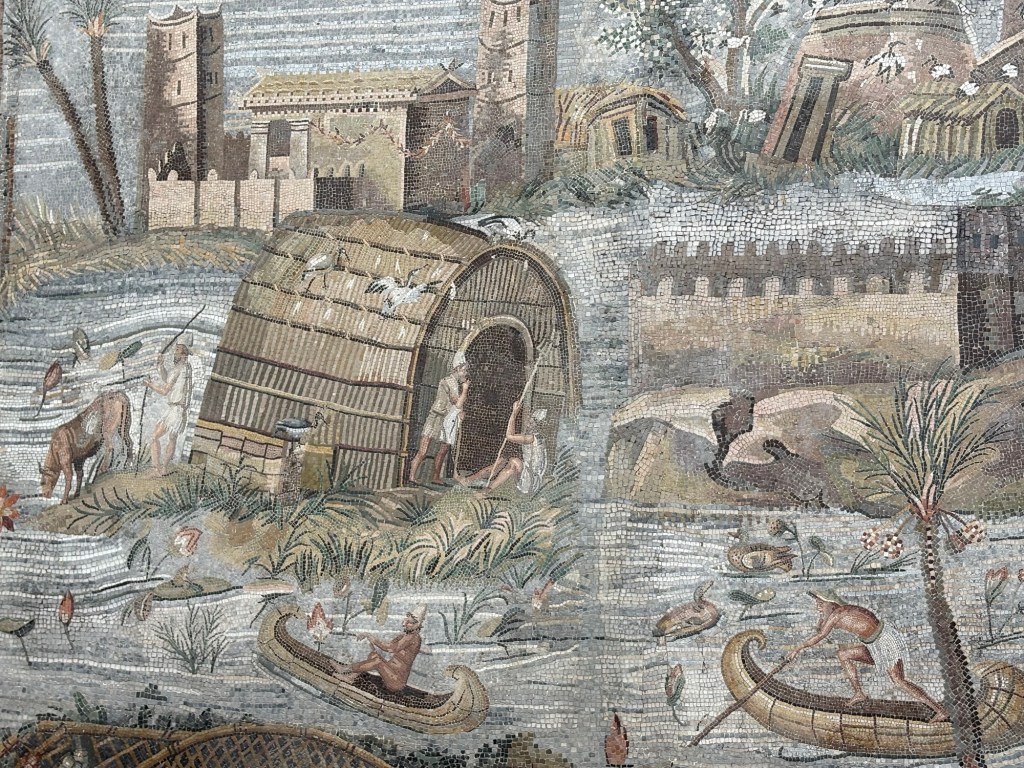
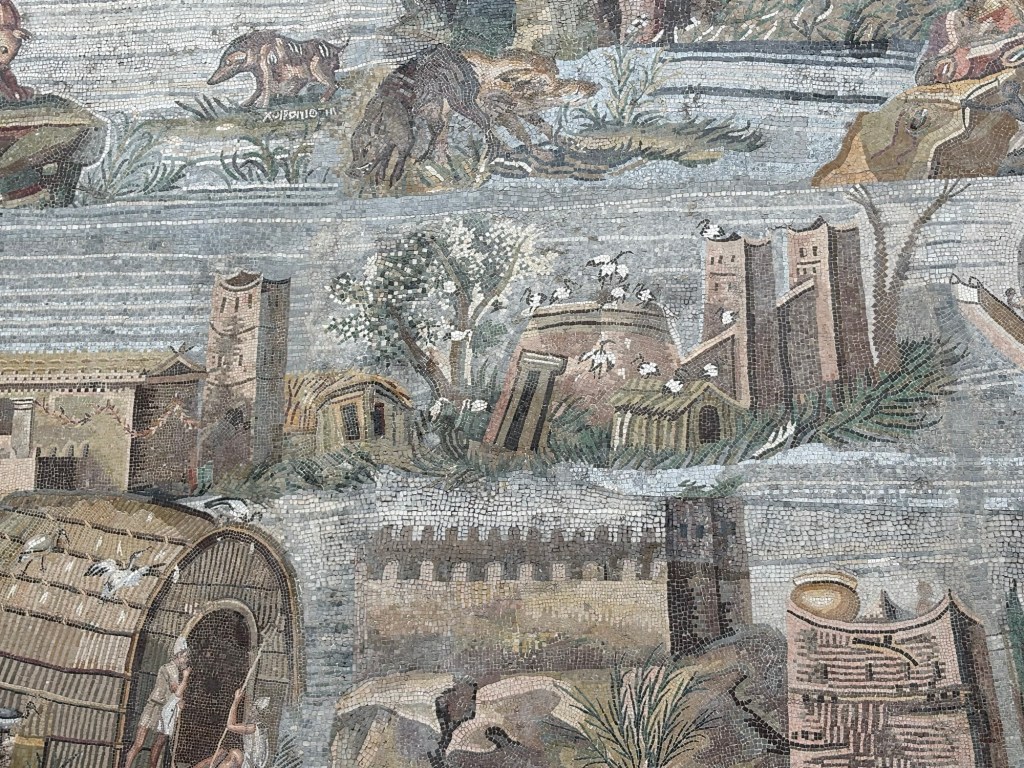
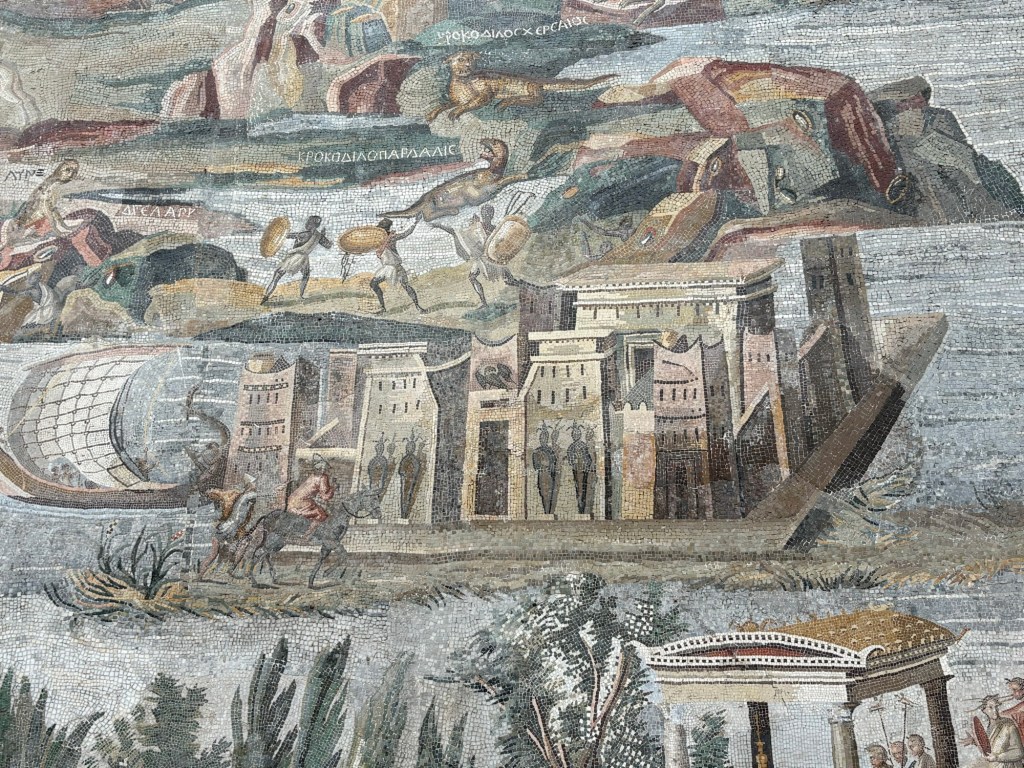
The Nile Mosaic ‘Mosaico Nilotic’ a Palestrina – photos www.educated-traveller.com
DIVINATION – The Latin and then Roman town of Palestrina found itself at the centre of Roman spiritual life when it came to consulting the gods. Just like the Greek sanctuary of Delphi, in Greece, eminent citizens would make their way to Palestrina to ask the opinion of the gods. I can imagine crossing the threshold into the sanctuary area of the temple, with the Nile Mosaic under my feet and the natural stream bubbling up from the hillside, flooding the area from time to time, this would have been a humbling and atmospheric experience.
So how did visitors to the Sanctuary of Fortuna Primigenia get the advice of the gods – well it was a fairly convoluted process. It involved the so-called ‘Lots of Praeneste’ or ‘Sortes Praenestinae‘ which were inscribed wooden tablets used for communicating with the gods. This process of communicating with the gods was known as divination.
According to legend a local nobleman called Numerius Suffustius had a dream, he was told to split open a huge flint rock with an axe. He followed the instruction in the dream, split open a large flint rock and when he did a collection of engraved wooden tablets miraculously fell from inside the rock. I wonder if they had little legs like cartoon characters. The tablets were kept in a special chest made of olive wood. The chest was kept in a very special and very sacred well within the temple complex. When a visitor came to the temple to ask an important question of the gods, one of the wooden tablets was drawn randomly (by a young child – signifying innocence) the message on the wooden tablet was then interpreted by the guardians of the temple to give the visitor an answer to his or her question. Flawless I’d say, a foolproof strategy, a perfectly theatrical solution to a pressing question. To go to fight the battle? Or to stay at home? What to do? I wonder how visitors felt as they headed back to Rome – justified, exonerated or perhaps just plain confused? Whatever the answer, the oracle continued to operate and remained highly popular well into the 4th century CE when the Christian church started to ban pagan cults. Sound familiar?
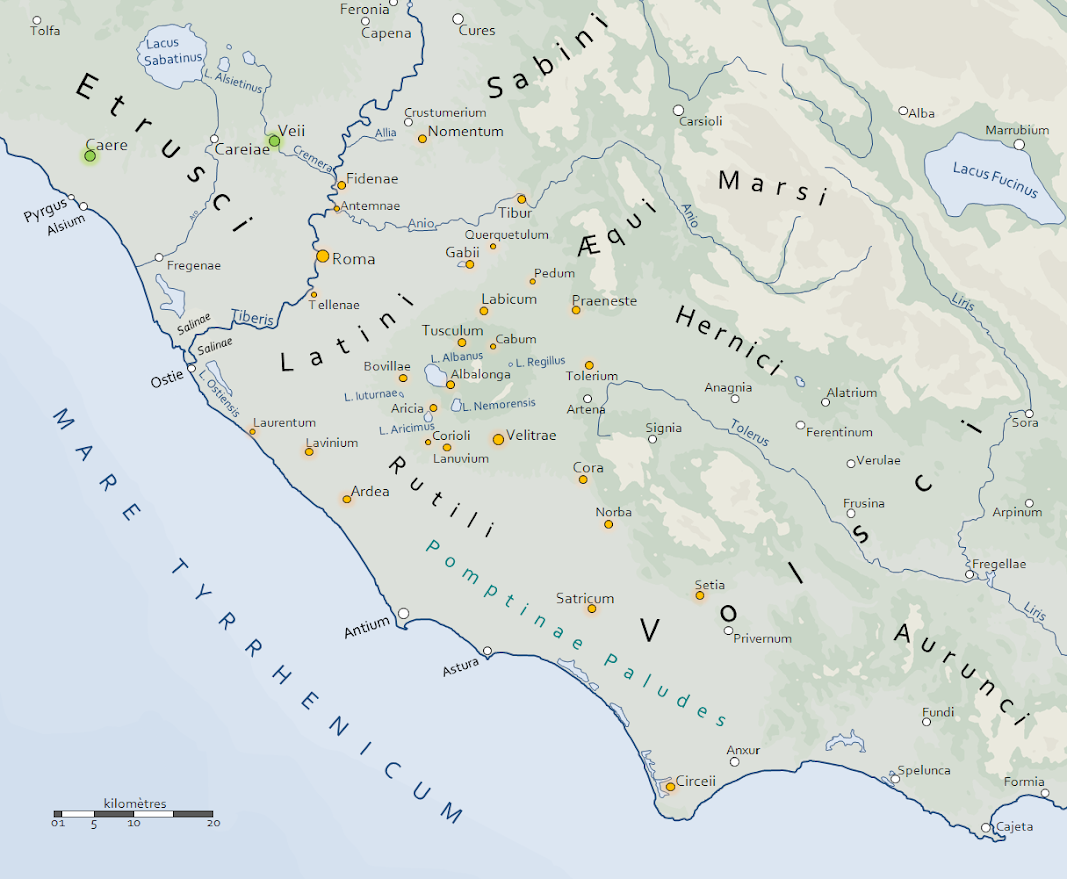
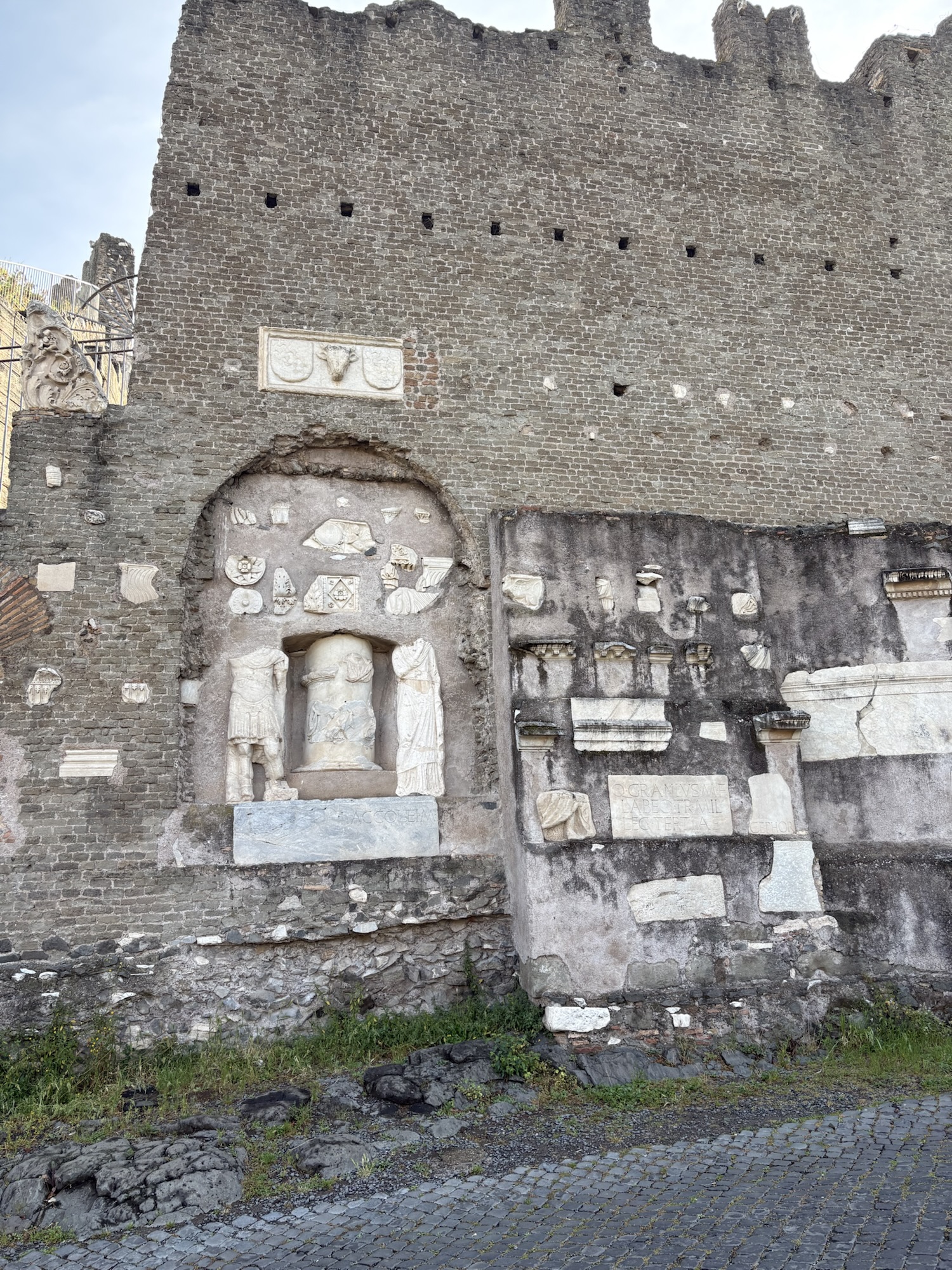
The map shows Latinum, Praeneste just north of centre (on map). Right – Renaissance recycling of Roman masonry.
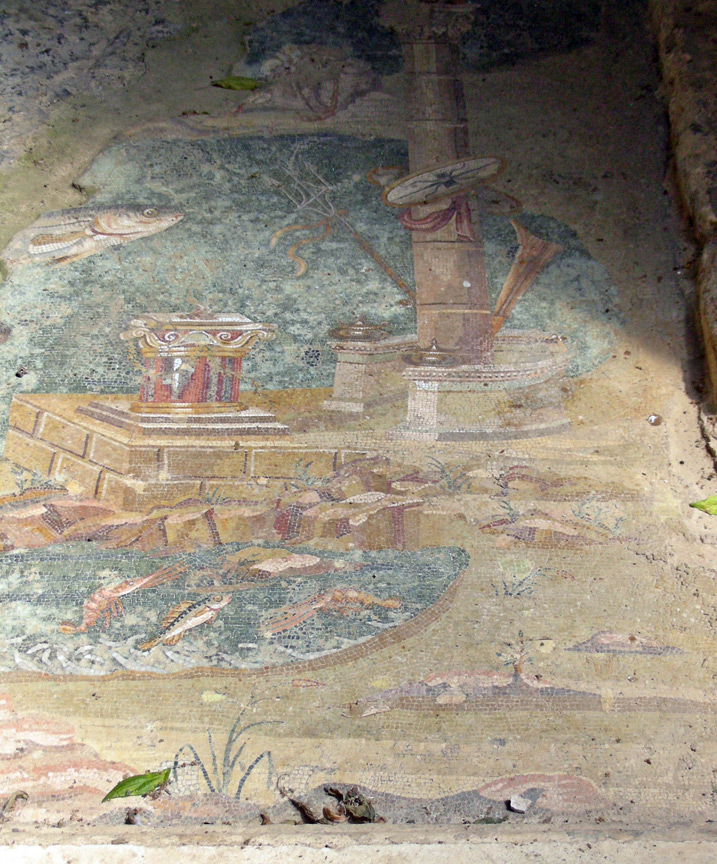
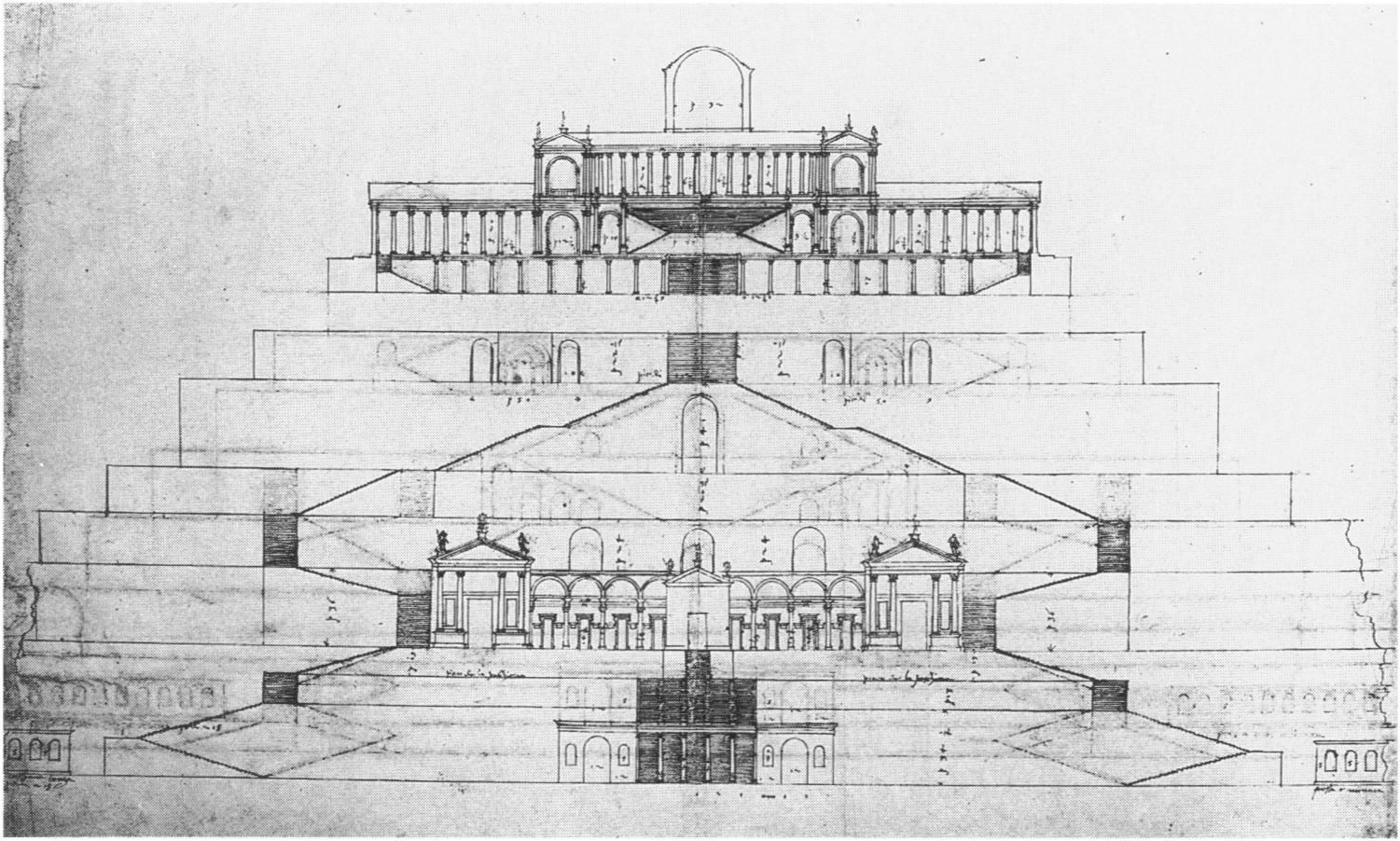
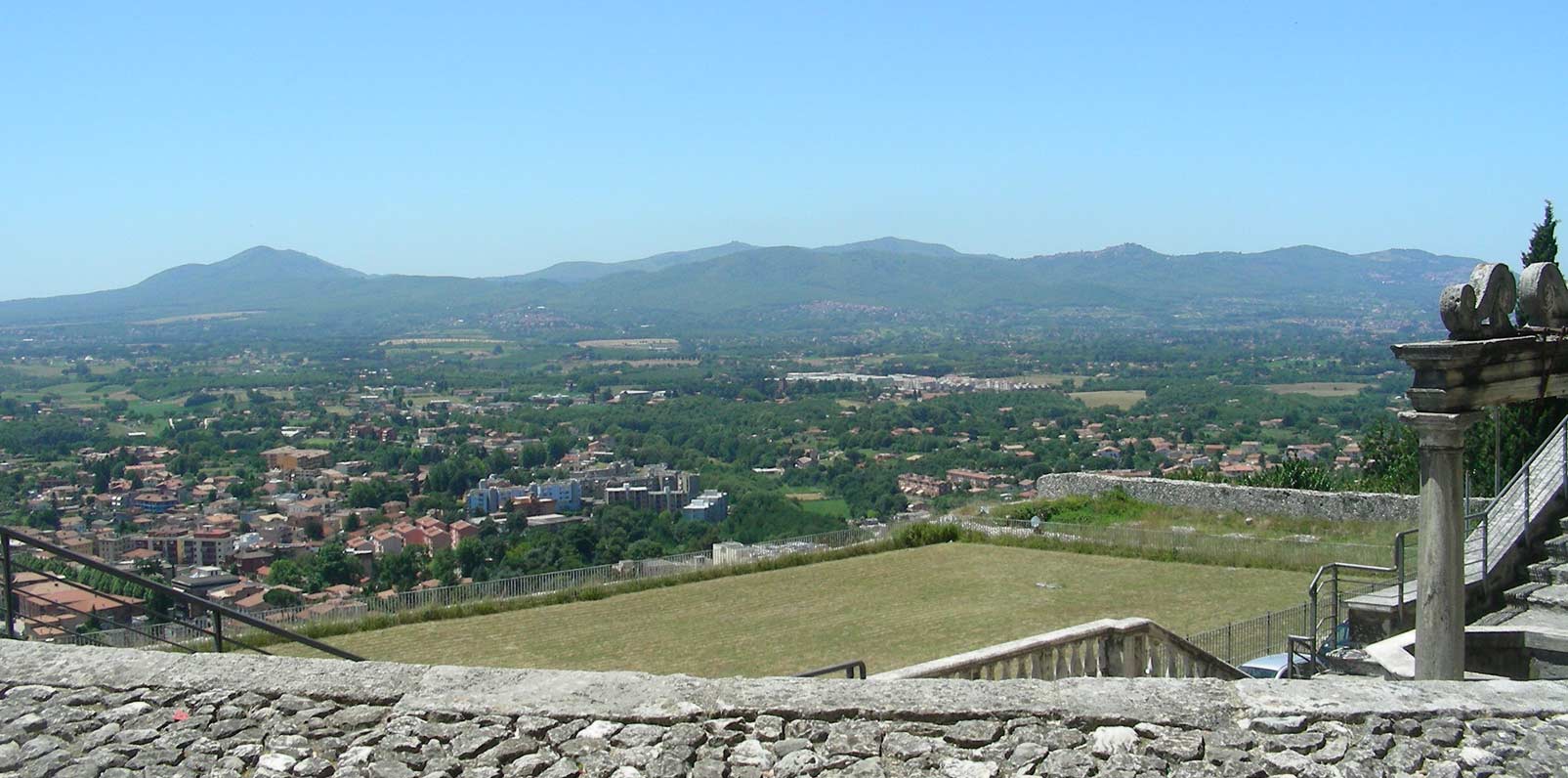
Fish Mosaic (detail) on left. Andrea Palladio sketches of Sanctuary – 16th C (RIBA, London) + right Colli Albani, Roma
JUST north of Palestrina in the little town of Tivoli (Tibur in Roman times) the Temple of Vesta was built on a ‘Greek style rotonda plan’ around the same time as the Roman sanctuary of Palestrina. The temple at Tivoli was built on a rocky outcrop high above the waterfalls on the River Aniene. It seems to me that the main theme here is water. The towns of Palestrina and Tivoli had natural springs and streams tumbling down the hillside feeding the towns and their inhabitants with a constant supply of fresh, clean, mountain water. It was these streams that were exploited by the Romans when they built their elaborate system of aqueducts, bringing water from the mountains into the heart of Rome. Both sites were important spiritual centres for the Etruscans and the Latini people long before the Romans came along.
Then in the Renaissance period – the cardinals from Rome were falling over themselves to build the biggest, best and grandest of country houses in the hills just outside Rome. The Colonna and Barberini families built and extended their country house at Palestrina, incorporating the Roman sanctuary into the foundations of their 16th century palace. The Colonna-Barberini Palace site is extraordinary – a classical renaissance palace planted on top of a vast Roman sanctuary creating a perfect architectural palimpsest. Even the architect Andrea Palladio came here in the 1540s and sketched the site in detail (photo above) trying to work out the extent of the Roman remains. Visiting the palace today is still an extraordinary experience. The basement of the palace is one of the terraces from the Roman sanctuary. The higher floors incorporate the curved natural grotto (nymphaeum) that would have contained a fountain. The disregard for the Roman site beneath the palace was complete. Since 1953 the palace has been operating as the Archaeological Museum with the Nile Mosaic displayed on the top floor.
MEANWHILE – back in Tivoli in the 1560s Cardinal Ippolito d’Este was building his spectacular country villa surrounded by terraces and thousands of fountains. The gardens were developed by Pirro Ligorio an architect, historian and antiquarian. Ligorio studied the Sanctuary of Fortuna at Palestrina in detail and incorporated aspects of the design into the gardens at Villa d’Este and the Belvedere Terrace at the Vatican. The gardens were built over a decade and featured innovative hydraulic pumps that moved the water from the bottom terraces to the top terraces with an ingenious system of water-powered pumps and holding tanks. Today Villa d’Este is a UNESCO world heritage site.
By the 18th century Palestrina and Tivoli were important places to visit for the Grand Tourists. The waterfalls at Tivoli and the Roman Sanctuary at Palestrina were visited by numerous travellers including Lord Burlington, Goethe, Piranesi, JMW Turner, John Soane and later Henry James. These people were the arbiters of taste in the drawing rooms of Europe. Through their writing and painting they described a Roman and Renaissance world to an audience of readers in London, Paris and Berlin dreaming of the sunny, history-filled countryside of Italy. The Grand Tourists invented tourism and embraced the idea of travelling to appreciate and enjoy other cultures and different landscapes.
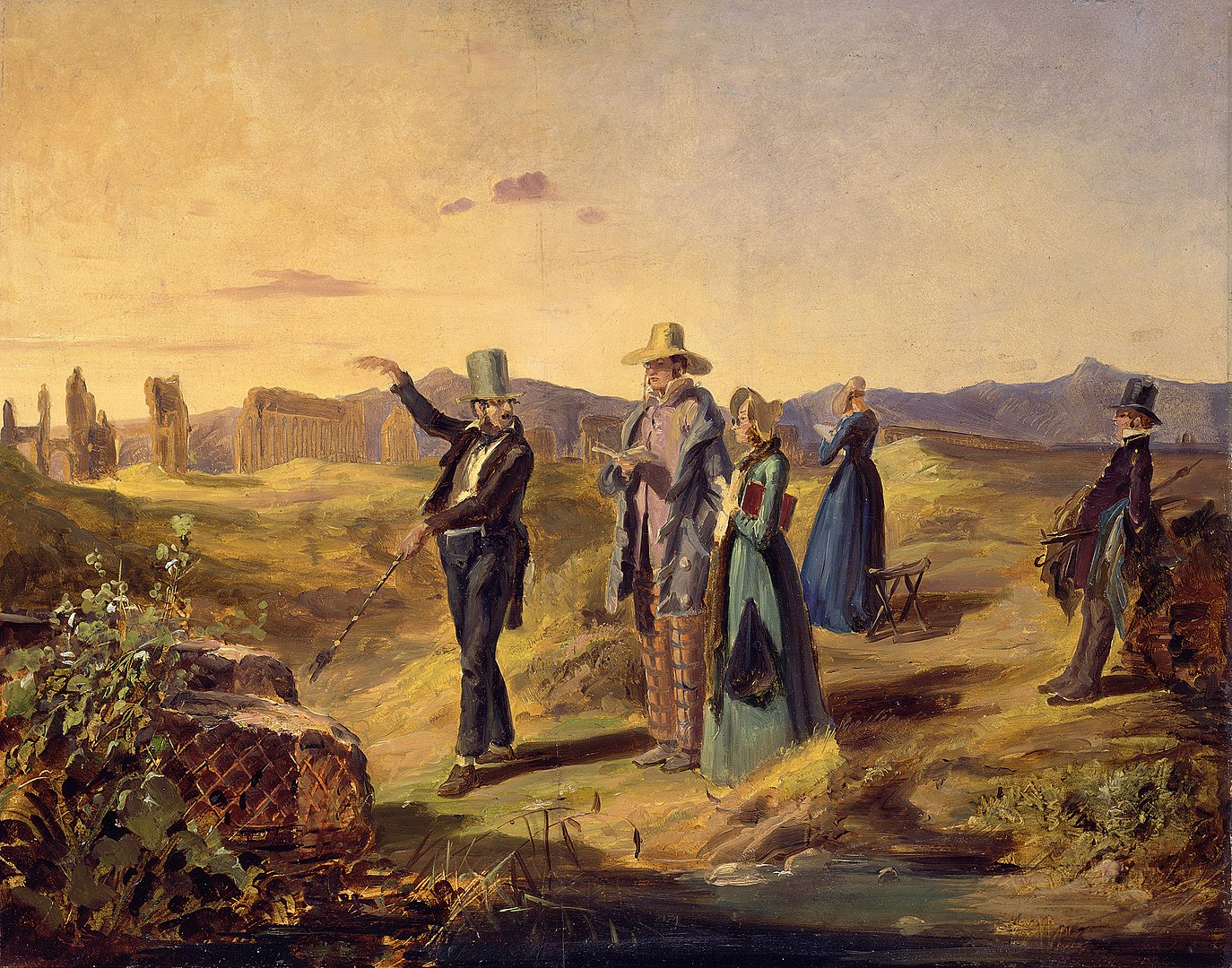
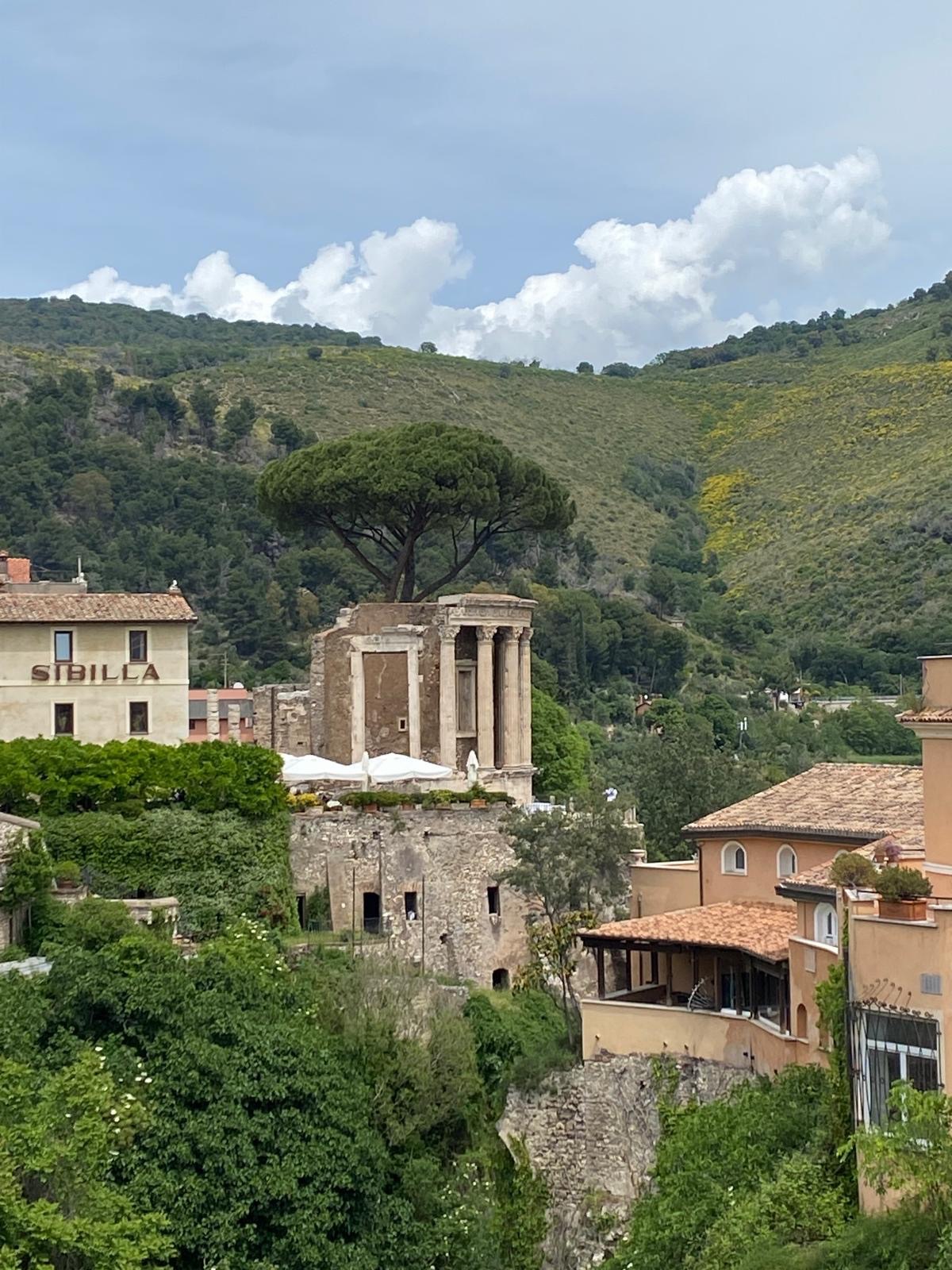
English Tourists in ‘Campagna’ c. 1835 – Carl Spitzweg – Staatliche Museen zu Berlin, Nationalgalerie. Tivoli – temple and Palazzo Colonna Barberini
STAIRWAY TO HEAVEN – so what started out as a trip into the Roman countryside to see the Nile Mosaic ended up being the discovery of a vast Roman and pre-Roman sanctuary that existed in Palestrina for centuries and pre-dated the Romans. A site that rivalled Delphi in importance. This area was the Roman and then later the Renaissance power axis in the countryside. Perhaps this really was the place where you could ascend into heaven, all you had to do was climb the monumental staircase, going up through layers of history until you reach the top.
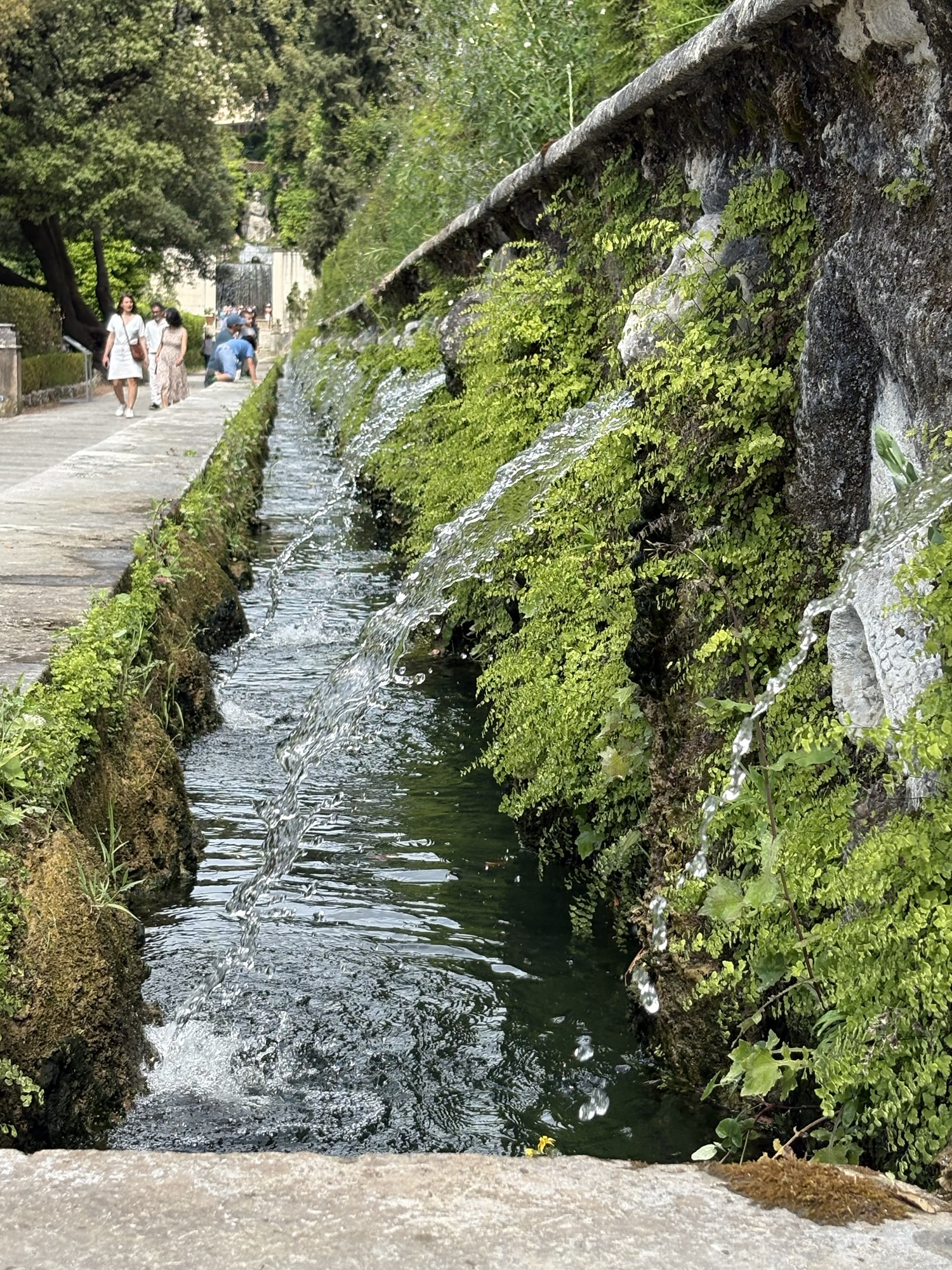
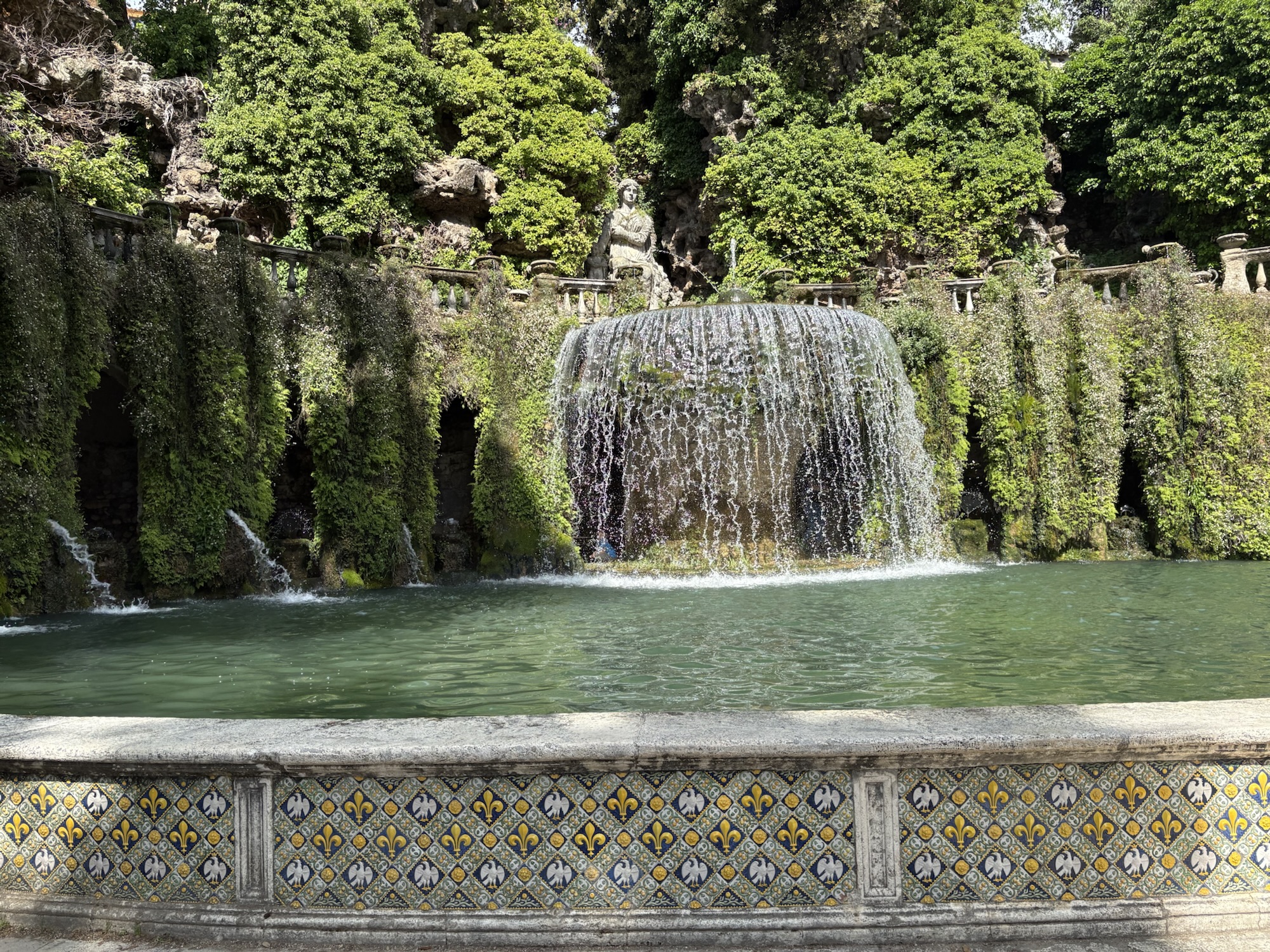
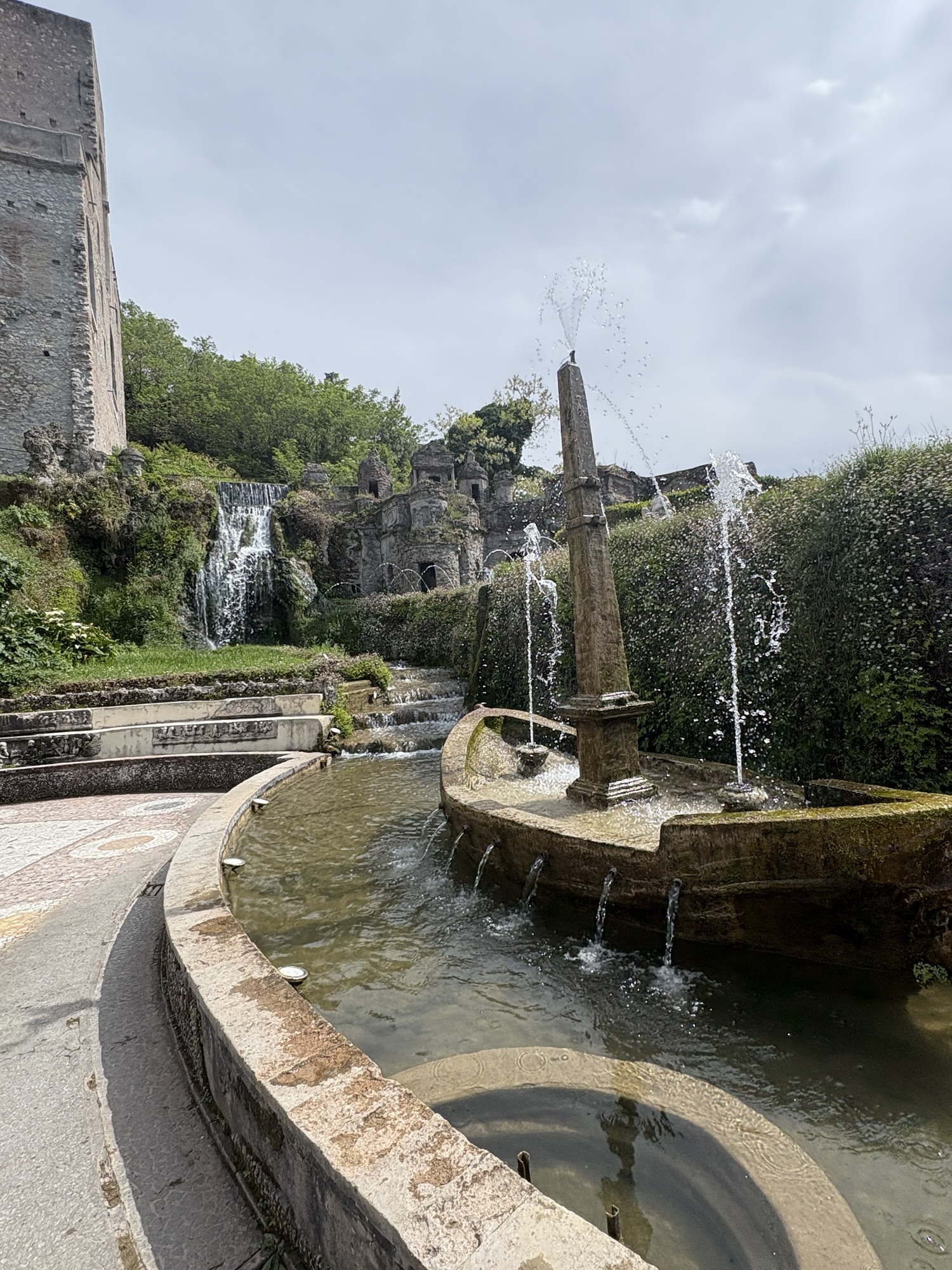
Villa d’Este fountains – May 2026
Notes:
- The Natural History (Latin: Naturalis historia) is a Latin work by Pliny the Elder. It was an encyclopedia of the time and the largest single work to have survived from the Roman period.
- Pliny identified the Nile mosaic of Palestrina calling it a lithostratum.
- The Roman Sanctuary of Fortuna Primigenia is similar in style to the Temple of Hatshepsut, Nile
- I’ve written about the history of the Grand Tour and John Soane, British architect here Soane on The Grand Tour…
- For a summary of my favourite mosaics in Italy: Mosaics in Italy – an A-Z
- A history of the Grand Tour: History of the Grand Tour
- Palladio visited the site of Palestrina in the 16th century – he was fascinated by the site and sketched it extensively. Many of his sketches are held at Royal Institute of British Architects, RIBA (London).
- For more on Palestrina and the sanctuary – here is a second article I wrote trying to create context for this complicated site: Palestrina its not just the nile mosaic – published July 2026
A NOTE ON THE AUTHOR – Janet Simmonds is an Art Historian and a Geographer. A graduate of the University of Oxford, she has a special interest in Venice and the history of tourism – especially The Grand Tour. She works as a guest lecturer in Italy for university groups and private individuals. She also works in Oxford, London and throughout Italy.
Blog: www.educated-traveller.com
Janet offers specialist travel services in Italy and Greece especially relating to art, history and culture. Her company is appropriately named Grand Tourist. www.grand-tourist.com
- May 2026
- July 2026

 The Educated Traveller
I loved Palestrina 30 years ago, an amazing place. Thanks for posting.
LikeLiked by 1 person
Thank you – yes a truly fascinating place x
LikeLike
4 million tesserae? The mind absolutely boggles! This was truly fascinating, Janet; you have earned your place in the league alongside Lord Burlington, Goethe, Piranesi, JMW Turner, John Soane and Henry James! Thanks you so much for and congratulations on, sharing this erudite piece! Luv John
LikeLiked by 1 person
I’m liking the company x
LikeLike