Visitors to the peaceful island of Torcello in the northern reaches of the Venetian Lagoon are often amazed to discover an enormous basilica and adjacent bell tower standing guard over an island where fewer than two dozen people now live. The basilica and bell tower that we can see today date from around the 10th century, although the foundations are much older. They are both a testament to the thriving settlement that once existed here.
Torcello has a long and fascinating history. The island was a sanctuary for Roman citizens fleeing their homes on the mainland in the twilight years of the Roman Empire. However generations before that there were small fishing communities living here existing on the bounty from the lagoon. They were fishermen, farmers and boat builders. They lived in small, family groups in simple reed houses. These early settlers were the Veneti people and were probably the first inhabitants of this part of north-eastern Italy. Recent archaeological research suggests that the Veneti people occupied the lagoon area and the coastal mainland at least 2000 years before the Romans arrived here.
However it was the fall of the Roman Empire and numerous invasions of marauding tribes from the east that forced the citizens of the Roman town of Altinum to move permanently into the lagoon. To start with they moved to Torcello on a temporary basis, returning home regularly to collect valuables from their houses and sanctuaries. Later the move became permanent and they started to construct a settlement on Torcello. Historians estimate that the population of Torcello around the 10th century was about 10,000 people. All that remains of this once bustling port town and trading emporium is the basilica, bell tower, a smaller romanesque church and a handful of modest palaces. Together these buildings create an open air museum that gives the visitor a glimpse of life on this island more than a thousand years ago.
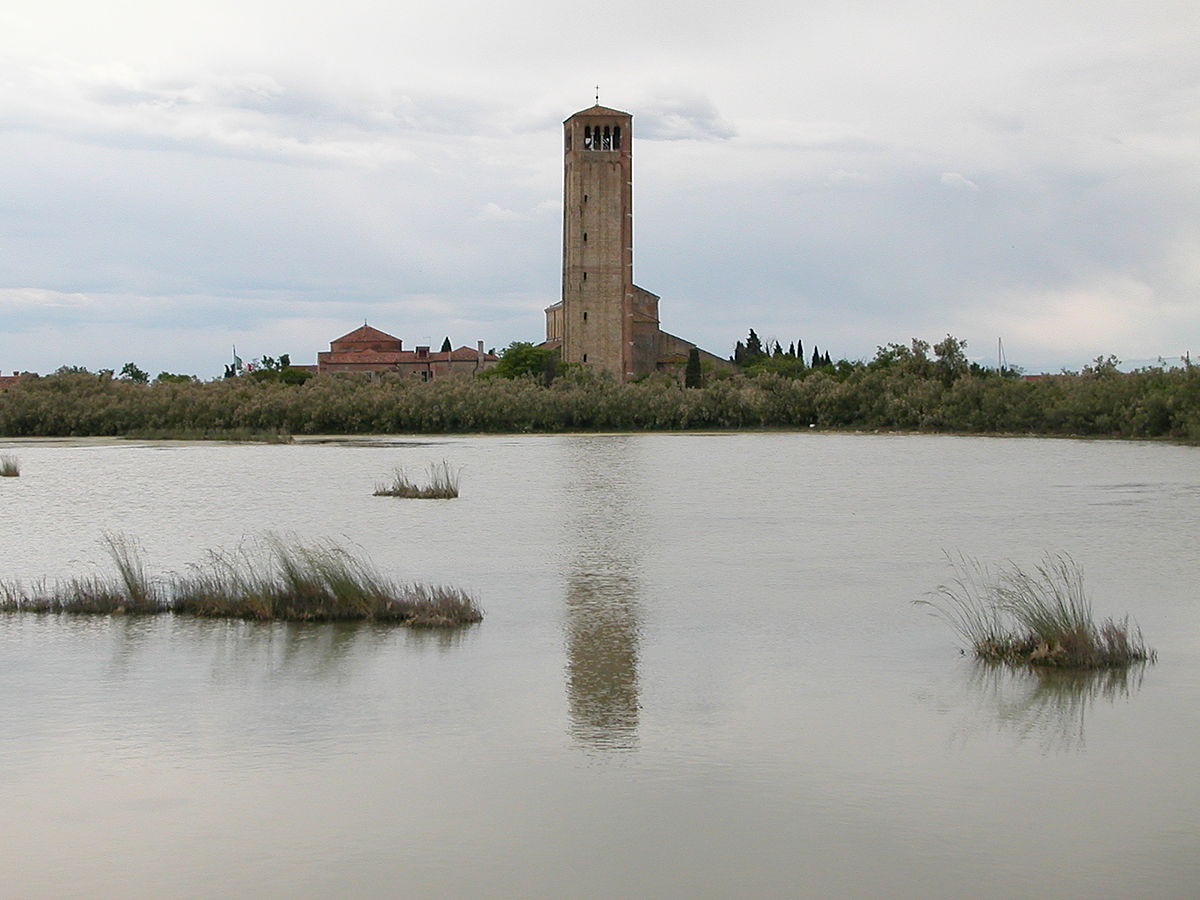
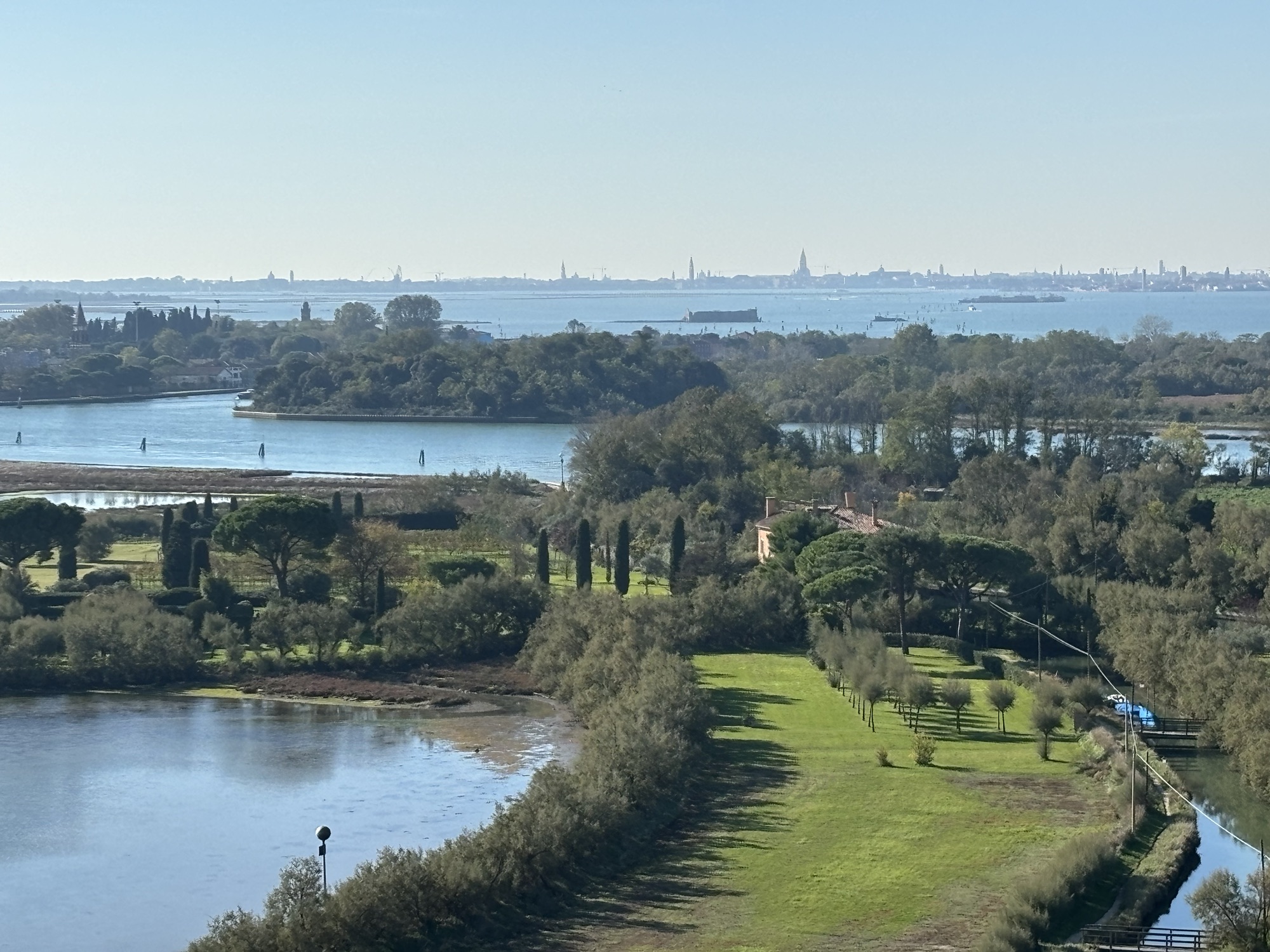
Torcello – bell tower rises out of the marshes of the Venetian lagoon (left) and the view from the bell tower (right)
This article will focus on one exceptional piece of art that can be found inside the Basilica of Santa Maria Assunta on Torcello. The artistic legacy in question is an enormous mosaic that fills the entire west wall of the church. The mosaic which stretches from the roof of the church to the original entrance portal is vast and detailed. The mosaic is telling a story, the story of the ‘Last Judgement’ and it tells this story in vibrant and colourful detail.
The mosaic dates from the mid-twelfth century and tells the story of Christ’s crucifixion, resurrection and ascension into heaven. The lower levels of the mosaic tell the story of the ‘Last Judgement’ where the souls of the departed are weighed and examined before determining whether they should enter heaven, represented as a garden paradise, or hell, brutally represented as an inferno of flames and dismembered bodies. The entire mosaic is made up of thousands of tiny tiles, known as ‘tesserae’. These tiny coloured pieces of glass are roughly one centimetre square. These ‘tesserae‘ were made in hundreds of colours including gold, green, blue, red, black and white and every shade in between. Each tile was made in layers, using a layer of glass, a layer of colour and then another layer of glass, like a tiny colourful sandwich. The gold ‘tesserae’ were made using gold leaf, whilst the coloured ‘tesserae’ were created using a range of pigments giving the mosaic artists a vast range of artistic possibilities. Evidence for ‘tesserae’ making workshops has been found during excavations in and around the Roman towns of Altinum and Aquileia. These workshops would have provided millions of ‘tesserae’ to create the exceptional mosaics on Torcello and also in the Basilica of San Marco in nearby Venice.
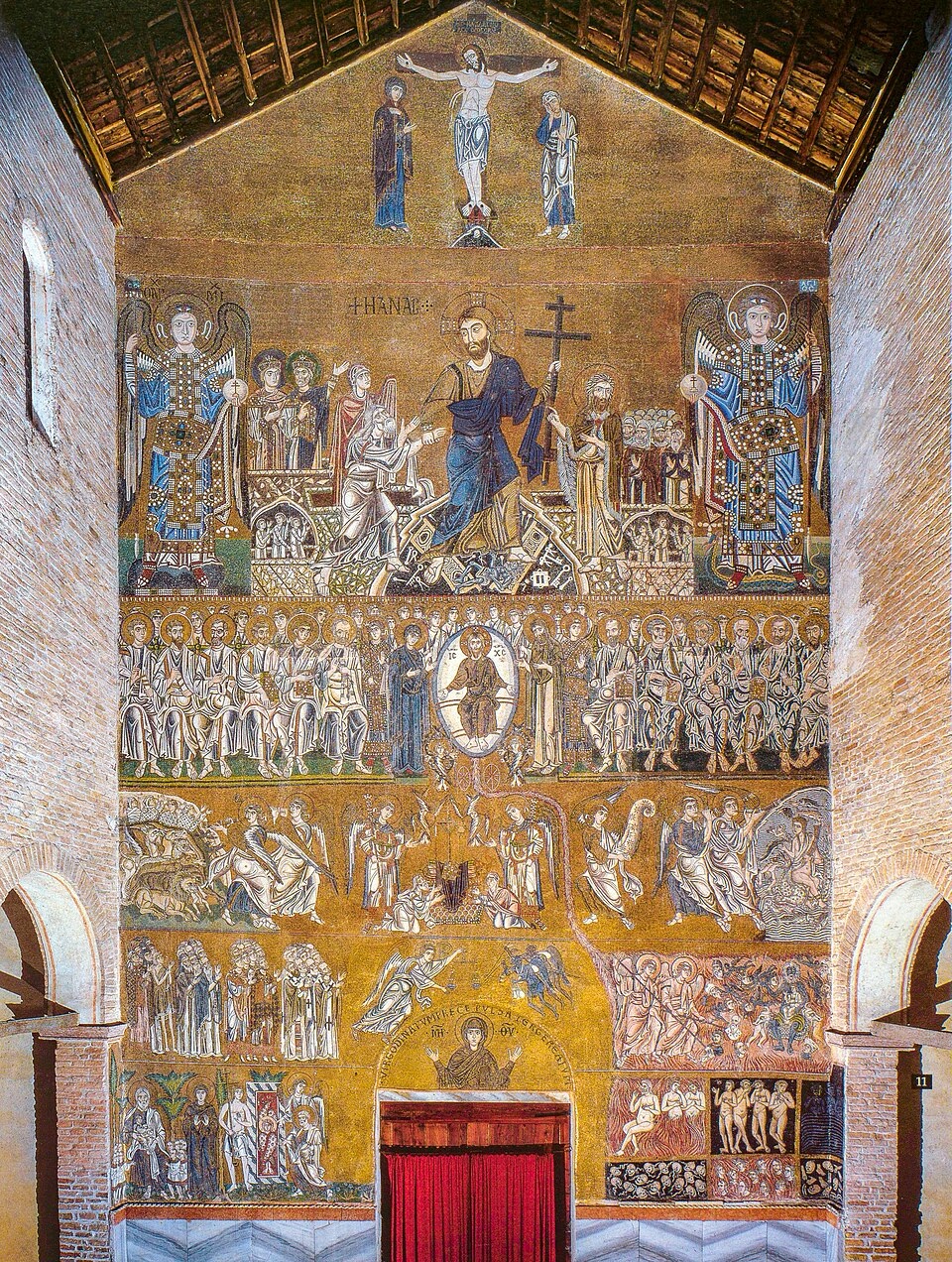
As with all good stories lets start at the beginning. In this case that means at the top – at the point where the mosaic wall nudges the timber-lined ceiling of the basilica. The mosaic can easily be divided into six registers or levels. So we’ll start at the top with the first register.
REGISTER I – At the top of the wall is a mosaic representation of the crucifixion. Jesus is nailed to the cross, he is flanked by Mary his mother on the left and John the Evangelist on the right. The eaves of the church create a natural triangular format that echoes the three figures on and around the cross. If you look carefully (and a pair of binoculars is not a bad idea) you can see below the feet of Jesus a small dome, perhaps a hillock, this is a reference to the stone tomb where Jesus would be laid to rest.
REGISTER II – Below the crucifixion scene we see the ‘Resurrection of Christ’ a crucial part of the story of Jesus. Here a larger-than-life Christ has risen from the dead. He is standing on a black mound, strewn with keys and padlocks. This signifies his escape from the stone tomb. He is trampling a devil figure under his feet. The figure of Christ is powerful and strong. This has been described as a vigorous ‘Harrowing of Hell’ when good triumphs over evil. This concept of the victory of ‘good’ over ‘bad’ is crucial to the christian doctrine. The letters ‘H ANA G’ to the left of Christ’s head are Greek letters possibly showing an abbreviated form of ‘ANASTASIS’ the Greek word for “Resurrection.”
The second register is flanked by large angels dressed in elaborate ‘imperial style’ gowns. This suggests that they are messengers delivering a divine message to the congregation of Torcello. Christ is being approached by Adam and Eve (in grey and red respectively) on the left. Behind them are the biblical kings Solomon and David. On the right of Christ is John the Baptist with the ‘Old Testament’ prophets behind him. Meanwhile below the kings and the prophets are children in white, enclosed in small alcoves, perhaps these are innocent souls in limbo. The mosaic artists manage to convey emotion, determination and compassion in the eyes of Christ and those around him.
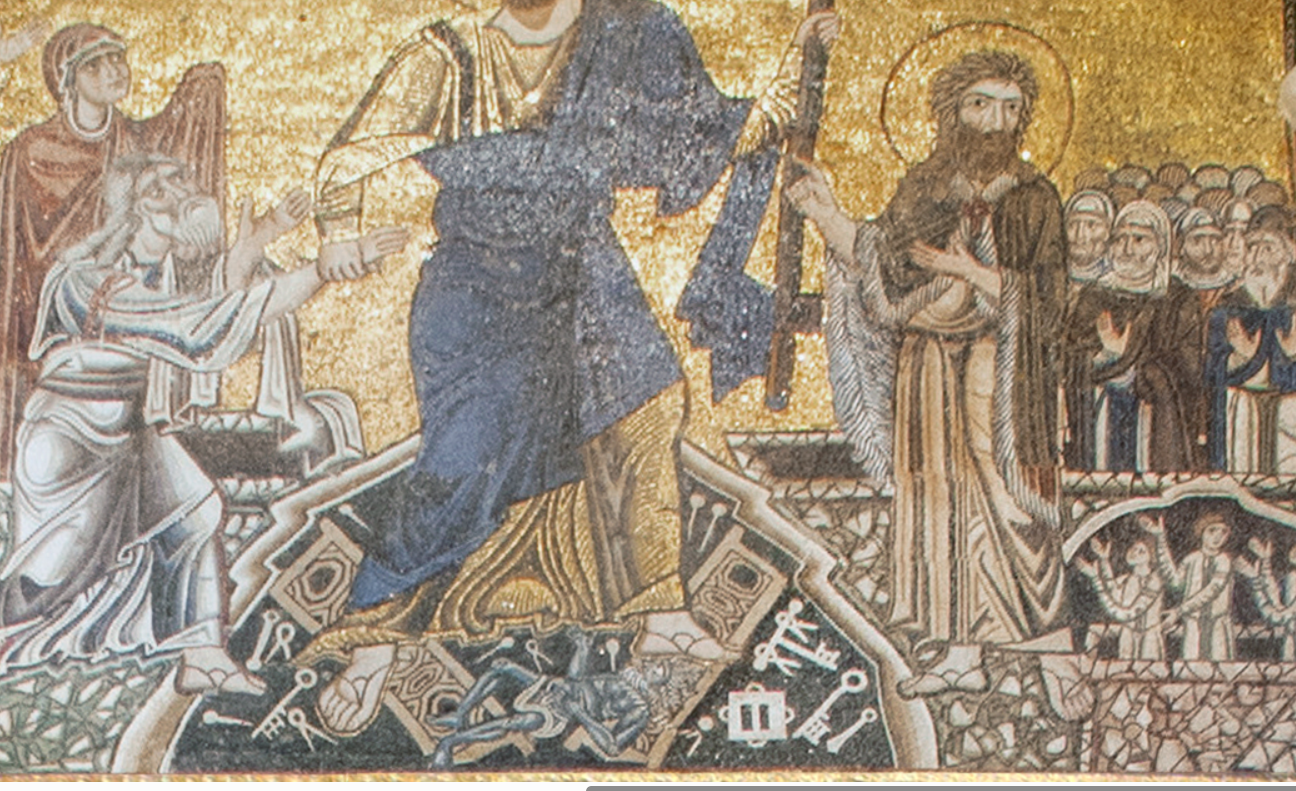
Register II – detail of Adam and Eve (left) and John the Baptist (right)
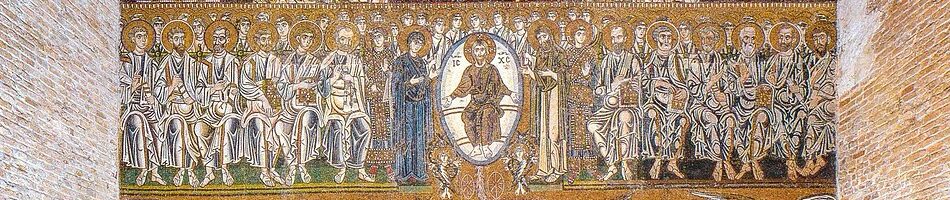
REGISTER III – Below the larger-than-life figure of Jesus stamping on the devil and signifying escape and ‘resurrection’ there’s a much more peaceful scene of Jesus seated within a ‘mandorla’ or lunette shaped frame. ‘Mandorla’ in italian means almond and is used in a religious context to emphasise an iconic figure – in this case Christ. He is flanked by the twelve apostles, six on each side. Immediately on the left and right of the lunette are Mary and John the Baptist. Here Christ is seated in judgement with the apostles on either side and angels behind them. At his feet there are angels entwined in wings and two red wheels. The wheels indicate the start of the flames of hell which start here and descend into the inferno.
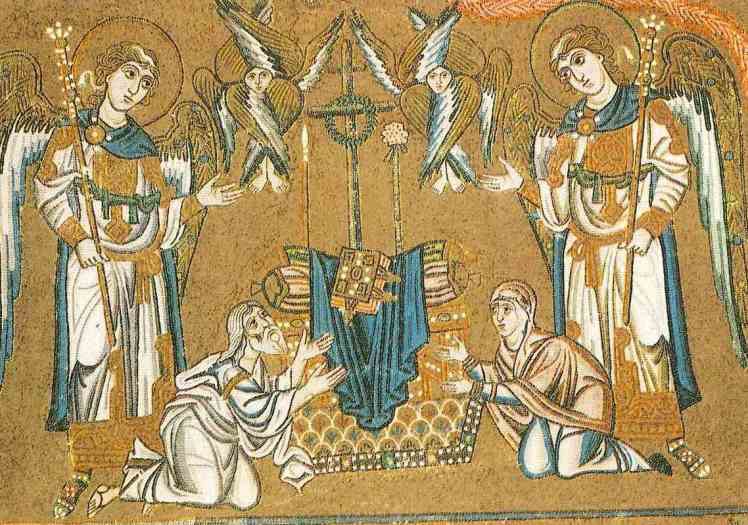
REGISTER IV – Next, one level down, we see a vacant throne, richly decorated with luxurious fabric, possibly velvet. On either side of the throne there are two kneeling figures, these are Adam (on the left) and Eve (on the right), they are begging Christ to take his position on the throne and also to forgive them. On either side of the throne there are angels trumpeting the call of judgement ‘giudizio’ so that the dead of the sea (on the right) and those that have died on the land (to the left) can come back to life, ready for the final judgement. This register is a call to action for the dead souls to come forward and to be judged. It’s also quite graphic, a dead child is being disgorged from the stomach of a lion, on the left. Whilst souls lost at sea through drowning or shipwreck are called back to life.
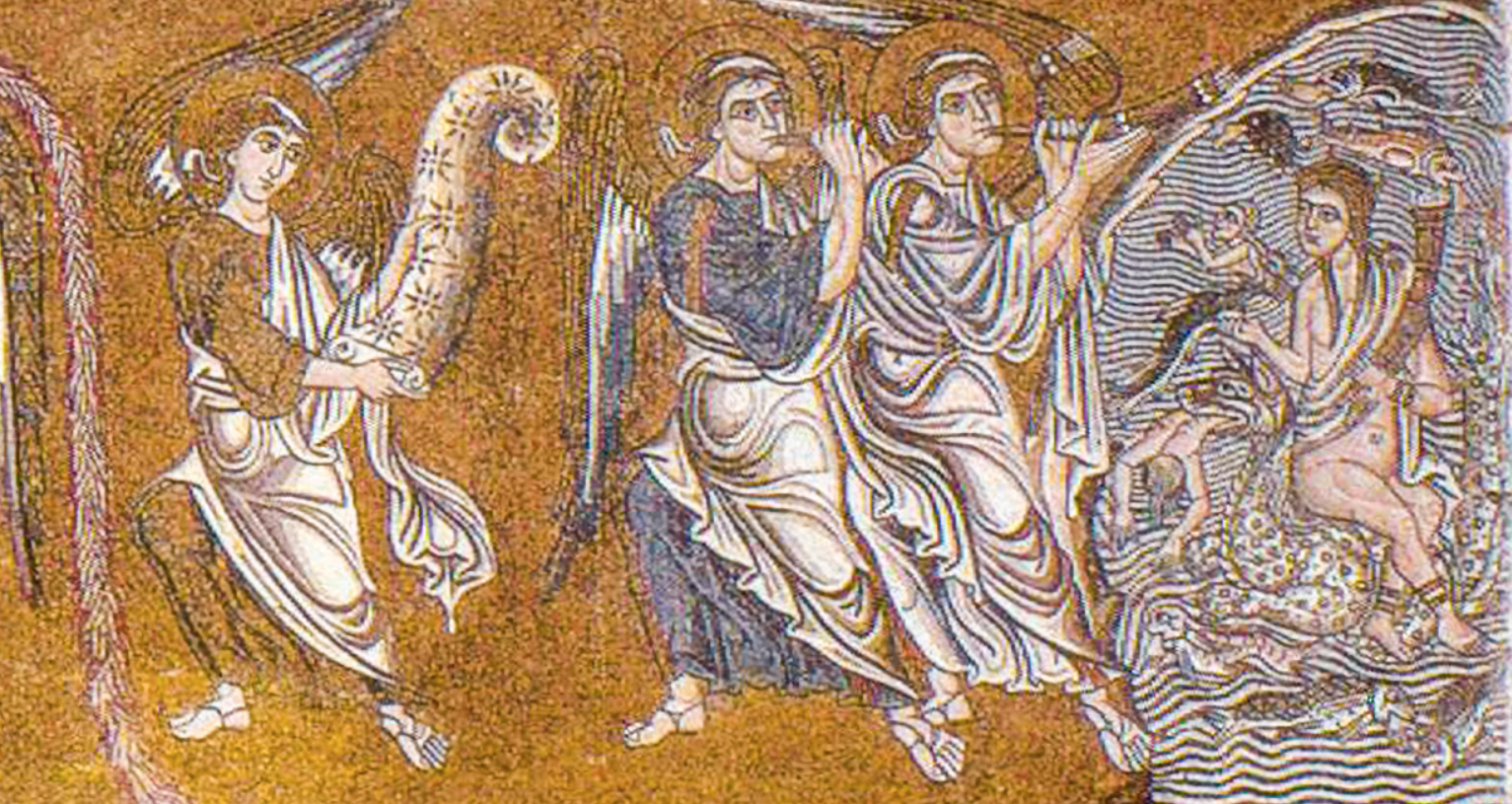
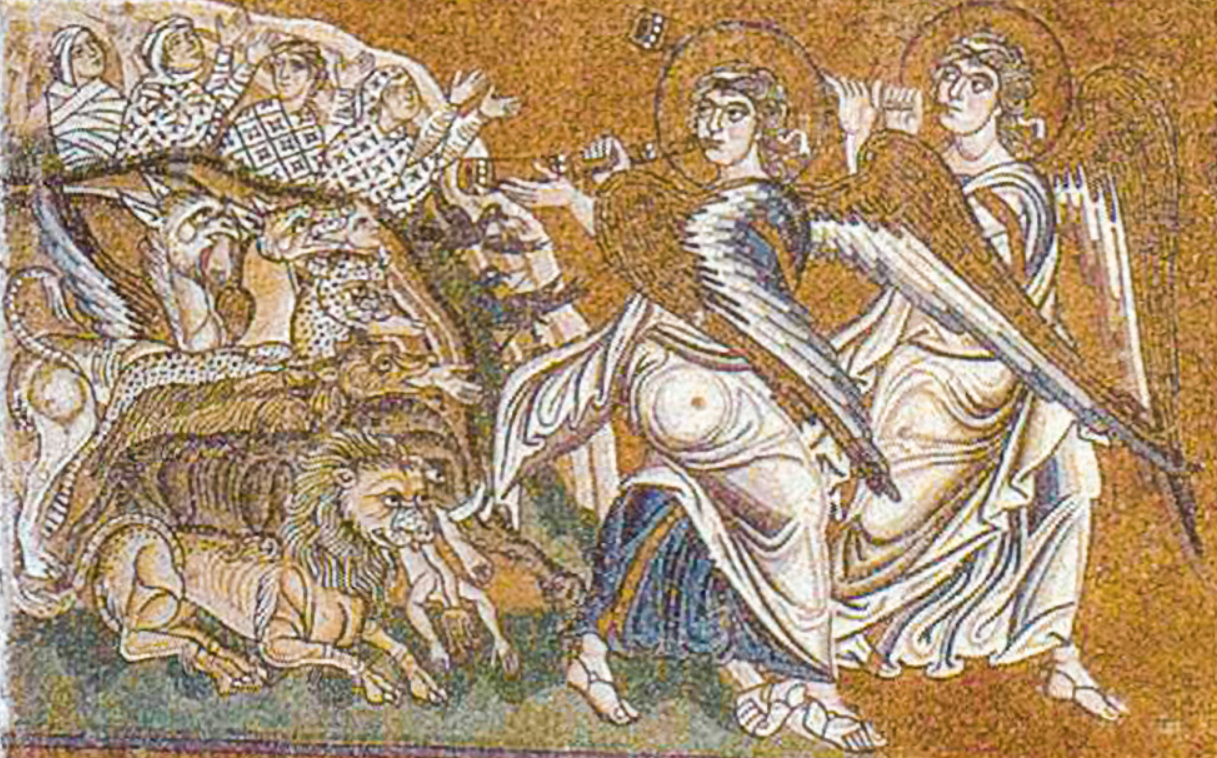
Detail of Register IV – note the red line of flames (far left) which will descend into hell
REGISTER V – Next we’ve got the weighing of the souls, the moment of truth, it’s judgement day. Will the souls of the departed make their way into paradise or into the fiery caverns of hell. There’s even a little bit of humour here. In the centre of the mosaic there’s a set of scales with an angel on one side and two nasty little demons on the other. Whilst the angel attempts to weigh the souls fairly, the demons are cheating with small white bags of flour to weigh the scales in favour of the devil. The gold leaf of the ‘tesserae’ dominate this part of the mosaic giving it a truly ‘eastern’ feel. This is highly appropriate given that the mosaic artists came from Constantinople and created this ornate style which we often refer to as Byzantine or even Greco-Byzantine. James Morris in his influential book ‘Venice’ describes Michael (the angel below) …’conscientiously weighing the souls, like an apothecary, to the poor damned sinners below, already writhing in the blasts of hell…’
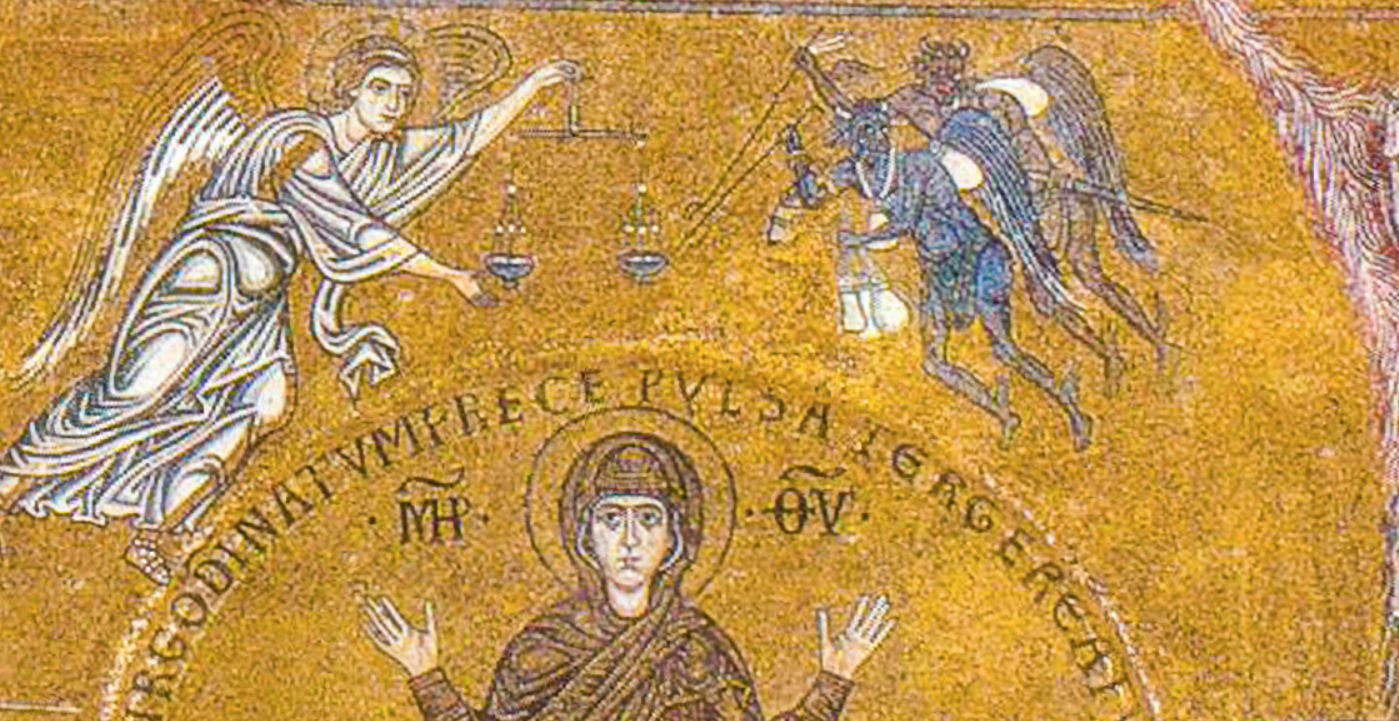
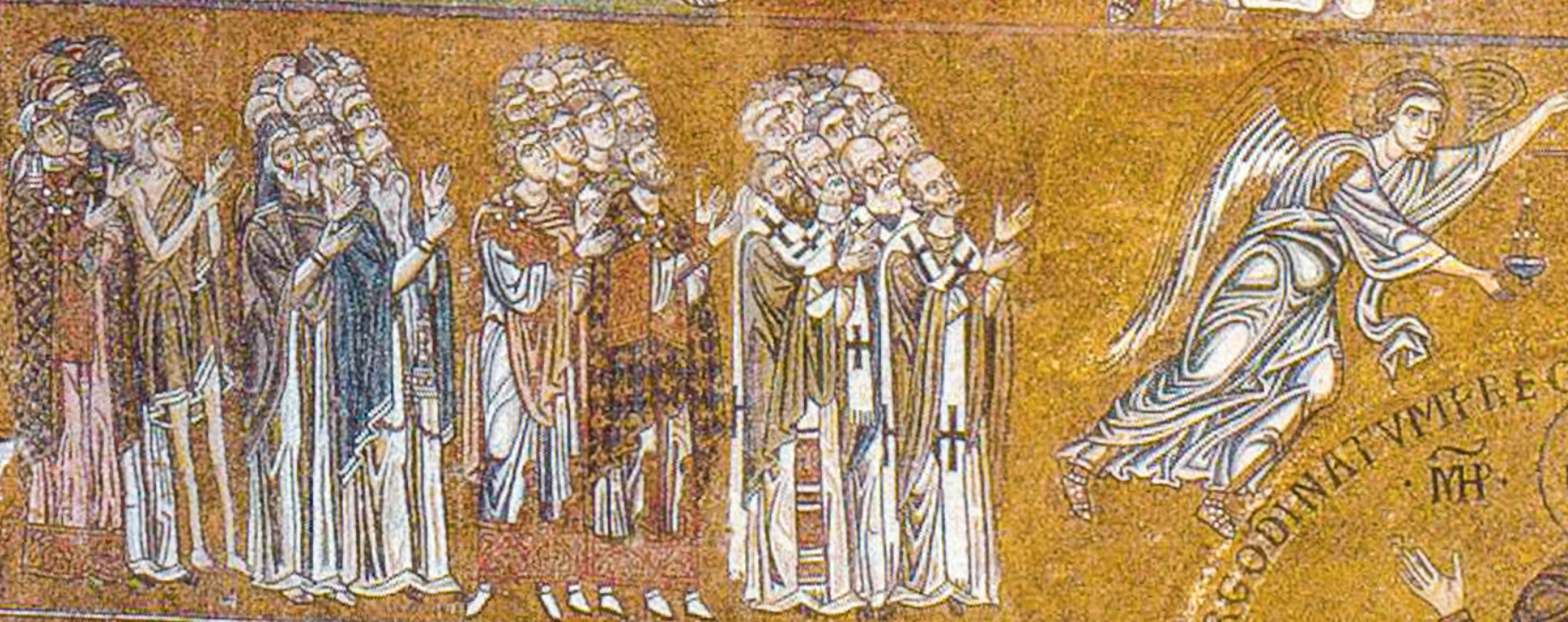
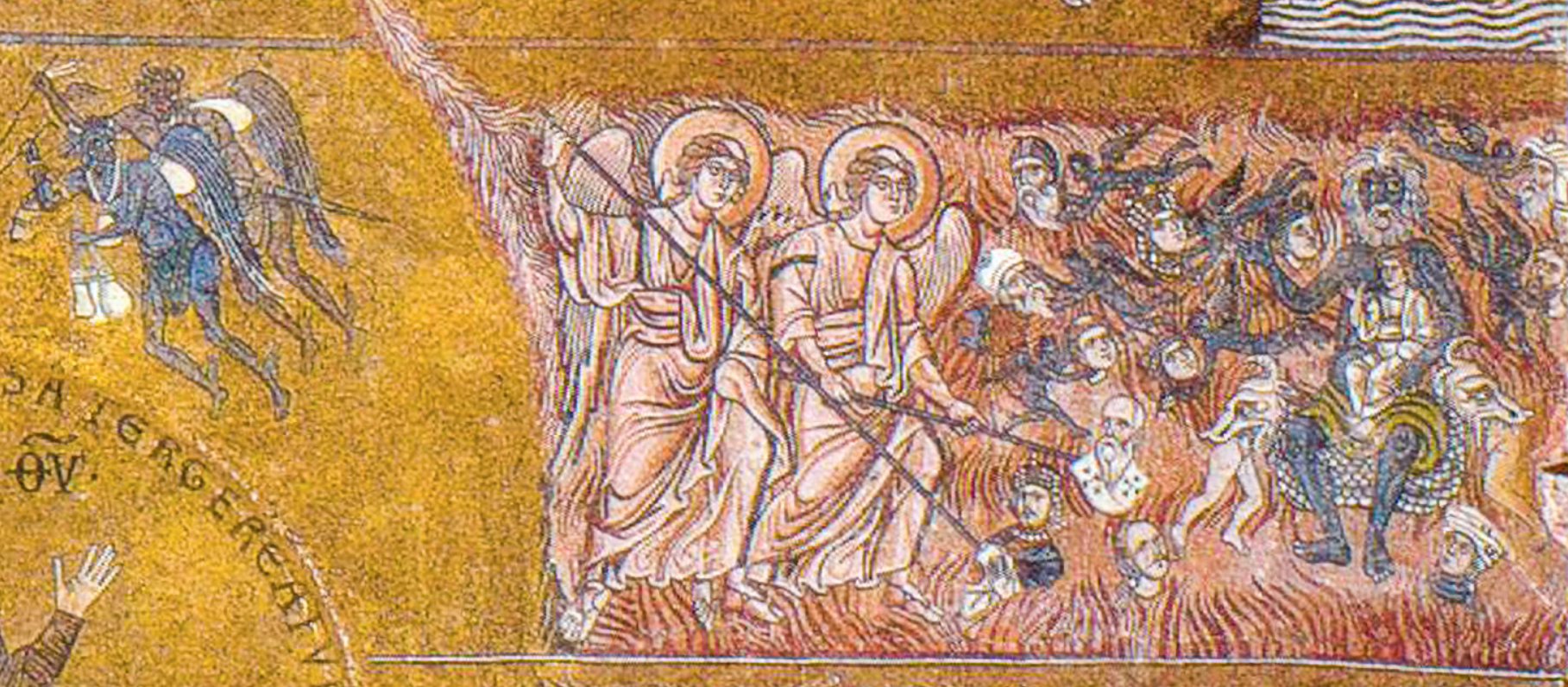
The good line up to be judged (left). Meanwhile the fallen angels fan the flames of hell (right)
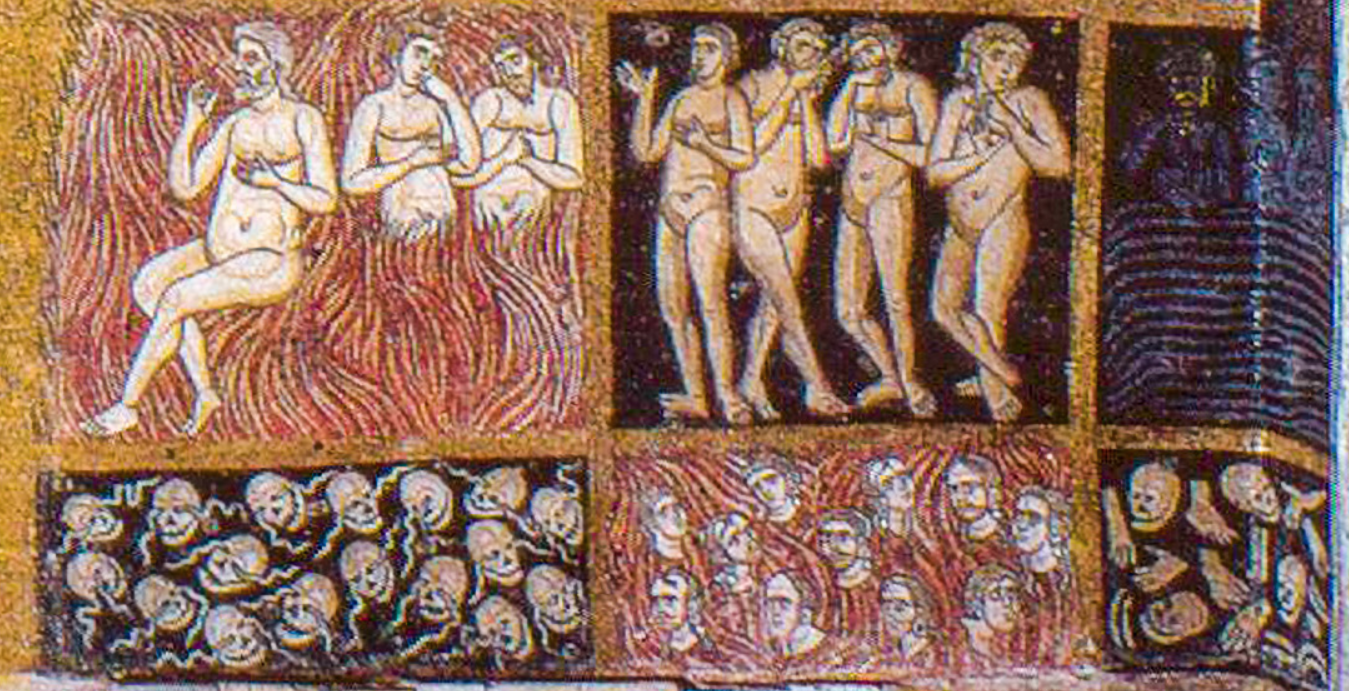
On either side of the crucial weighing scales are the good and the bad. On the left hand side are the good, divided into clergy and bishops, upstanding citizens and then at the back a group of honourable women. All are praying for entry into paradise. Meanwhile on the right it’s a much more chaotic scene. Everything is fire and brimstone and blood. The entire scene is engulfed with red, grey and black. The devil sits on a throne nursing the anti-christ. In theology the anti-christ is an evil version of the christ child and is a devious figure who will confuse the faithful by claiming to be the true saviour. The dismembered heads are significant because, in the medieval world, it was impossible to enter the kingdom of heaven if your body was not complete. It’s interesting to look at the individual heads here, often adorned with elaborate hair styles, jewellery, crowns and helmets. Perhaps the heads in hell abused their power during their lives. There’s also a possible reference here to vanity, greed and arrogance.
REGISTER VI – Finally we reach the last register of the mosaic, we’ve descended down through six registers or layers. It’s important to remember that this mosaic was designed to be seen and absorbed by the church congregation when they were leaving the church after a service. The main entry and exit door of the church is in the centre of the wall. An arch above the doorway, in mosaic, represents the Virgin Mary, she is the patron saint of this beautiful basilica. She is also encouraging the church-goers to live a life of prayer and thus guarantee their place in paradise, rather than the nasty, dark, fiery alternative.
The final register is perhaps the most extreme, on the left hand side is a beautiful garden, filled with colour and tranquility. The characters in paradise are at peace meanwhile on the right hand side of the mosaic we’ve got the grim chambers of hell. Which one shall we start with? Let’s start with the inferno, in the depths of hell. This was the part of the mosaic that fascinated my son William, as a little boy. Firstly there’s nakedness, lots of it, and flames too, creeping up the bodies of the unfortunate residents. There’s a blackened chamber filled with freezing cold water and the shadows of the souls lost within its depths. There are skulls with snakes squirming through empty eye sockets and heads burning, quite literally, in the fires of hell. There’s even a display of body parts, feet and hands, skulls and bones. The message is quite clear, hell is to be avoided at all costs.
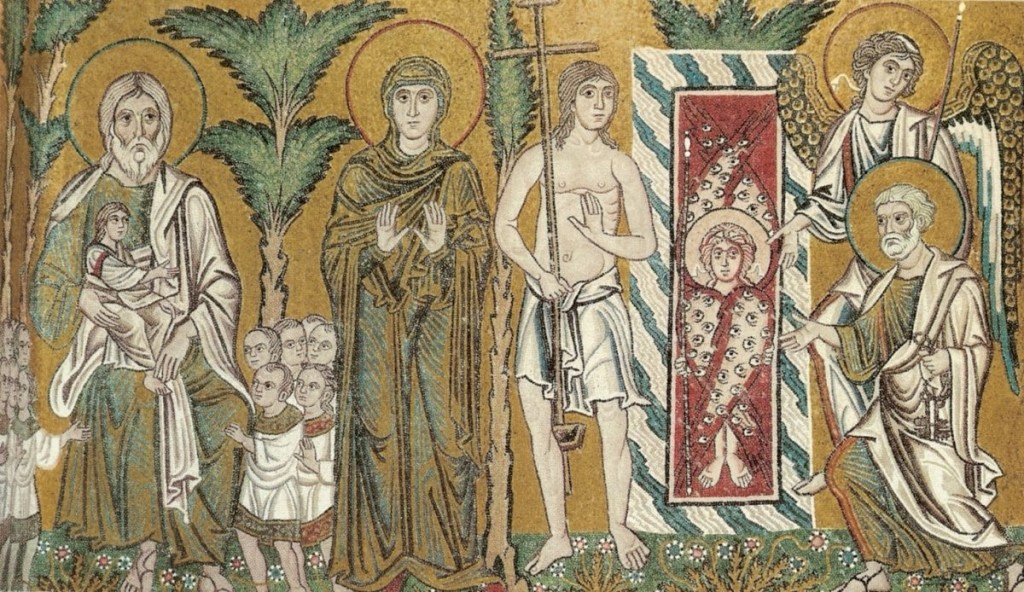
Meanwhile, for the penitent and honourable Paradise awaits; a land of milk and honey, spring flowers, shaded gardens, palm trees and peace. The characters are Abraham, seated on the far left with a small child on his knee, various ‘infants’ sidle up to his tunic (they are the innocents) children who died with no mortal sin. There’s Mary, in a gold and blue gown. Next to her is either ‘the good thief’ or Lazarus (sources differ). Then we have an angel and St Peter (carrying his keys) the first bishop of Rome. Peter and the angel are pointing to a banner or flag, showing the head of a saint (or Jesus) surrounded by hundreds of eyes. The eyes remind me immediately of Argus, the unfortunate shepherd, in Greek mythology, who was an excellent shepherd because he could never sleep, at least some of his eyes were always open and awake. We know that Greek or Byzantine craftsmen created these mosaics, so perhaps they brought Greek folklore and myths with them.
On consideration I’d like to suggest that the banner, with wings covered in eyes, is a reference to Greek mythology and the character of Argus/Argos (the multi-eyed shepherd). The myth is the story of Jupiter and Io. Jupiter falls in love with Io (a young nymph). An enraged Juno (Jupiter’s wife) turns Io into a white cow and sends Argus to watch over her. Jupiter sends Hermes to dispose of Argus. Hermes lulls Argus to sleep and then kills him. Juno in her fury takes Argus’s eyes and places them on the tail feathers of her favourite bird, the peacock. I think that the ‘all seeing eyes’ of Argus were adopted by medieval Christians as an ‘all seeing God’ symbol. The adaptation of pagan ideas (Greek myths for example) by the Christian hierarchy to suit their own needs. The positioning of the banner to the left of St Peter (kneeling) possibly indicates Jesus (centre) and then the four wings, covered in eyes, perhaps representing the evangelists. The gospel writers are collectively delivering an ‘all seeing’ message to the congregation. The location of the paradise panel in the lowest part of the mosaic, immediately to the left of the Santa Maria mosaic, and just next to the door, would be the last thing the congregation saw (after morning service) when exiting the church.
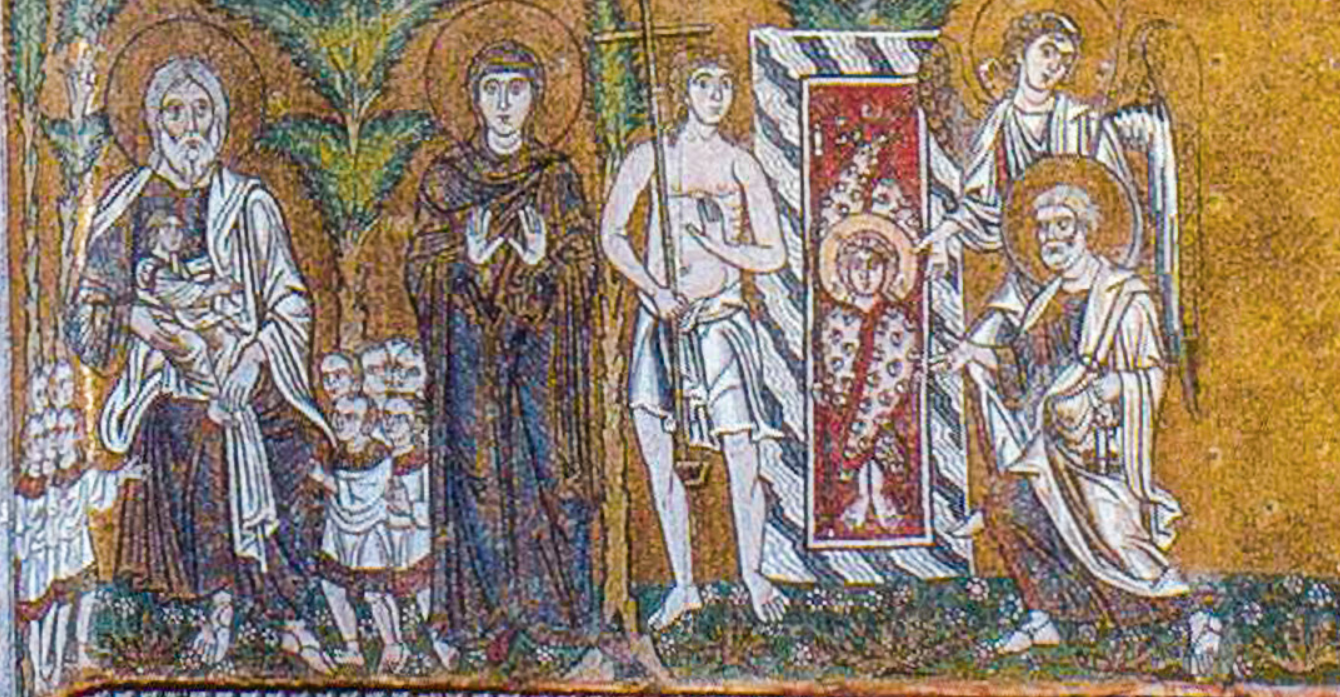
Paradise (above) with Abraham (left) and St Peter (right) with Mary and the ‘Good Thief’ in between
John Ruskin, visiting Torcello in the 1840s concluded that the church was luminous and hopeful, despite the ‘Last Judgement’ mosaic. He regarded it as a solemn subject but conveyed in a relatively light-hearted manner. I think I’d agree with him, there’s a definite message here, but it’s told in a straight-forward and even humorous fashion. Ruskin compares the interior basilica of Torcello as ‘brightly executed’ after the ‘excessive gloom of St Mark’s’. He also suggests that the basilica was like an ark, at sea in the lagoon, a place of refuge for the displaced Roman citizens from Altinum. Poetic and well observed.

I first set foot on the island of Torcello in 1980. I was a trainee tour guide and learning the history of the lagoon. A stop at Torcello was included. In those days there was nothing much open on the island except the basilica. The bell tower was closed up and the museum infrequently open. However the basilica and its exceptional mosaic was available to see. It was breathtaking. I’ve never forgotten that first view and the realisation that the images were all made up of mosaic pieces. When I discovered that the mosaics were 900 years old I was in complete awe. I’ve returned hundreds of times since and tried, each time, to appreciate and understand a little more about this exceptional artistic masterpiece. It’s taken me four decades to summarise my thoughts!

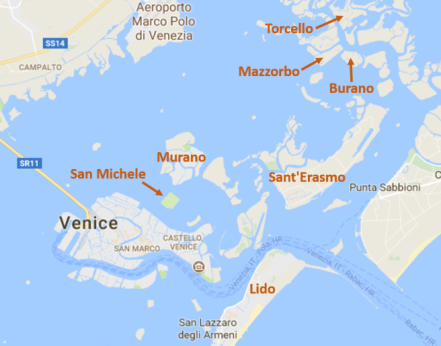
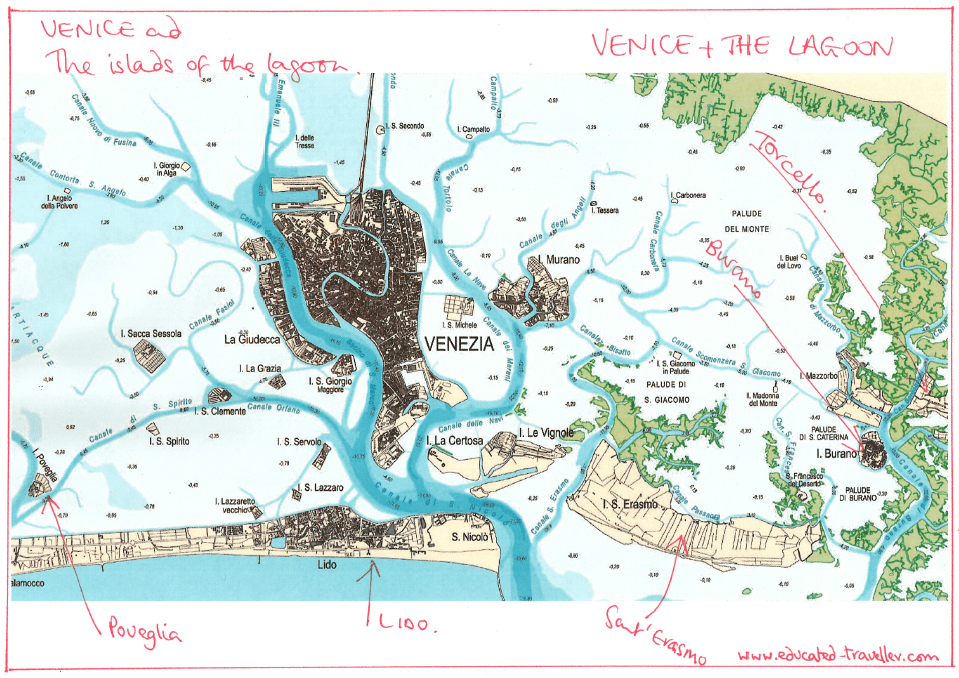
The lagoon of Venice – 1932 map with Torcello and Burano islands far right. www.educated-traveller.com
Interesting facts:
- The archaeological origins of Santa Maria Assunta date back to the 7th century. The narthex of the building dates from around the 9th century although pretty well everything we see today dates from the 11th and 12th centuries.
- The Basilica & bell tower of Torcello are described by John Ruskin in his ‘Stones of Venice’ he even refers to the stone shutters that can still be seen today. These could be closed to protect the windows of the church from Adriatic storms.
- The back wall of a church in italian is described, rather poetically as the ‘controfacciata’. Literally the opposite of the ‘facciata’ facade.
- In the article I refer to the Greek myth of Jupiter and Io. This story is shown in a gorgeous fresco cycle by artist Zelotti, at Villa Emo, a Palladian villa in the Veneto region of Northern Italy (about an hour from Venice). I’ve written about the frescoes here: True Romance – Greek God style… The paintings are beautiful and romantic, despite Argus’ unfortunate end!
- For more on Villa Emo – Villa Emo – a perfect Palladian Villa, Italy
- The idea of a ‘Last Judgement’ or ‘Giudizio Universale’ appears frequently in churches throughout Italy (usually as a fresco). The Torcello judgement is probably the largest mosaic version.
- All photos of ‘The Last Judgement’ from Wikimedia Commons (photos not permitted in basilica)!
- Locanda Cipriani was open in the 1980s. You could even have a coffee at the bar. There was a water colour painting by Winston Churchill on the left as you went inside. It has long since disappeared! In 2024 it closed for massive renovations. These renovations are on going!
Bibliography-Sources:
- Ruskin, John – The Stones of Venice (1851-3) – an extensive survey and description of the numerous palaces, churches and bell towers of Venice – hugely influential in 19th century England.
- Morris, James – Venice (1960) Faber & Faber – Venice a biography of a city – still frequently quoted.
- Norwich, John Julius – Venice – The Rise to Empire (1977) Allen Lane – Volume I – History of Venice.
- Dodwell, CR – The Pictorial arts of the West, 800-1200 (1993) Yale – former Curator of the Whitworth Art Gallery, Manchester
- Arte Piu (in Italian) excellent article: https://artepiu.info/torcello-mosaici-basilica-maria-assunta/
Further reading – the first couple of articles by me and several recommended sources:
- Torcello – Island of legends – Cipriani, Hemingway, Venice
- Venice, Torcello, Lagoon – fun on Saturday afternoon
- Venice – The Venetian Lagoon
- Ravenna – mosaics from the east…
- https://studitorcellani.it/bibliografia/
- https://www.veniceinperil.org/mosaics-cathedral-of-santa-maria-assunta-torcello/
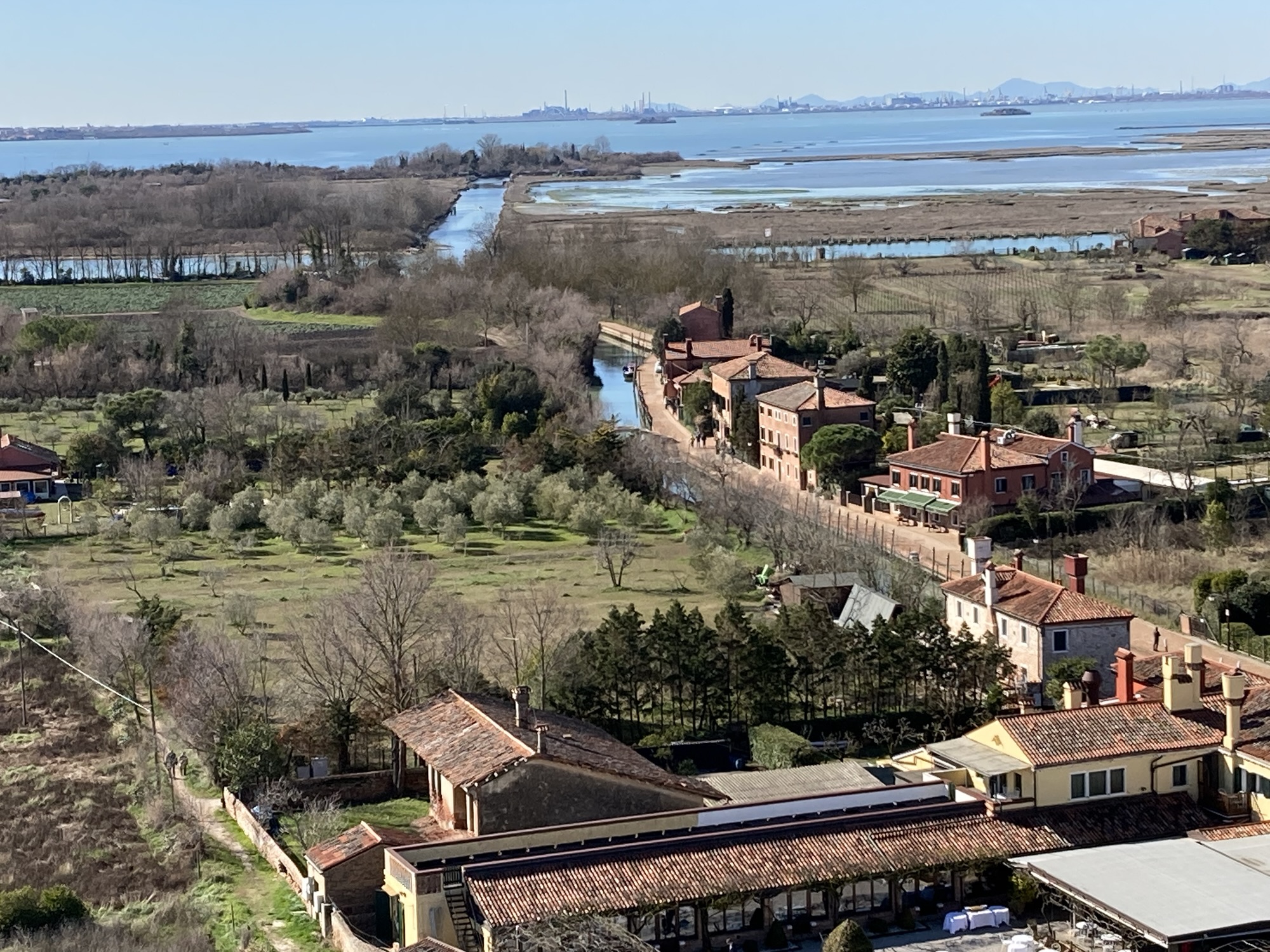
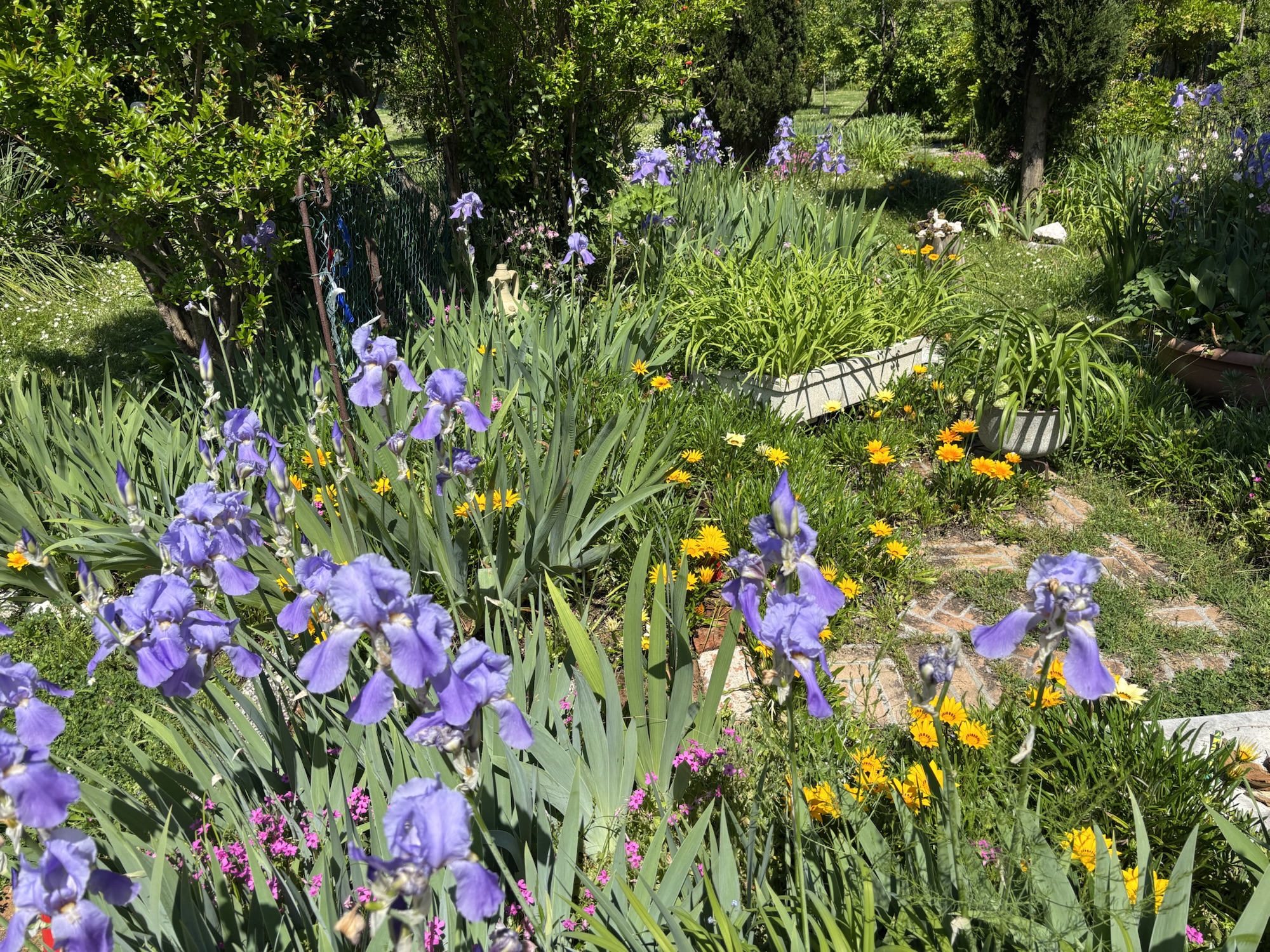
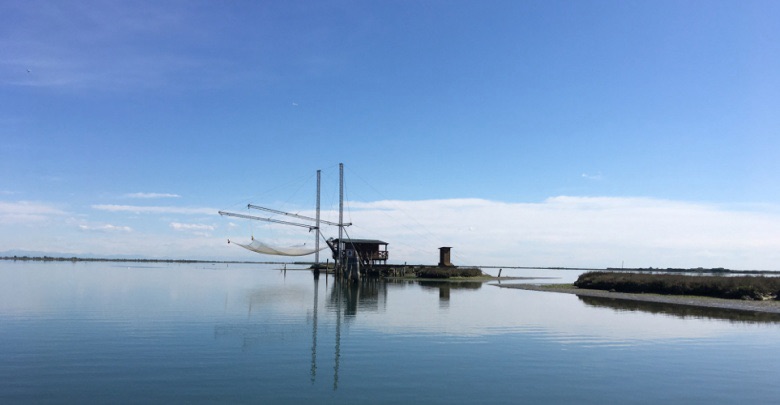
Torcello in springtime – photos www.educated-traveller.com
The Author – Janet Simmonds writes about Italy, especially Venice, Ravenna, Trieste but also The Alps, Sicily, Naples and Basilicata. She has Master’s degrees from Oxford University and Manchester University in Geography and History of Art respectively. Janet has worked with university groups, professional groups and well-known journalists assisting and informing guests on Italy and Italian culture. She offers guided tours throughout Italy where she acts as a guest lecturer and local expert.
You can follow her activities at www.grand-tourist.com and www.educated-traveller.com
- Date: 16th May 2025
- Updated: 26th Sept, 2025

 The Educated Traveller