Every year on the night of 10th August the ‘Notte di San Lorenzo’ is celebrated in Italy. It’s a night when the chance of seeing a shooting star is at its highest. There are songs and poems written about the ‘Notte di San Lorenzo’ describing clear skies, shooting stars and often romance. These days the ‘Notte di San Lorenzo’ is about summer romances, evening walks on the beach and gazing at the stars.
The real story behind the night of San Lorenzo is actually dark and very brutal.
This is San Lorenzo’s sorry story. San Lorenzo was an early Christian martyr. He was a Bishop or Deacon in the Church of Rome. He had the important job of giving alms (financial assistance) to the poorer members of the community. He was also put in charge of the church’s treasures. In true Robin Hood style he took his role very seriously. He started to distribute both money and the church’s treasures (paintings, gold, sculptures and manuscripts) to the poor. He declared that their need was the greatest. However rather predictably many of his fellow clerics disagreed.
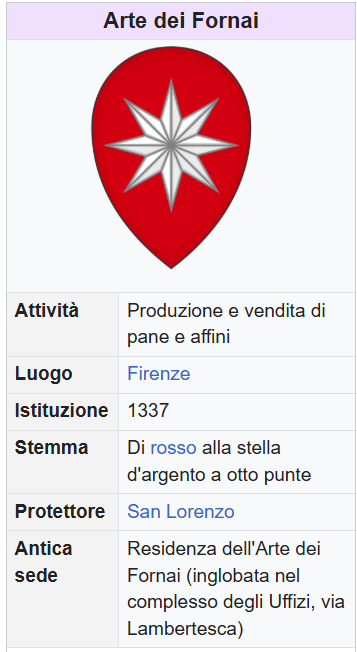
When the Prefect of Rome discovered San Lorenzo’s exceptional generosity, he sacked him immediately and ordered him to be put to death. A giant gridiron was prepared with hot coals beneath the metal frame. When flames began to rise through the metal bars Lorenzo was laid on top – like a large sacrificial lamb about to be roasted. Legend has it that after a significant period of time he declared himself to be cooked on one side and requested to be turned over. Tragically and predictably he did not survive the grilling! His death was excruciatingly painful and inevitable. Over the centuries the death of San Lorenzo became part of Italian folklore and the brutal method of his demise was remembered, especially in medieval times by the Guild of Bakers (Arte dei Fornai) who made him their protector and patron saint. To this day San Lorenzo is the saint of chefs, cooks and comedians.
The graphic and brutal death of San Lorenzo has been the subject of numerous paintings, frescoes and mosaics. My absolute favourite representation of San Lorenzo is in Ravenna. It is a beautiful Byzantine mosaic in the mausoleum of Galla Placidia. The mosaic, dating from the 5th century shows San Lorenzo stood next to a huge burning fire. There is some discussion in academic circles about the true identity of the cross-carrying character on the right of the mosaic but I prefer to see him as San Lorenzo.
On the left hand side of the mosaic is a cabinet, holding copies of the four gospels. This is the earliest depiction of a library that I have seen. Whilst it was the manuscripts that caught my attention initially I soon began to wonder about the holy man on the right, with his worrying proximity to the open flames and in fact I was right to be worried about that. The mosaic is prominently located on the opposite wall to the entrance. A powerful message to visitors and pilgrims.

To go back to the ‘Notte di San Lorenzo’ for a moment, the night of 10th August has become popular in Italy as the feast of San Lorenzo, a night to look at the sky, catch a shooting star, if you can, and remember the martyrdom of this early Christian saint. As is often the case with folklore and myth there is a basis of truth in looking for a shooting star on the 10th of August. The Perseids Meteor Shower is at its most active in the first half of August. The Perseids appear to radiate from the the part of the sky where the Perseus constellation is located. Meteor or shooting star activity usually peaks around 12th August. Some say that the Perseids are the tears of San Lorenzo, whilst others say the shooting stars are the burning shards of coal and wood that burned the saint to death. The night of San Lorenzo is regularly mentioned in songs and poems in Italy even today.
Below I’ve chosen two paintings of San Lorenzo, painted at roughly the same time but in very different styles. Firstly there’s the Martyrdom of San Lorenzo by Titian – painted in 1550 and still hanging in the Church of the Gesuiti in Venice. It’s dark and brutal, with the victim being held on top of the griddle whilst a Roman soldier prods and stabs at his torso. In the bottom of the picture a man feeds the fire. A bleak scene indeed.
Next there’s the Bronzino fresco painted in the 1560s – it can still be seen in the Basilica of San Lorenzo in Florence. Painted in a light and colourful palette, reminiscent of Raphael, unfortunately the result for San Lorenzo is still the same, although the torture is rather more subtle.

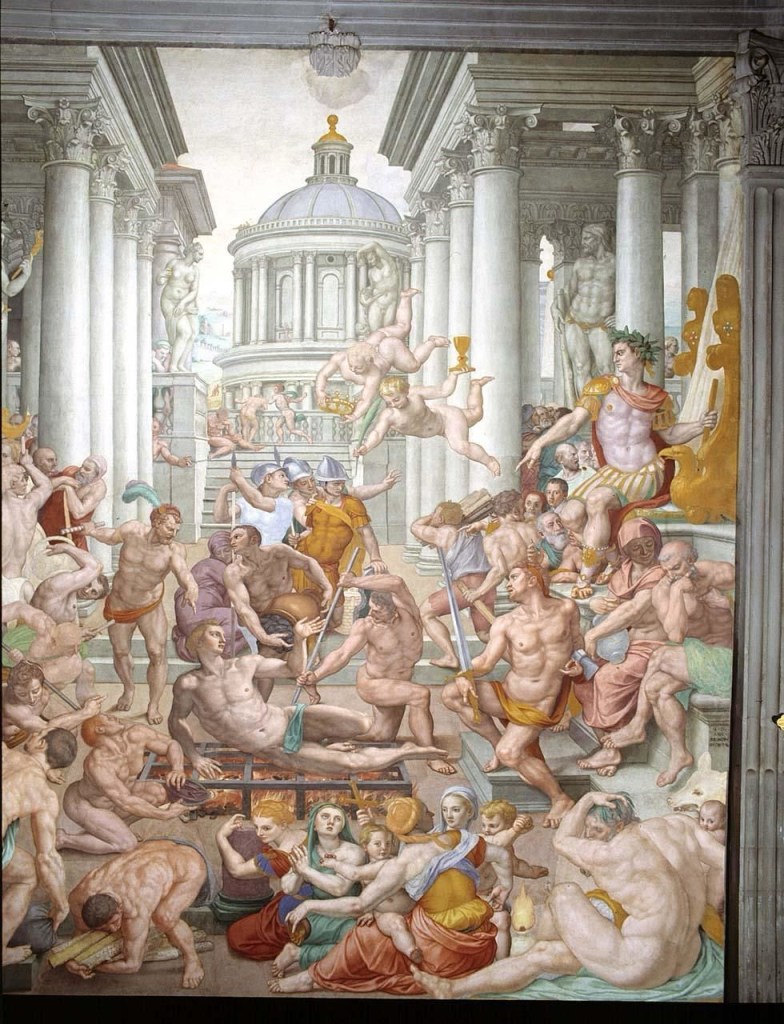
- The Basilica of San Lorenzo in Florence houses the wonderful Bronzino painting (above).
- The other painting of San Lorenzo I discuss is in the Church of the Gesuiti, Venice
- The poem – X Agosto by Giovanni Pascoli (one of the crepuscolari “twilight poets” of the early 1900s)
- The song San Lorenzo was a big hit for Annalisa and Alfa in the summer of 2020 and 2021 – you can find it on spotify – it’s quite good if you like Europop!
X Agosto (10th August) by Giovanni Pascoli
San Lorenzo, io lo so perché tanto
di stelle per l'aria tranquilla
arde e cade, perché sì gran pianto
nel concavo cielo sfavilla.

Ritornava una rondine al tetto
l'uccisero: cadde tra i spini:
ella aveva nel becco un insetto:
la cena de' suoi rondinini.

This poem inspired by the death of the poet's father on the Feast of San Lorenzo. The poet talks of the 'stelle cadente' falling stars associated with San Lorenzo and specifically the tragic death of his father. The first two verses of the poem are here!
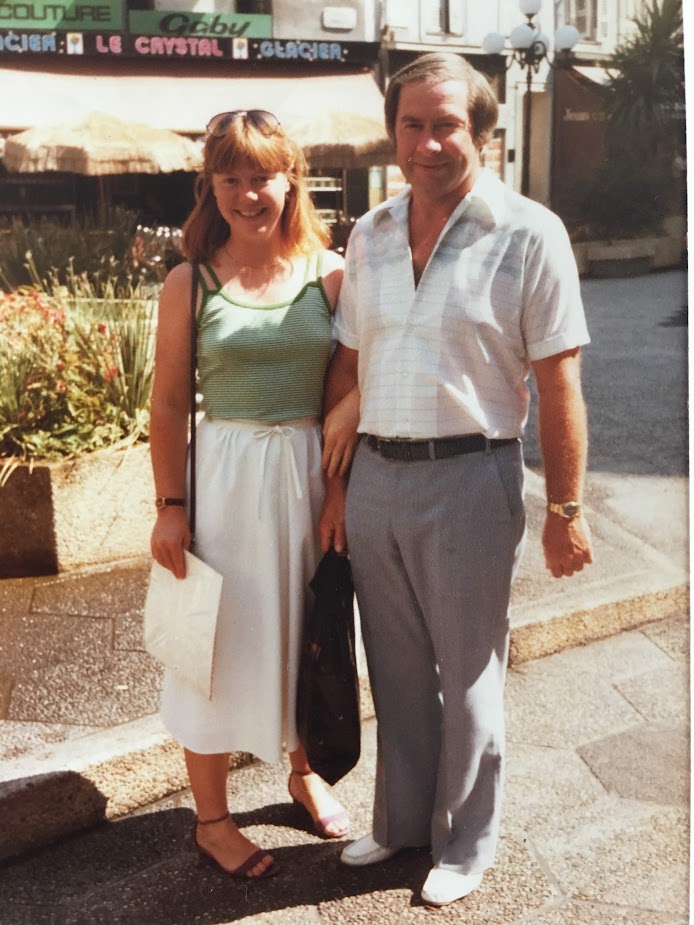
Curiously I started writing this without realising that this is actually an epitaph to my own father Derek Panagakis who died on 16th August, 2026 – he had a great life.
August 2026
Postscript:
I’ve written about quite a few saints – their stories are all different and yet the themes are all the same:
- St Catherine of Alexandria
- Christopher – patron saint of travellers
- Santa Lucia – bringer of light …
- Sant’Apollinare
- There isn’t a St Derek – yet!! Perhaps there should be….
- Below: Dad and me, The Guild of Bakers crest, Recanati Polyptych by Lorenzo Lotto