Today is St Stephen’s Day. The day when Stephen the first Christian martyr is remembered. Stephen was born in 5 AD and died in 36 AD. He lived in Jerusalem and was a Deacon of the Christian church.
Stephen was a pious and religious man, he claimed to have seen Jesus seated next to God in the heavens. He also spoke of Jesus as the ‘Son of God’. As the name Stephen, comes from Stephanos, a Greek name, it has been assumed that he was a Hellenistic Jew. Stephen was one of the early Christian followers of Christ and was prepared to die for his faith.
He was tried for blasphemy by the local Jewish leaders and found guilty. He was sentenced to death by stoning.
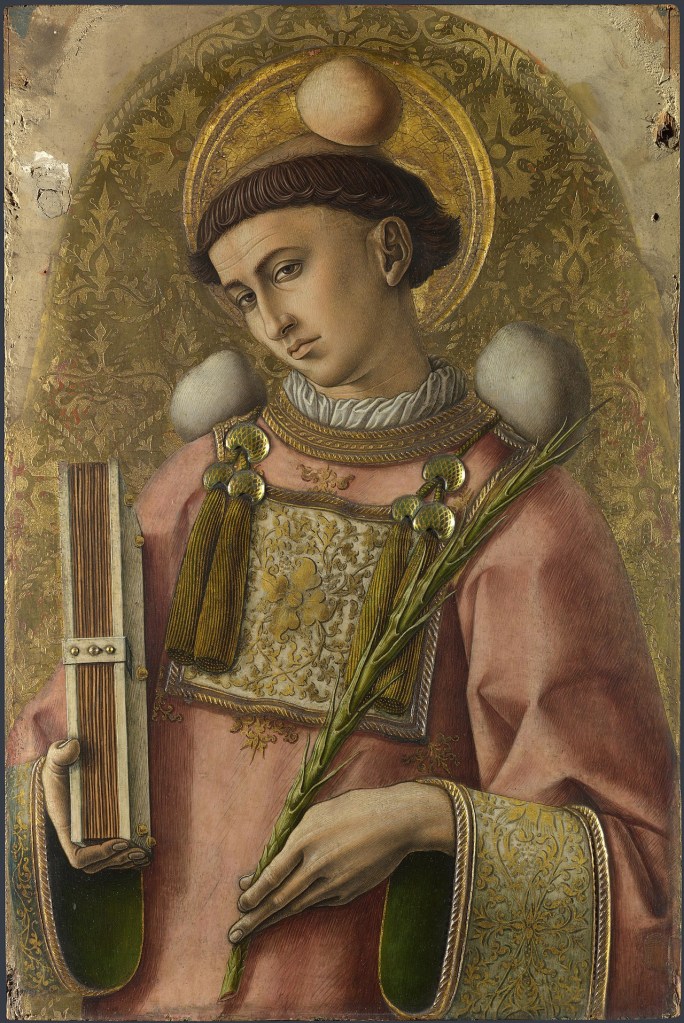
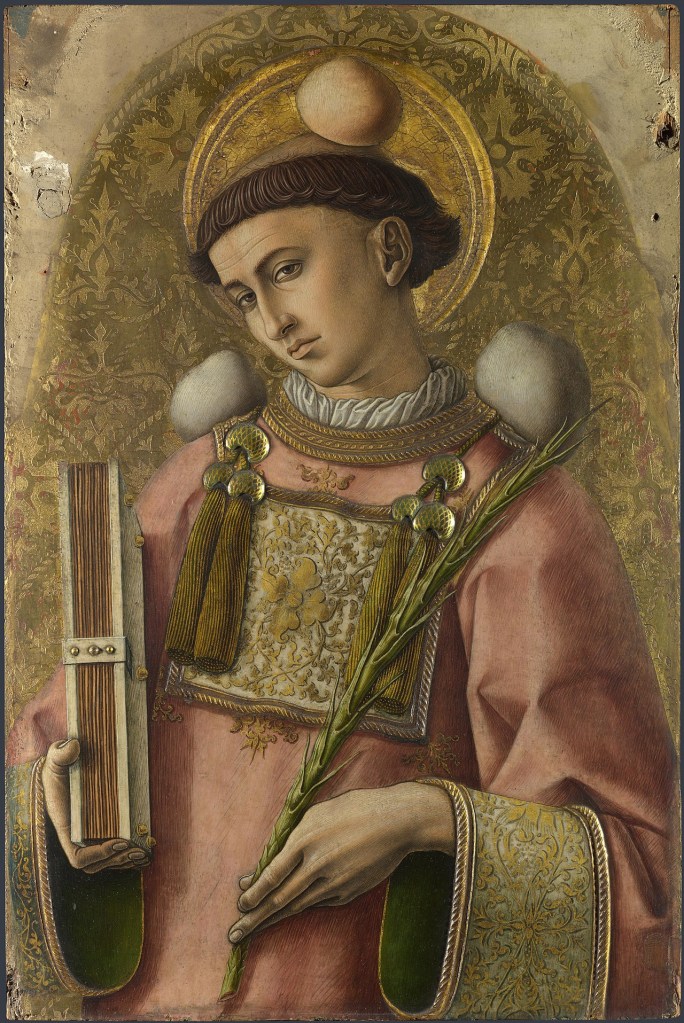
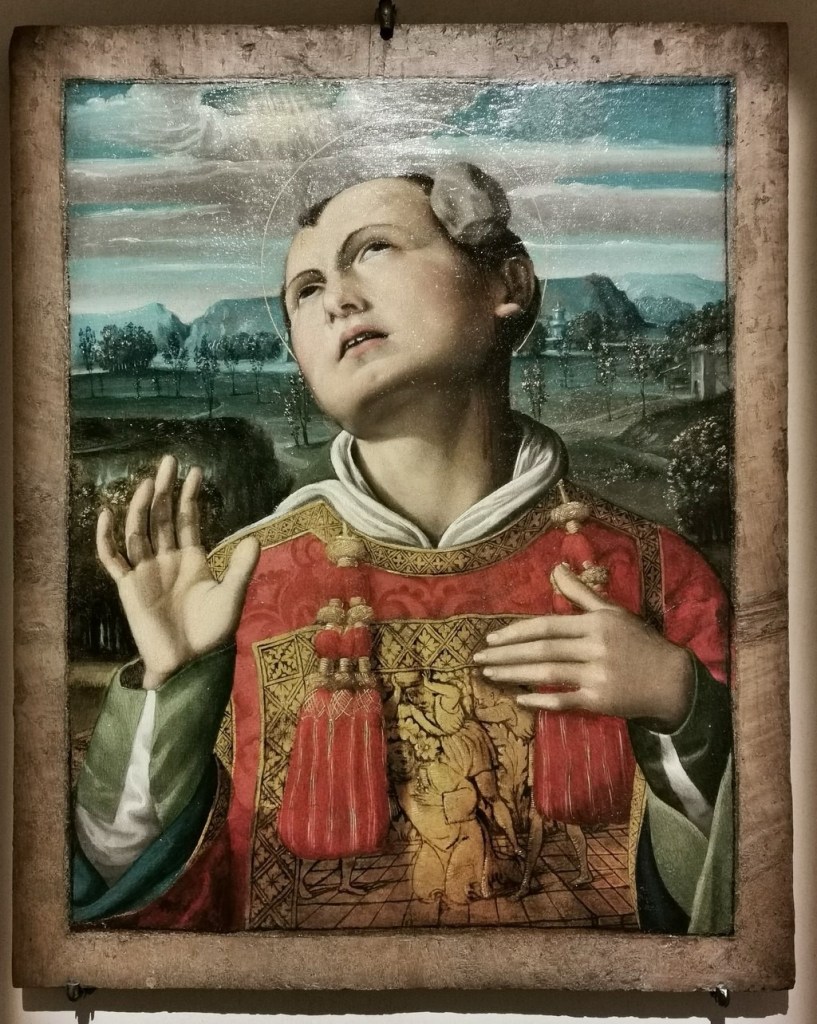
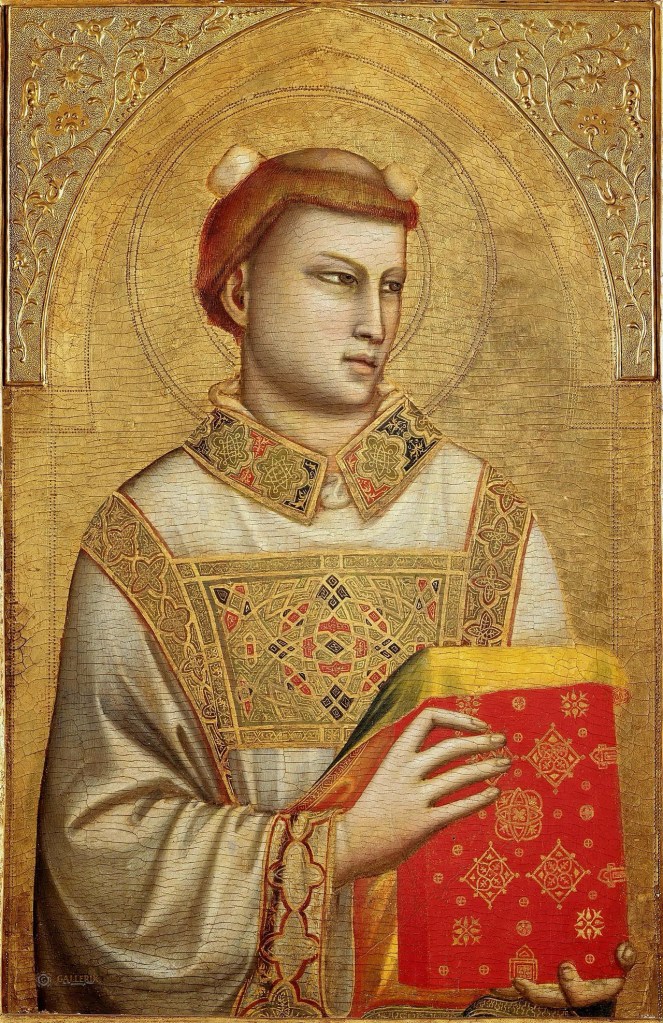
In art St Stephen is often shown wearing an elaborate robe known as a ‘dalmatia’ and surrounded by stones, to show the way that he died. Sometimes he is shown with a tonsured (shaven) head which also suggests humility and faith. In Christian hagiography (the stories of the saints) Stephen is regarded as the first Christian martyr or a protomartyr. In other words the first committed Christian to die for his faith.
In medieval times, towns and cities across Europe and the Mediterranean scrabbled to get their hands on a really good relic of a saint. This could be anything from a full body to a significant element of a saint’s body. In the case of Santa Lucia (St Lucy) her body ended up in Constantinople and later Venice, where a church was built especially to house her remains. Also in Venice, the remains of St Mark arrived in the city from Alexandria (Egypt) concealed in a barrel of pork.
In the case of St Stephen with his status as ‘First Christian Martyr’ there was a huge demand for fragments and relics of the saint’s body. In fact it was impossible to fulfill this demand from just one corpse. Here are just a few examples:
Venice – The Church of Santo Stefano claims to have the whole body of St Stephen.
Rome – the skull of the saint’s body can be seen at the Basilica of San Paolo fuori le mura
Rome – An arm can be found in the Church of Sant’Ivo, Roma
Rome – A second arm can be found in the church of Santa Cecilia, Trastevere
Rome – a third arm (!) is in the church of San Luigi dei Francesi
Rome (again) – almost his entire body is in the Church of San Lorenzo (fuori le mura)
Clearly more relics were needed than a single body could deliver!! Other claims relating to the body parts of St Stephen come from Naples, Constantinople, Minorca and even Besancon in France. All these places claim to hold important parts of the first Christian martyr.
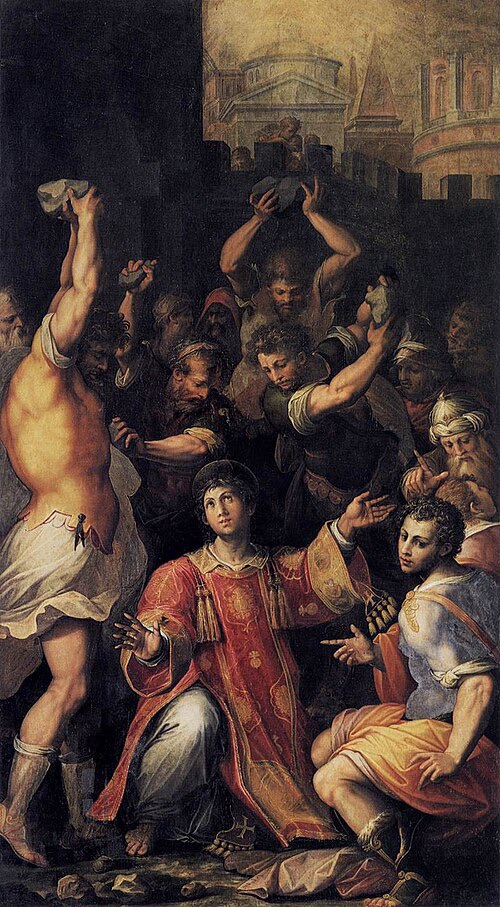
St Stephen’s impact on the art world was significant. He was painted by Giorgio Vasari, no less, the sixteenth century art critic and an able artist too (see above). This painting is held, unsurprisingly, in the Vatican Museums (Rome).
Other examples of paintings of St Stephen can be seen in Perugia and Florence (see below).
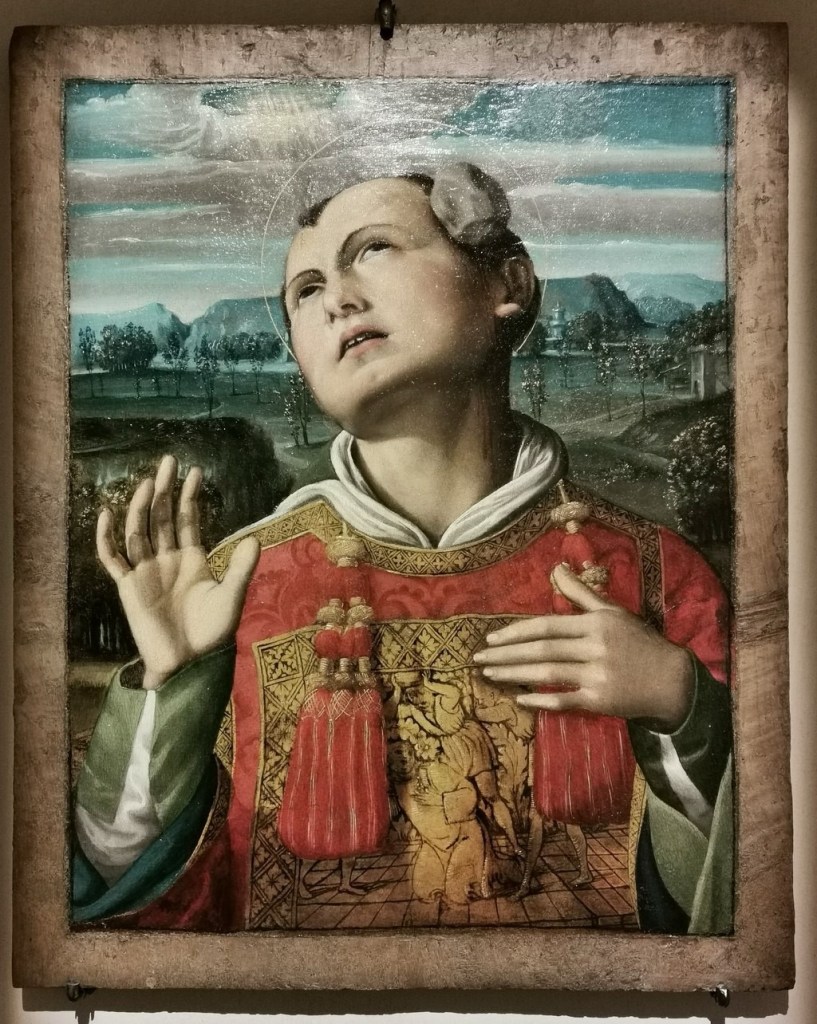
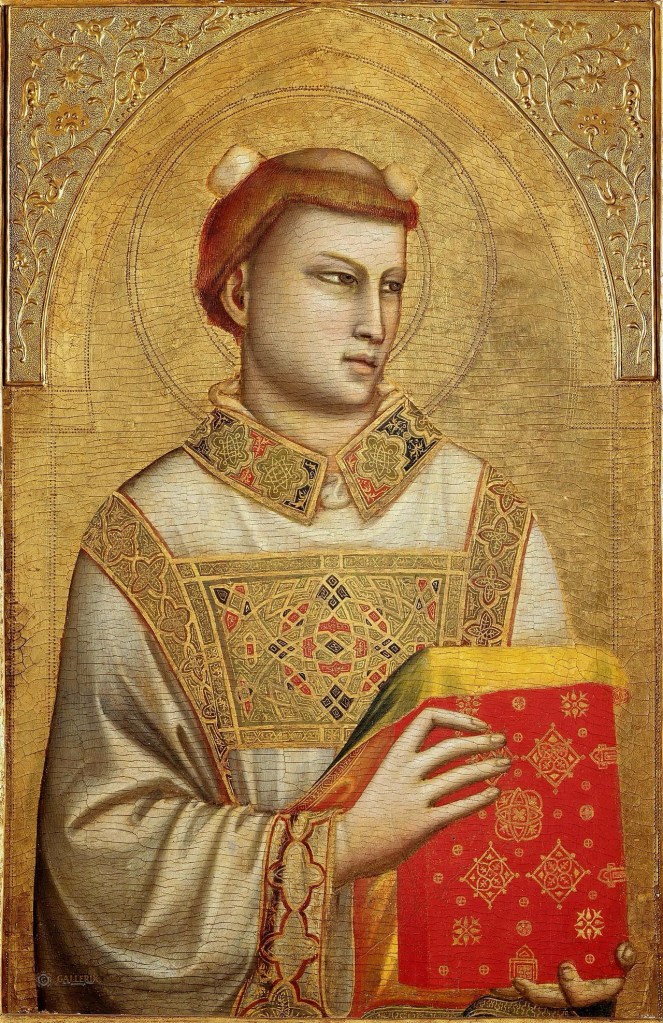
Saint Stephen is often painted with a tonsured head because this was the traditional hairstyle for deacons and clergy in Western medieval art, symbolizing his role in the early Christian church and his devotion to God.
St Stephen is also depicted with stones around his head, demonstrating the way he met his end. Sometimes he is painted holding a palm leaf or frond depicting peace. But my favourite symbolism associated with Stephen is the luxurious long tunic, the ‘dalmatia’ he is wearing. This long, elegant gown or tunic is associated with deacons and bishops of the church. It is typically embroided in red and gold. It has wide sleeves and might even include mosaic tesserae sewn into the front of the gown.
You can still buy a ‘dalmatia’ in Rome (of course you can) at Comandini, outfitters to The Vatican (since 1962). Immediately my mind is filled with images from 1970s Fellini films portraying so vividly the relationship between the church and the state even in modern day Italy.
For today, however, 26th December lets finish with the words of St Stephen, according to gospel writer Luke;
…..Father, forgive them for they know not what they do’….
Perhaps we can invoke such humility and forgiveness in our daily lives.
Notes:
1/ It’s relatively easy to establish the date of St Stephen’s death as 36 AD. According to an Italian source this is because the Romans favoured death by crucifixion, whilst the Jewish population used death by stoning as their preferred capital punishment.
2/ The seven deacons of the early Christian church were chosen by the apostles to oversee charitable distribution of alms in Jerusalem. They were Stephen, Philip, Timon, Prochorus, Parmenas, Nicanor and Nicholas of Antioch.
3/ The Deacons were all men of good reputation, full of the Holy Spirit and wisdom, as recorded in Acts of the Apostles 6:1-6. They served as the first ambassadors of the Christian Church.
4/ I’ve written extensively about the lives of the saints. Go to my blog www.educated-traveller.com and type in saint / saints to discover more.
5/ And lastly, Stephen appears in the King Wenceslaus carol ‘on the feast of Stephen’
….Good King Wenceslas [last] looked out, On the feast of Stephen, When the snow lay ‘round about, Deep and crisp and even…..
December 2026

 The Educated Traveller
Happy Boxing Day, Janet, and congratulations on yet another relevant, timely, interesting and informative article, which just about tripled my knowledge of St Stephen! We’re in the process of recovering from a Christmas which I. hope has been as full and joyful for you as it has been for us! With warmest regards and love from John & Margaret
Sent from Outlook for iOShttps://aka.ms/o0ukef ________________________________
LikeLiked by 1 person